
Free Marketing Plan Report Template

Track how your marketing efforts are leading to conversions and growth with a ready-to-use marketing plan report template.

Show progress, measure impact, and keep your team aligned in one view.

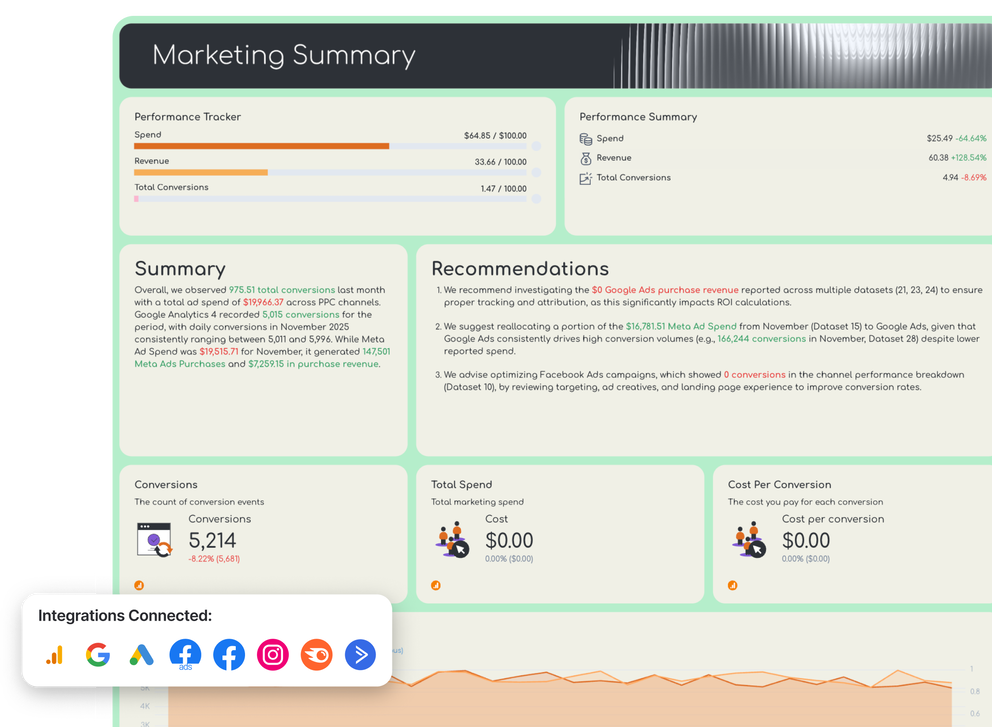
Marketing Plan Report Template - Dashboard with charts and graphs displaying performance metrics.

Create Custom Marketing Plan Reports in Seconds

With Whatagraph IQ, just tell us what you need, and we'll build a stunning marketing plan report for you. No templates or manual setup required.

What To Include in a Marketing Plan Report Template

Based on Whatagraph’s marketing plan report template—created by marketers for marketers—these are the core sections to include when reporting on the execution of your plan.

Each one helps connect your day-to-day marketing activities to your broader strategy, goals, and budget.

1. Marketing Summary

Channels connected: All my marketing channels

This is your top-line view of how the plan is progressing. It helps stakeholders quickly assess if your marketing strategy is delivering on its core objectives—and whether your marketing team is executing against plan.

What to include:

  • High-level key performance indicators (KPIs) aligned with your marketing goals like conversions, spend, and revenue
  • Planned vs actual KPIs
  • Conversion rate trends and budget pacing
  • Campaign highlights and underperformers
  • A clear executive summary of performance
  • Monthly trend charts and channel-level rollups
  • Notes on plan adjustments and next steps

2. Website Performance

Channels connected: Google Analytics

Track how your target market engages once they land on your site. This helps assess whether your marketing channels are bringing in the right traffic—and whether the site supports your goals.

What to include:

  • Actual vs traffic targets in your marketing plan
  • Sessions, users, returning visitors
  • Goal completions tied to business objectives
  • Bounce rate, time on page, and engagement
  • Page-level performance by landing page
  • Device and location-based demographics
  • Channel breakdown: paid, organic, referral, etc.

3. SEO Performance

Channels connected: SEMrush

This section tracks how your SEO efforts are performing against planned goals—whether it's growing organic traffic, improving rankings, or capturing specific target customers through search.

It ties performance back to the marketing strategy and helps inform future optimization.

What to include:

  • Actual SEO and keyword performance vs planned (rank, clicks, CTR)
  • Organic traffic trends and growth rate
  • Top-performing pages by impressions and clicks
  • Branded vs non-branded search breakdown
  • Technical issue tracking from SEO audits
  • Competitive visibility from competitor analysis
  • SERP features captured (e.g., featured snippets)
  • Summary of progress toward search-related marketing goals

Channels connected: Google Ads

Evaluate how your paid search efforts are delivering against the plan. This section is particularly useful for showing if spend, reach, and results are aligned with your planned initiatives.

What to include:

  • Goal widget showing planned Google Ads metrics vs. actual
  • Impressions, clicks, conversions
  • Spend pacing and cost-per-click
  • Campaign-level performance vs goals
  • Keyword groups tied to strategic messaging
  • Branded vs non-branded terms (great for competitive analysis)
  • Performance by device or location
  • Notes on ad tests, copy updates, or bid changes

5. Facebook Ads

Channels connected: Facebook Ads

Track how your paid social campaigns are progressing and how they’re contributing to brand awareness and/or conversions.

What to include:

  • Goal widget showing planned Facebook Ads metrics vs. actual
  • Campaigns grouped by goal or audience
  • CTR, CPM, and conversion trends
  • Creative performance breakdowns
  • Audience performance by buyer personas
  • Spend pacing vs forecast
  • Key insights from A/B tests
  • Overall alignment with your roadmap

6. Organic Social Media (Facebook & Instagram)

Channels connected: Facebook, Instagram Business, LinkedIn

This section helps monitor your social media content’s contribution to plan business goals—especially reach, engagement, and audience growth.

What to include

  • Planned social media KPIs vs. actual
  • Engagement rate and follower growth
  • Top-performing content formats
  • Reactions, shares, and comments
  • Channel performance vs targets
  • Contribution to social media marketing goals
  • Audience alignment with your target audience

7. Email Marketing

Channels connected: ActiveCampaign

Report on email marketing’s role in your marketing plan—whether for lead nurture, product announcements, or driving traffic. This section helps track performance against timeline-driven email initiatives.

What to include:

Campaign volume vs plan

  • Open rate, CTR, and conversion rate
  • Top-performing subject lines or CTAs
  • Performance by segment or target customers
  • Impact on broader content marketing or funnel efforts
  • Summary of nurture sequences or triggered emails
  • Key takeaways for future emails

Why Marketers Love Reporting With Whatagraph

Whatagraph's AI is saving so much time and energy for our marketing specialists. We now have more time to focus on strategic things that help both our agency and our clients grow.

Lars Maat

Lars Maat

Co-Founder @ Maatwerk Online

StarStarStarStarStar

Whatagraph is easy to use, visually attractive, and much smoother compared to tools like Looker Studio. It helped us not only get clients on board but also keep them within the agency.

Stef Oosterik

Stef Oosterik

Quality Manager @ Dtch. Digitals

StarStarStarStarStar

Whatagraph took us to the next level with our clients and within our team. Our relationships with clients have been amazing, and we’ve even been able to retain them longer.

Kim Strickland

Kim Strickland

Digital Marketing Specialist @ Peak Seven

StarStarStarStarStar

Whatagraph has become an essential partner for scaling our reporting, and my teams love it because it saves so much time. We’d recommend it to any team looking to automate data reporting and use AI for insights.

Danielle Roberts

Danielle Roberts

Director of Implementation & Support @ Rentable

StarStarStarStarStar

Frequently Asked Questions

Have more questions? We answered them below.

What is Whatagraph’s pricing?

Whatagraph offers flexible plans that scale with your reporting needs: 


Free plan


- Forever free


- Basic reporting with limited source credits


- Access to essential features and templates


Start plan (from ~$229/month, billed annually)


- 20 source credits


- Essential integrations


- Pre-made templates and data transformations


- Whatagraph IQ


- Live chat support


Boost plan (from ~$579/month, billed annually)


- 60 source credits


- Advanced integrations


- Custom data transformations


- White-label reports


- Dedicated Customer Success Manager


Max plan (custom pricing)


- 100+ source credits


- Premium integrations


- Advanced data aggregations


- Whatagraph IQ+


- Single Sign-On (SSO)


- Tailored onboarding and priority support


Plans can be upgraded in-app as your reporting needs grow.

What are the phases of a marketing strategy?

A solid marketing strategy typically includes five core phases: market research, SWOT analysis, setting clear marketing objectives, building an action plan, and tracking against key performance indicators. 


Each phase helps ensure your marketing initiatives are aligned with your business goals, target the right buyer personas, and support your overall marketing plan template.

Does anyone have a good marketing plan template I can use?

Yes, you can use Whatagraph’s marketing plan report template.


It’s built by marketers and structured around real-world planning workflows. 


You can track marketing channels, map progress toward business objectives, and measure KPIs without building a report from scratch. It’s especially useful for small businesses, startups, and in-house marketing teams.

How do you create a content marketing plan?

Start by identifying your target audience and core pain points, then align your content marketing efforts with broader business objectives. Use performance data to inform your messaging, choose the right marketing channels (like email, LinkedIn, or SEO), and define measurable goals.

To save time on reporting, use our ready-made content marketing report template.

Where can I find a free marketing plan report template?

You can find a free marketing plan template from Whatagraph.


It’s pre-built with sections for your executive summary, marketing activities, social media performance, email marketing, competitive analysis, and more—so you can focus on execution, not formatting. 

Where can I find a comprehensive marketing plan report template for my business?

Right here—with Whatagraph’s marketing plan report template. 


It combines planned vs actual performance, supports multiple marketing channels, and makes it easy to visualize results with built-in graphs and dashboards. 


You can align marketing efforts to your marketing budget, track progress on initiatives, and report clearly to any target market.