
TLDR
Sababa team’s specialists now have more space for deeper analysis, new tests, and proactive optimization for clients. Agents draft the first pass of weekly reports and optimizations using reliable data from Whatagraph, while Sababa’s own skills and scripts on GitHub provide the expertise and context. Specialists review every output and make decisions.
The case
At Sababa team, every client gets a set number of specialist hours each week. A large share of those hours went to the same recurring work: preparing the report, checking the numbers, comparing metrics, and finding optimizations.
This meant specialists had less time for deeper analysis, new tests, and proactive optimization. It also left them less room to grow and deepen their expertise.
Sjoerd van Harmelen, Co-owner at Sababa team, decided to automate the recurring work with AI, while keeping specialists responsible for reviewing the output and the decisions that follow.
Two years ago, Sjoerd set up Sababa Hub on GitHub, a library of skills and agent instructions, and built his own connections to the Meta Ads and Google Ads APIs.
This setup worked, but Sjoerd found he needed to maintain everything constantly.
Ad platforms change how their APIs work every few months, and each of Sababa's channels changes in its own way. Every change meant updating a connection, and because the numbers go straight into client reports, they had to be right every time.
“I can use the API from Meta Ads and the API from Google Ads, but it's a hassle. Every couple of months, they change how the connectors work, and then you have to update them. We have six or seven channels, and they all have their own connectors. And you're showing that data to a client, so it needs to be right."
That was when Sjoerd decided to buy the data layer underneath, where the connectors are maintained for him, and build on top of it. This is the hybrid setup we described in this build vs. buy reporting stack guide.
“Building is great, but maintaining it is the pain. If you have a company, you learn to stick with your specialty and hire people who are more specialized in those things."
The solution
Sababa’s setup splits the weekly work three ways. Whatagraph provides the reliable data and the agents, Sababa’s skills and scripts provide the expertise, and specialists make every decision.
Whatagraph’s connectors pull the data from Meta Ads, Google Ads, and other channels into client reports, replacing the API connections Sjoerd used to maintain. Through Whatagraph MCP, Claude can read that data directly too.
When Whatagraph introduced IQ Agents, Sjoerd moved the work to agents. Sjoerd had previously built skills and scripts in GitHub, which he connected to Whatagraph’s agents through the GitHub MCP.
Each skill holds Sababa’s performance marketing judgment: which metrics matter and what to do when something goes wrong. And each script contains how Sababa calculates metrics and how campaigns and ads should be scored. Scripts help the team do calculations consistently and reduce the risk of made-up numbers.
This is how it works in practice.
Sababa’s weekly reporting workflow with GitHub and Whatagraph IQ Agents
Here’s a diagram summarizing Sababa’s weekly Meta Ads workflow:
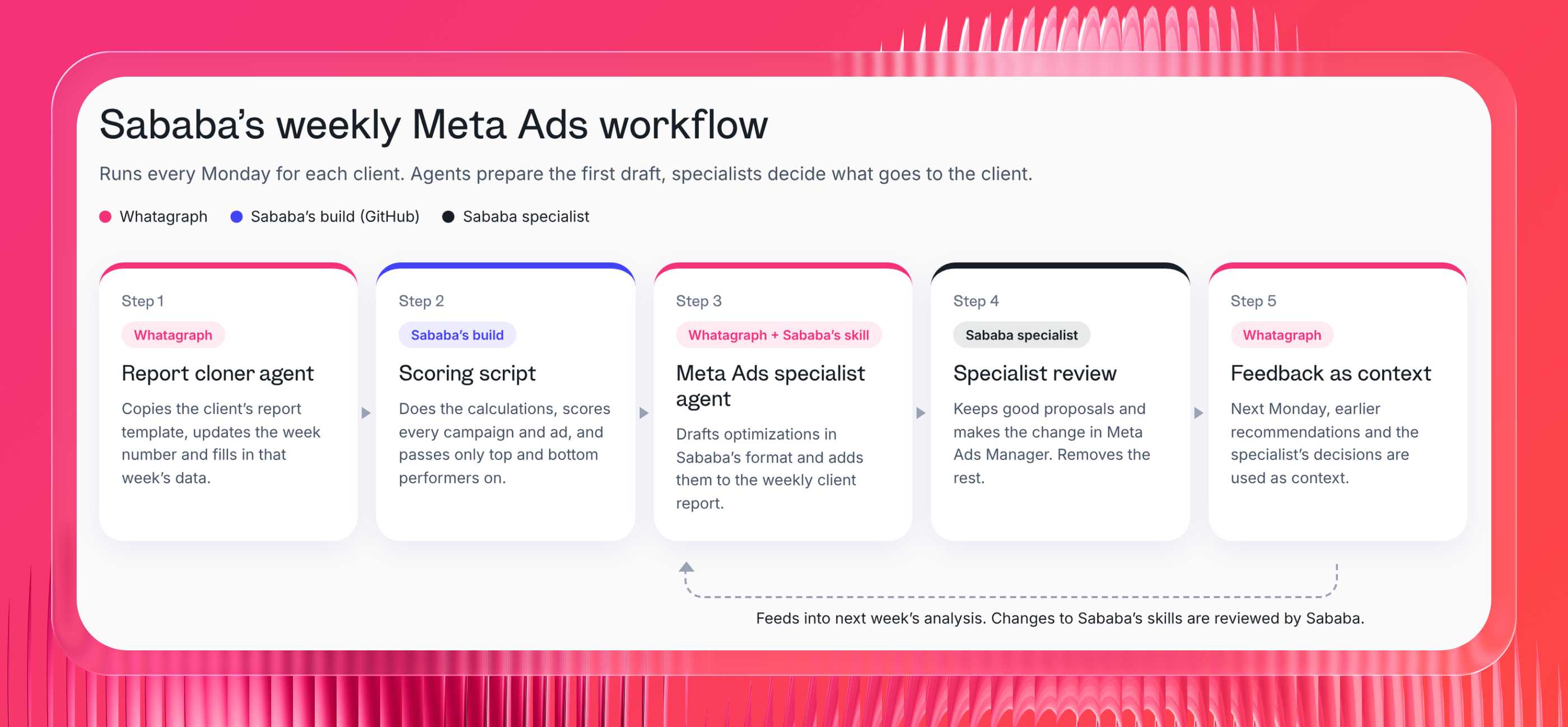
Step 1: Report cloner agent (Whatagraph)
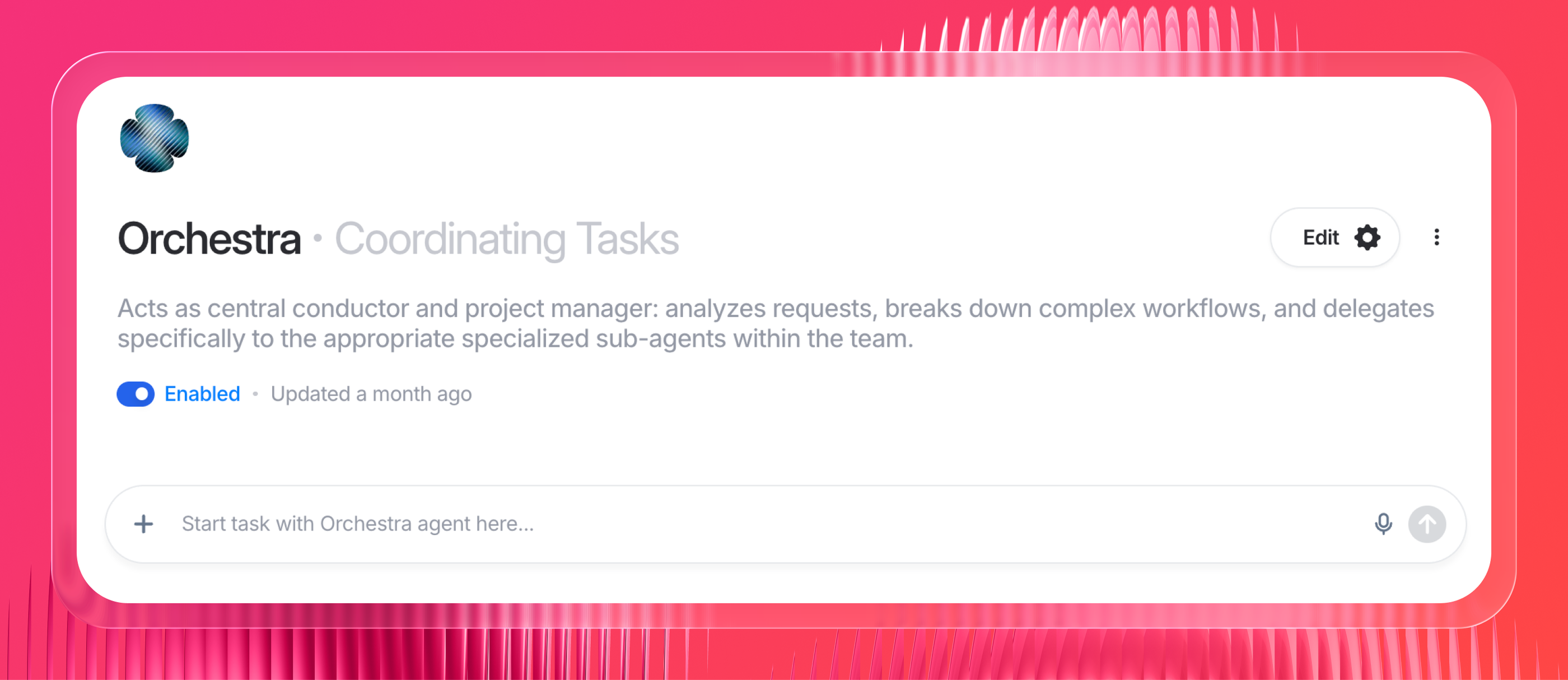
Sababa sends weekly reports for most clients, and every Monday morning, an “Orchestrator” agent delivers the reports for them. The agent:
- Duplicates the client’s standardized Whatagraph report template.
- Updates the week number.
- Populates the dashboard with that week’s data.
Step 2: Meta Ads scoring script
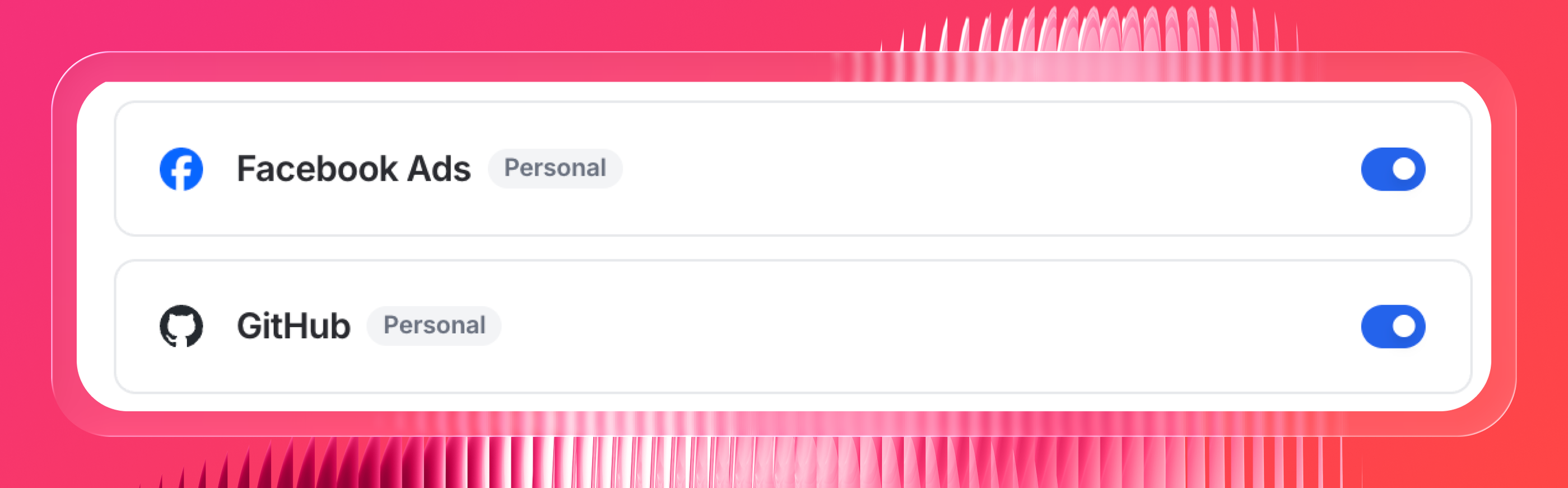
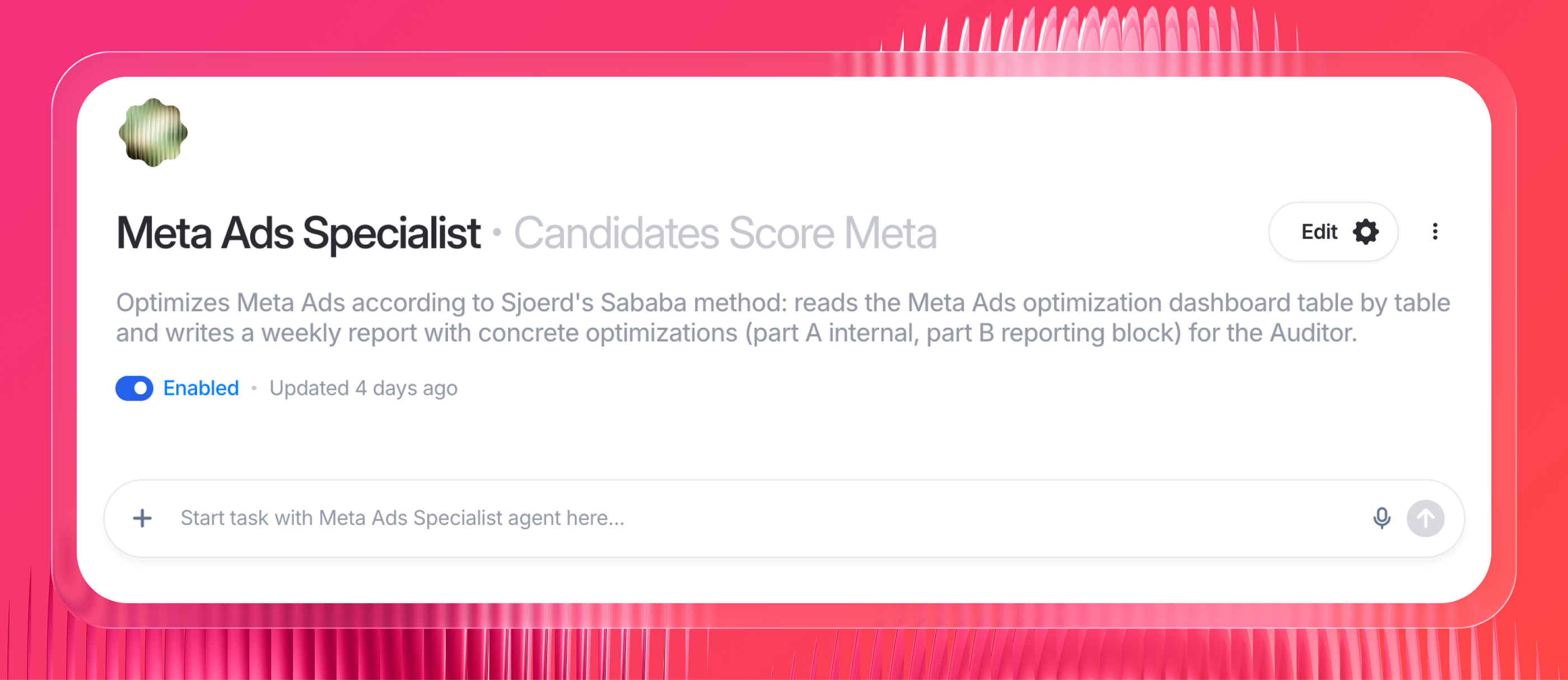
Next, Whatagraph triggers a Meta Ads specialist script agent that is connected to both Facebook Ads and GitHub.
This script has all the context of how Sababa calculates metrics, compares them against each other (such as link clicks against all clicks on an ad), and scores every campaign and ad. Scripts help keep calculations consistent, but they don’t guarantee the analysis is correct, so specialists still review the output.
Here’s how the script works:
- Pulls ad-level data, such as link clicks against all clicks, CPM, and how often an ad is watched without being clicked.
- Gives every campaign and ad a performance score based on Sababa's criteria.
- Filters out the noise, so only the top performers and underperformers move to the next step.
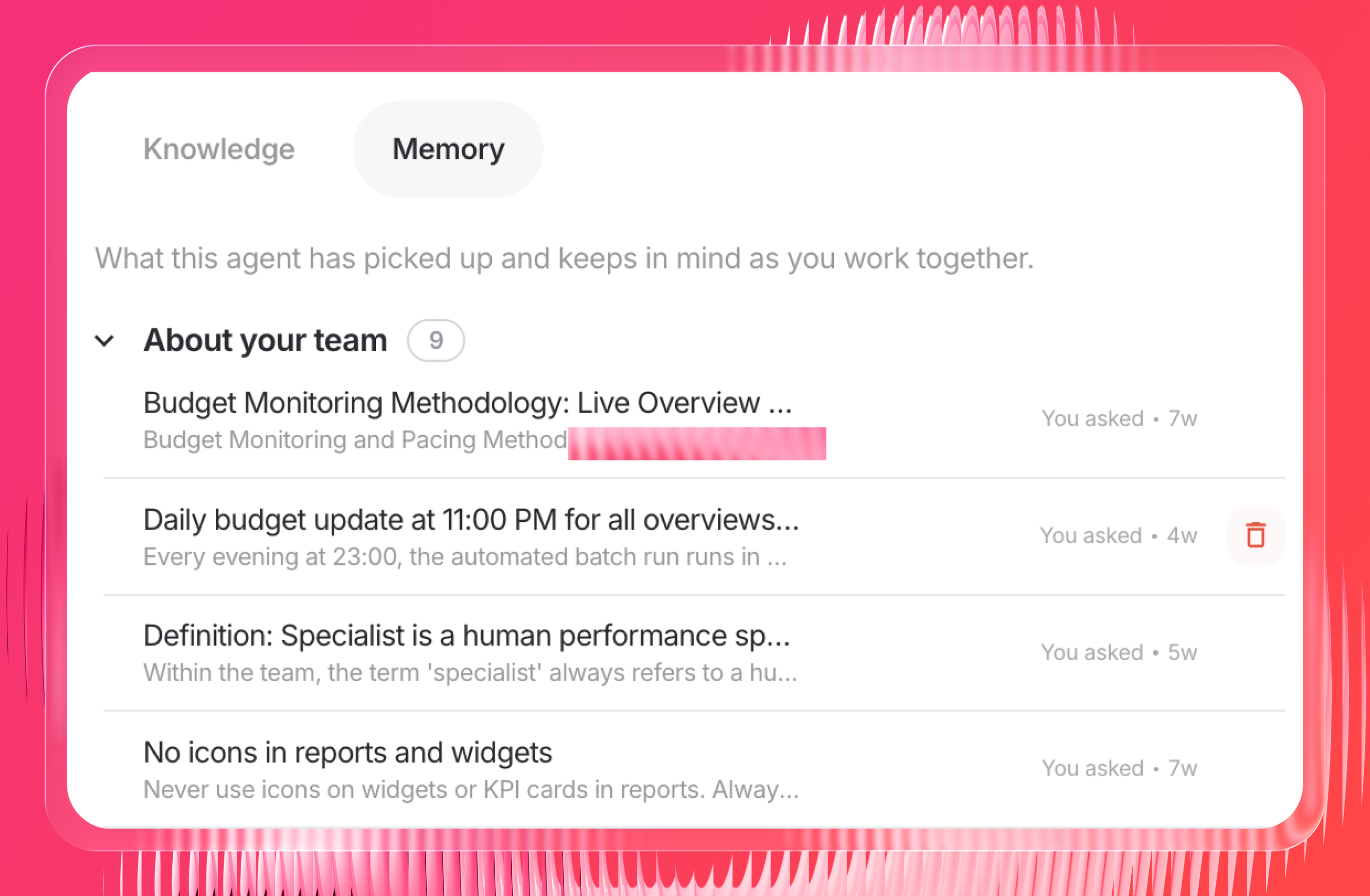
The output is saved in the agent’s memory, so previous recommendations and feedback can be used as context for future analyses.
Step 3: Meta Ads specialist agent (Whatagraph)
The agent receives only the pre-scored shortlist the script created, which keeps its context small and its advice specific.
Using Sababa's Meta Ads skill from GitHub, the agent then:
- Writes short markdown briefings on what stands out, split across several files so each fits in its context window.
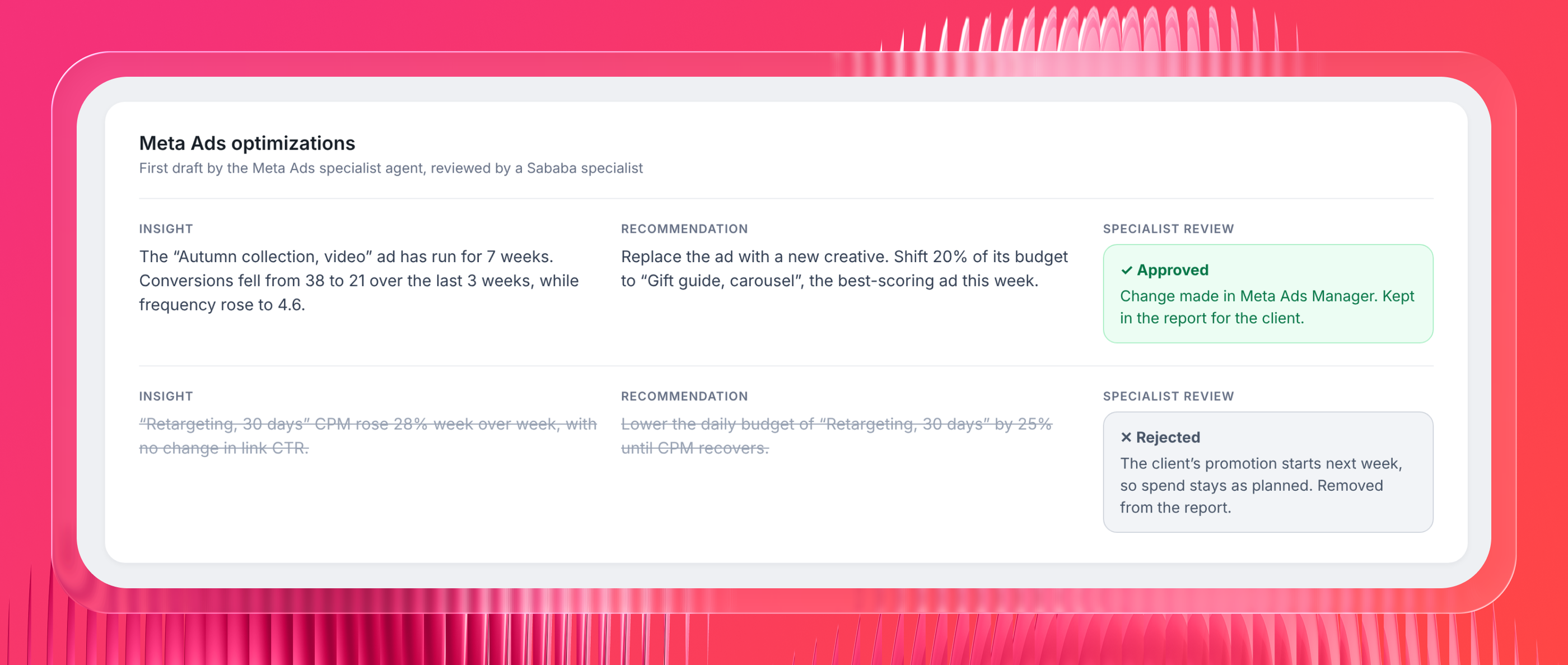
- Drafts concrete optimizations in Sababa's format, such as replacing an ad that has run for a long time while conversions drop.
- Places the proposed optimizations in the weekly client report, in Dutch.
Step 4: Specialist review (Sababa's team)
This is where the specialist's time now goes. A specialist opens the report and checks each proposed optimization:
- Approved: the specialist makes the change directly in Meta Ads Manager, and the optimization stays in the report for the client.
- Rejected: the specialist deletes it from the report.
With the first layer done, the specialist can go deeper into the account, such as which locations and age groups perform better, and plan new tests and proactive optimizations for the client.
Step 5: Feedback loop (Whatagraph agent, Sababa's skill)
The following Monday, the agent opens the previous report. The agent:
- Compares what it proposed with what the specialist kept, which shows it what the specialist wants.
- Uses those earlier recommendations and feedback as context for the next analysis.
The output:
The end result of this workflow is a weekly report for each client, with the updated data for the last week and the first draft of optimizations written by AI, and specialists reviewing everything.
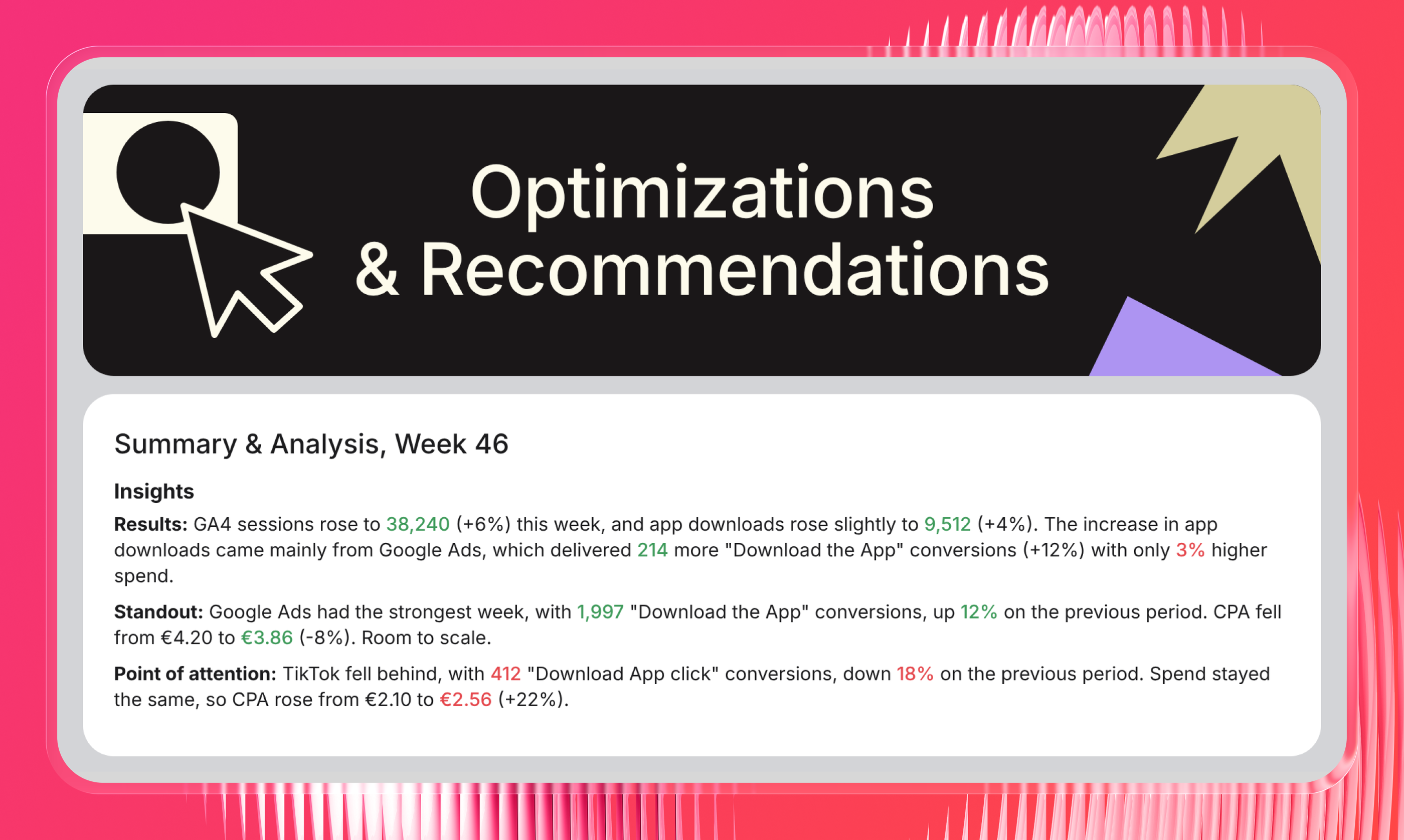
Sababa calls this workflow “Human in the Loop.” The agent does the first pass, and the specialists can do deeper analysis and decide what happens next.
“The first layer of optimizations can be done by the agent, and now the specialist can go deeper: what kind of locations are better, what kind of age groups are better. They're not working less, they're working smarter and doing the big stuff."
Daily budget pacing for each client
Another area that Sababa is automating with Whatagraph is budget pacing for each client.
Client budgets used to live in an Excel sheet, and specialists worked out pacing by hand.
Now the budgets sit in Whatagraph as offline data. A script calculates spend against budget, and an agent updates the numbers every day and gives insights on how the budget is pacing.
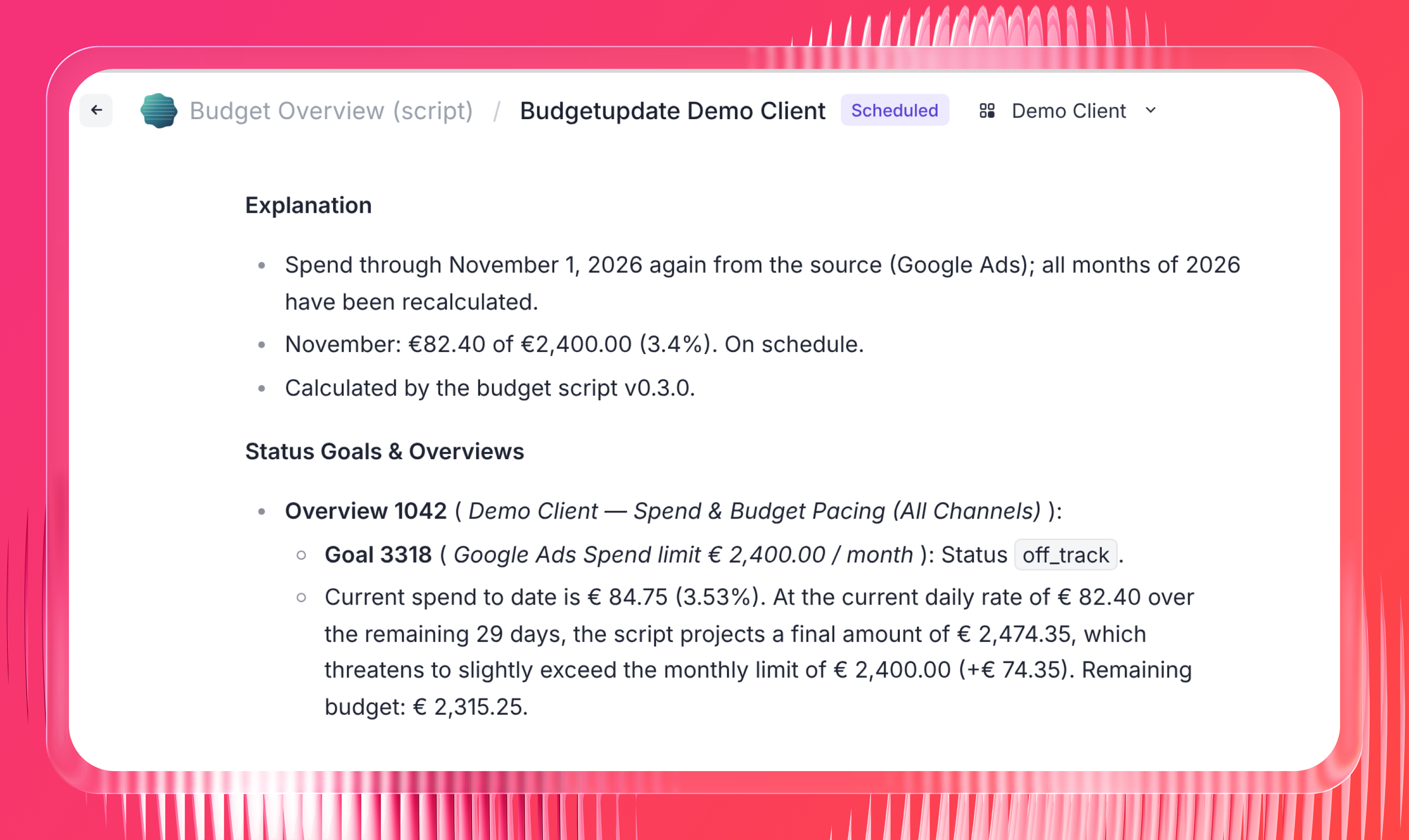
A specialist now only needs to open the budget pacing overview report for the current month and make budgeting decisions.
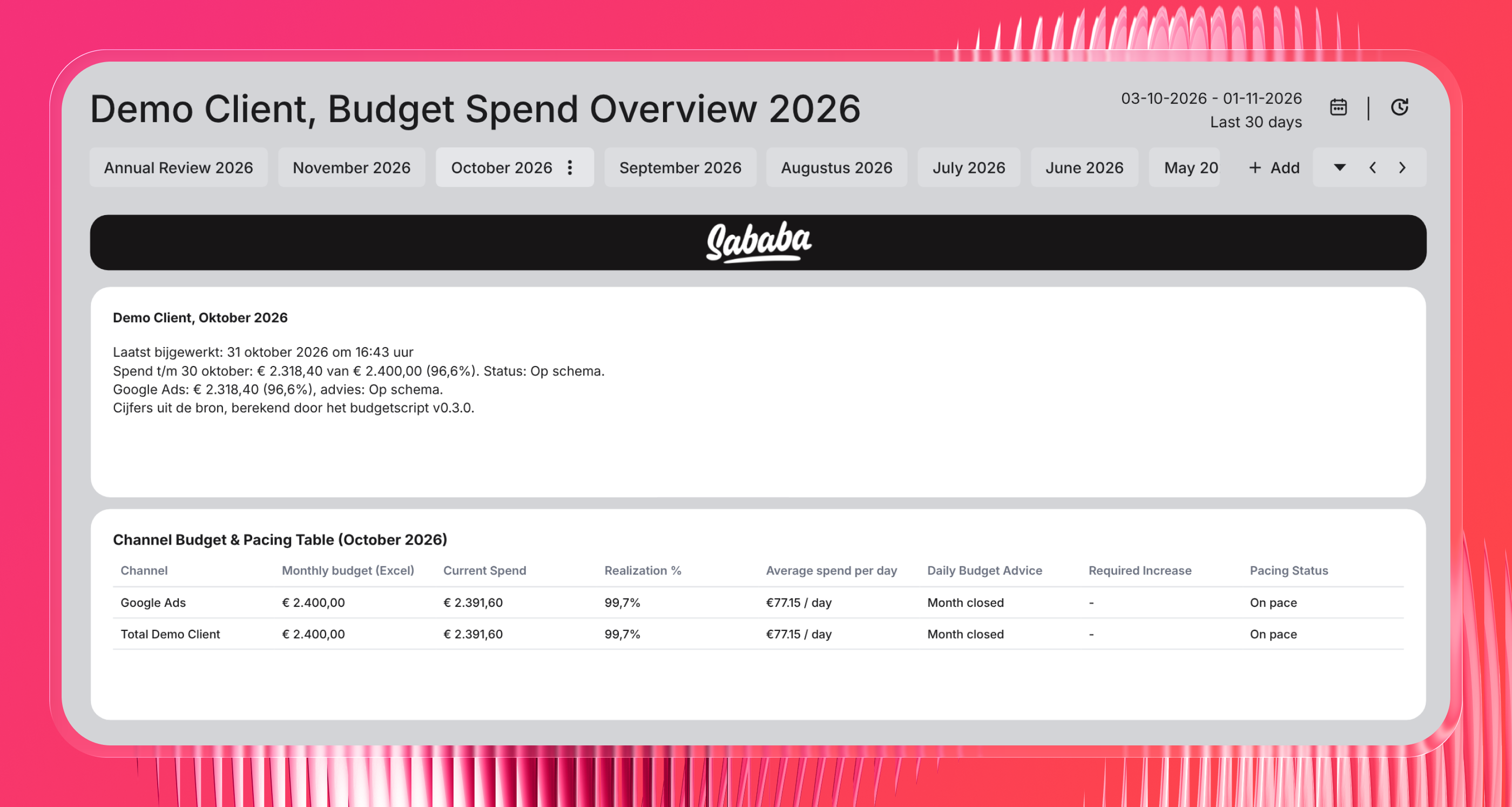
“Specialists only have to go to the month and see: OK, I still have a little budget for Meta Ads, I still have a little budget for Google Ads. Oh, I need to amp up my budget for that one. Otherwise you have to calculate it yourself."
The result
Sababa hasn’t measured time savings yet, but what has changed is how specialists spend their client hours.
The agents now take the first pass at the recurring work, which has created space for specialists to properly analyze accounts, spot opportunities, and do proactive optimization.
“Agents handle the low-hanging fruit, which frees up our specialists to tackle the bigger things and go deeper. Less time on standard work means more focus on what actually moves the needle for a client. Specialists still remain responsible for reviewing the output and the decisions that follow."
The hybrid setup also changed what Sababa spends its own time on behind the scenes:
Sababa doesn't need to maintain connectors anymore. Whatagraph keeps the data from all channels accurate, and Sababa's own time goes into its skills and scripts.
“It's really good to use a tool like Whatagraph, where you can trust that the data is right. Otherwise it will be a day job to look at the emails from all the APIs you have."
The setup stays portable. Skills live in GitHub and the hub stays with Sababa, so a new model can be swapped in without rebuilding anything.
“It's always good to have everything you make in your hub, and then put your AI on it as a brain. If a new model comes along, just stick the other model in and you're good to go."
What's next
Sababa's goal is for IQ Agents, together with its other agents, to become a permanent part of the team: digital colleagues that build on each other's work.
One collects numbers and client context, the next analyzes them, and another checks the conclusions. Specialists review the proposals and decide what happens next.
After human approval, Sababa wants agents to carry out the agreed optimizations too. That can go beyond campaign settings: an agent might propose new creative, which Sababa produces in its own creative studio, and the results feed back into the analysis.
“Step by step, we're building a way of working where agents and people reinforce each other, from insight and idea to execution and learning from the outcome."