




Ready-to-use CallTrackingMetrics integration
Your call and paid media data shouldn't live in separate tools.
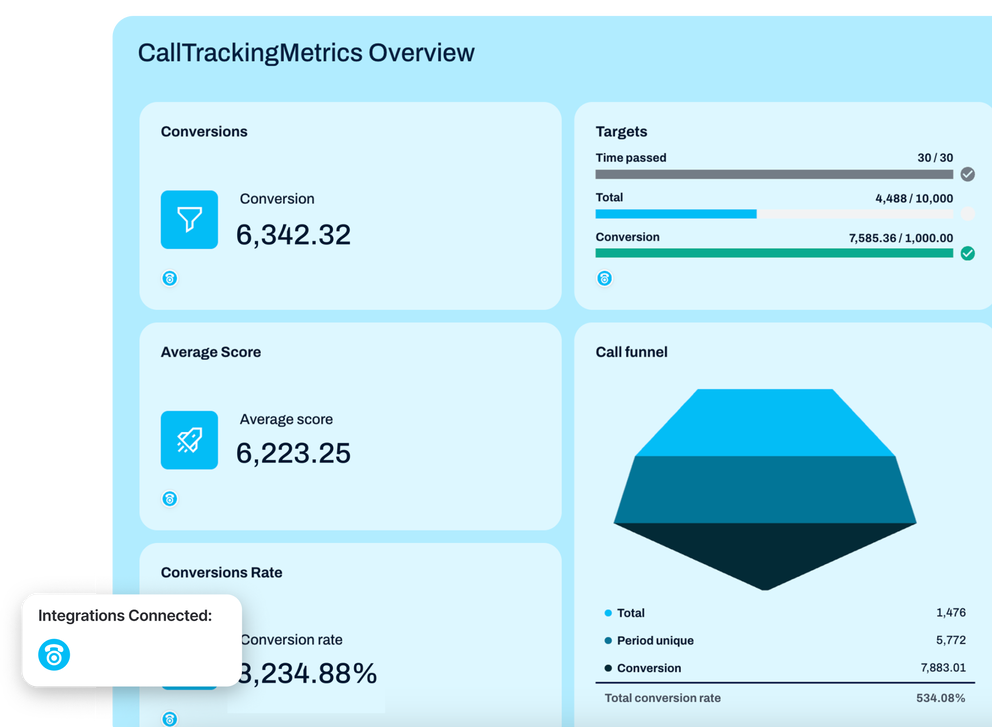
Connect both CallTrackingMetrics V1 and V2 to Whatagraph and visualize key metrics.
Blend your call data with paid media and other marketing data and analyze it inside Whatagraph or with your favorite LLM.
Marketing intelligence platform you can trust for your CallTrackingMetrics data

Connect
Connect CallTrackingMetrics to Whatagraph with a stable, native integration. Authenticate once using your Access Key and Secret Key, and call and SMS data starts flowing immediately.

Organize
Blend CallTrackingMetrics call data with paid media sources like Google Ads or Meta Ads. Create custom metrics and dimensions with no SQL required.

Visualize
Build CallTrackingMetrics reports from a prompt using Whatagraph IQ, or start from a pre-built template and customize it in minutes. White-label every report with agency and client branding.

Analyze
Ask Whatagraph IQ Chat anything about call performance data and get instant answers. Use IQ Summaries to generate written performance commentary, or your favorite LLM to analyze data.

Automate
Schedule automated delivery of CallTrackingMetrics reporting to clients, stakeholders, or internal teams via email, live links, PDF, or CSV.

Share
Export CallTrackingMetrics data to BigQuery, Snowflake, or Looker Studio alongside every other connected channel.
All CallTrackingMetrics V1 and V2 metrics, instantly available in Whatagraph
All
CallTrackingMetrics V1 Groups
20CallTrackingMetrics V1 Series
1CallTrackingMetrics V2 Calls
20CallTrackingMetrics V2 Text Messages
4Search...
Total
Total %
Period unique
Period unique %
Global unique
Global unique %
Average ring time
Ring time
Average talk time
Talk time
Average duration
Duration
Score count
Minimum score
Maximum score
Average score
Score
Conversion
Conversion rate
Revenue
Calls
Answered
Missed
Voicemail
Abandoned
First-time callers
Hold time
Wait time
Conversions
Billed amount
Text messages
Inbound texts
Outbound texts
Frequently Asked Questions
What is the difference between CallTrackingMetrics v1 and v2, and which does Whatagraph support?
Whatagraph supports both.
They appear as separate sources in the source picker, and you can connect either depending on your account setup.
The core difference is how each connector handles data.
V1 relies on server-side aggregation: CTM's API returns pre-grouped, pre-computed data using a fixed schema, so you get a limited set of metrics (totals, averages, conversion rates) with no raw record access.
V2 fetches raw call-level records directly and computes all metrics in Whatagraph, giving you a far richer field set, a dedicated text message stream, and timezone-aware date handling.
Here's a table breaking down the key differences:
V1 | V2 | |
| Report types | Aggregations (deprecated), Groups, Series | Calls + Text Messages |
| Aggregation model | Server-side — CTM returns pre-grouped data | Client-side — raw records fetched, all metrics computed by Whatagraph |
| Text messages | Mixed into call streams | Separate dedicated stream |
| Metrics | Fixed schema: totals, unique counts, conversion rate, duration avg, talk/ring time avg, score min/max/avg | Computed from raw fields: call count, answered, missed, voicemail, abandoned, first call, duration, talk time, ring time, hold time, wait time, billed amount |
| Date handling | Basic date range | Timezone-aware, uses your account's stored timezone |
| Caching | None | 6-hour cache per source, date range, and page |
| Schema | Hardcoded | Dynamic field mapping |
What other marketing data sources can I connect alongside Call Tracking Metrics?
Apart from Call Tracking Metrics sources, you can connect CallRail, Google Analytics 4, PPC platforms like Google Ads, Google Ad-Manager, Microsoft Ads, and Facebook Ads, social media like LinkedIn and TikTok, search engine optimization tools like Semrush and Ahrefs, CRMs like Salesforce and HubSpot, e-commerce platforms like Shopify and WooCommerce, and email marketing apps like Mailchimp and Klaviyo.
If you can’t find the integration for your data source, connect it via a Custom API or export it to Google Sheets docs or BigQuery data warehouse and add it as a source.
Do I need a separate report builder to visualize CallTrackingMetrics data?
No, you don’t need any other tool to visualize your CallTrackingMetrics data. Whatagraph is an all-in-one marketing data platform that connects, organizes, visualizes, and shares all your data.
This makes Whatagraph a better choice than other data platforms that provide only the functionality to connect CallTrackingMetrics sources, so users need to use a separate reporting platform to visualize their data. Having one platform to connect, organize, visualize, and share insights from your call recording saves time and allows faster decision-making.
How to connect CallTrackingMetrics API to Whatagraph?
Whatagraph has a pre-built CallTrackingMetrics connector, so you don’t have to purchase and configure third-party data connectors. Adding a new CallTrackingMetrics source is simple:
1. Go to the Data Sources menu and locate CallTrackingMetrics among the channels.
2. Click +Add new in the Accounts column.
3. Enter the Access name and the secret API key to connect your CallTrackingMetrics account and click Add account (Find this in your CallTrackingMetrics account settings)
4. All done.
You have successfully created a new integration to your CallTrackingMetrics API, which allows you to use CallTrackingMetrics data in your reports and dashboards.
When you integrate CallTrackingMetrics data from your account to Whatagraph, you can organize your pool of tracking numbers to get more granular insights into your lead generation metrics. You can visualize data in various widgets and share the insights via automated email lists or live links for near real-time access.
How to connect CallTrackingMetrics to a reporting tool?
Connecting CallTrackingMetrics to a reporting tool like Whatagraph takes a few minutes.
You'll need your CallTrackingMetrics Access Key and Secret Key, which you can find in your CTM account settings. In Whatagraph, navigate to the source picker, select CallTrackingMetrics, paste your credentials, and your call and SMS data will start syncing.
From there, you can add it to any report or blend it with your paid media channels to build a unified view of campaign performance.
How to report on call tracking data?
To report on call tracking data effectively, you need more than just total call counts.
Whatagraph pulls all CallTrackingMetrics call fields, including answered rate, missed calls, duration, conversion value, and the campaign and keyword fields CallTrackingMetrics captures on each call, so you can see which campaigns are driving qualified calls.
You can build a CallTrackingMetrics report template in Whatagraph from scratch or use a pre-built starting point, then customize it to show the call metrics that matter most to your clients.
Can you blend call tracking data with paid media reporting?
Yes. Whatagraph lets you combine CallTrackingMetrics data with Google Ads, Meta, or any other connected source in a single cross-channel view.
Use a shared dimension like date or UTM campaign to join call performance to ad spend data.
This makes it straightforward to show clients the relationship between inbound call tracking and analytics and the campaigns driving those calls, without building a separate report for each platform.
What metrics does CallTrackingMetrics have in Whatagraph?
CallTrackingMetrics data in Whatagraph includes call activity metrics (call count, answered, missed, voicemail, abandoned, first call), time metrics (duration, talk time, ring time, hold time, wait time), conversion fields (conversion value, revenue value, billed amount), the UTM and campaign fields CallTrackingMetrics captures on each call, and caller identity fields.
Text message data is available as a separate stream with message count, direction, billed amount, and location data.
Do I need a separate tool to visualize CallTrackingMetrics data?
No. Whatagraph is a CallTrackingMetrics reporting tool that handles connection, transformation, and visualization in one platform.
You don't need Looker Studio, a separate BI tool, or manual exports to build call performance dashboards for clients.
Whatagraph IQ can generate a full report from a single prompt, including your CallTrackingMetrics data and any other connected sources.
How can I integrate CallTrackingMetrics with Google Analytics?
CallTrackingMetrics captures UTM parameters on every web visit that precedes a call, so the campaign, source, medium, and keyword data from Google Analytics is already flowing through your call records.
In Whatagraph, you can connect both CallTrackingMetrics and Google Analytics 4 as separate sources and blend them on a shared dimension like date or UTM campaign.
This gives you a combined view of site traffic and call conversions in one report, without manually reconciling data between the two platforms.
How do I integrate CallTrackingMetrics with Google Ads for conversion tracking?
CallTrackingMetrics records the UTM parameters attached to every Google Ads click that led to a call, including campaign, ad group, keyword, and network fields.
Connect both CallTrackingMetrics and Google Ads to Whatagraph, then blend the two sources on UTM campaign or date to see ad spend and call conversion data side by side.
Your clients can see exactly which Google Ads campaigns are generating answered calls, missed calls, and conversion value, all in a single branded report without logging into either platform separately.
How can I track the effectiveness of my marketing campaigns using CallTrackingMetrics integration?
With your CallTrackingMetrics integration connected in Whatagraph, you can build reports that show call volume, answered rate, conversion value, and billed amount broken down by the campaign, source, keyword, and ad group fields CallTrackingMetrics records on each call.
Blend that data with your paid media channels to see total spend and call outcomes in one view, then use Whatagraph IQ to generate a written performance summary automatically.
This gives your clients a clear picture of which campaigns are driving real leads, not just clicks, without your team spending hours pulling data from multiple sources.
