NinjaCat pricing in 2026: ALL you need to know
As of August 2026, NinjaCat doesn't publish pricing and the only thing that exists on the website is a “Get a demo” page.
Third-party sources put NinjaCat somewhere between $1,500 and $3,000 a month on an annual contract. That's about $18,000 to $36,000 per year.
Our internal research also found NinjaCat's pricing between $40,000 to $50,000 a year, depending on the amount of data sources and features you need.
In this article we’ll break down NinjaCat’s pricing, how it’s structured and how alternatives compare.

Aug 14 2026●12 min read


- Why you can trust this NinjaCat pricing breakdown
- How much does NinjaCat cost? (Update 2026)
- How NinjaCat pricing is structured: modules, accounts, and AI usage
- What are the extra costs on top?
- Is there a NinjaCat free trial?
- Is NinjaCat worth it? What users actually say
- Who NinjaCat pricing makes sense for (and who it doesn't)
- Whatagraph vs NinjaCat: pricing and features side by side
- NinjaCat pricing vs. the alternatives
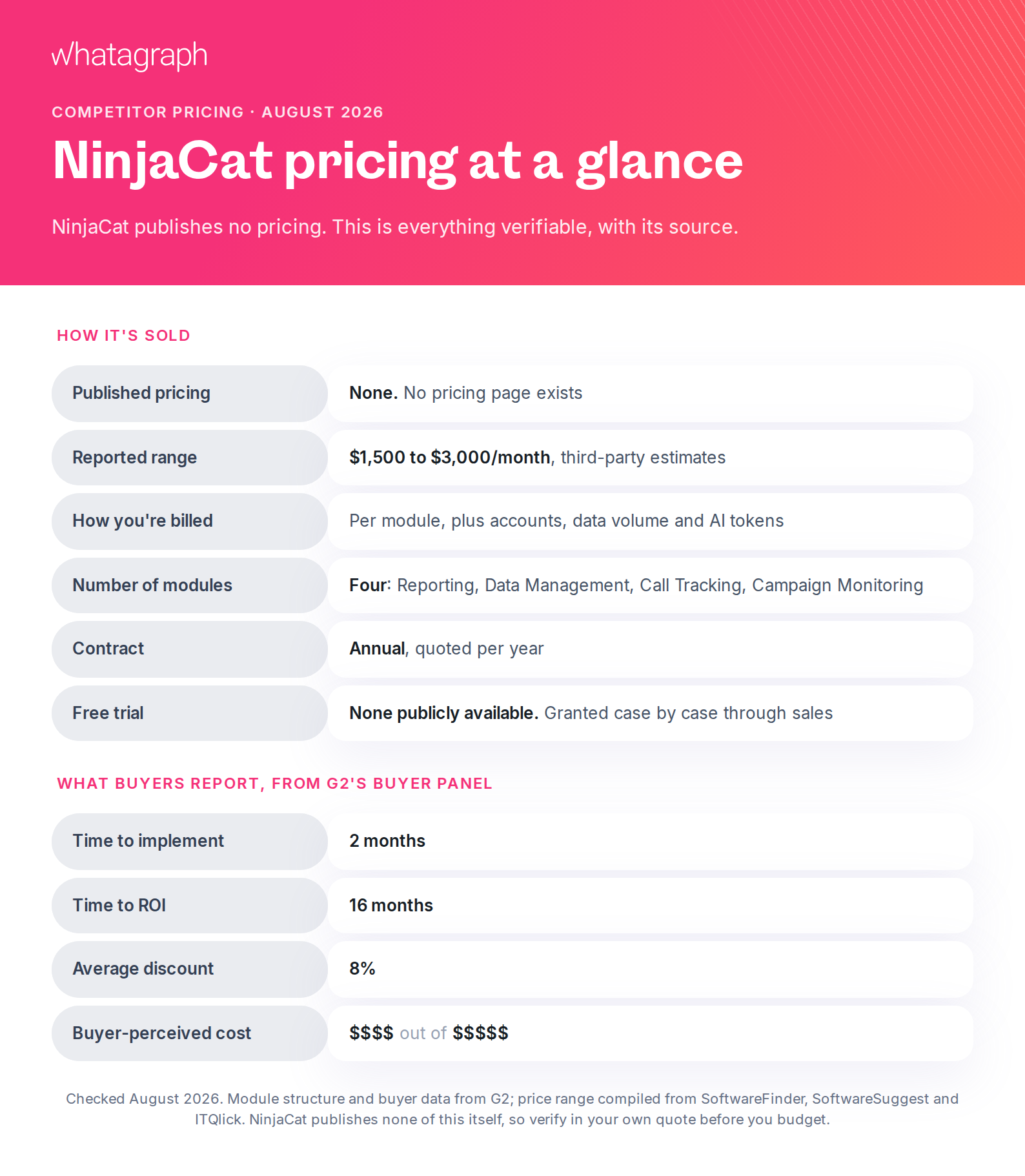
Before we get into the nitty gritty, here’s NinjaCat pricing at a glance:
| Published pricing | None. No pricing page exists |
| Reported range | $1,500 to $3,000/month (third-party estimates, 2026) $40k to $50k a year (internal research) |
| How you're billed | Per module, plus accounts and data volume, plus AI token usage |
| Number of modules | 4: Reporting, Data Management, Call Tracking, Campaign Monitoring |
| Contract | Annual, quoted per year |
| Free trial | None publicly available. Granted case by case through sales |
| Time to implement | 2 months (G2 buyer data) |
| Time to ROI | 16 months (G2 buyer data) |
| Average discount | 8% (G2 buyer data) |
| Buyer-perceived cost | $$$$ out of $$$$$ (G2) |
Now, let's get into the nitty gritty.
Why you can trust this NinjaCat pricing breakdown
At Whatagraph we sell a competing platform, so let's get that out of the way first. But we’re not here to dump on NinjaCat. It’s a powerful product with serious customers, and everything below is what I actually found and verified online and from prospects we’ve talked to who used or are using the platform.
Here's how I put it together:
- Checked NinjaCat's own properties first. Their site, their integrations page, their agent documentation and their own blog on AI token usage. Their words beat anyone else's summary of their words.
- Cross-referenced every third-party pricing figure. G2, Capterra, TrustRadius, Software Advice, SoftwareSuggest and SoftwareFinder, plus the comparison pages competitors publish. Where a figure came from a competitor of NinjaCat, I've labelled it.
But we highly recommend emailing or even getting on a demo with NinjaCat to confirm the actual prices.
How much does NinjaCat cost? (Update 2026)
I went looking for NinjaCat's pricing page first, the way anyone would.
There isn't one. The only page I saw was "Get a demo".
As of August 2026: NinjaCat does not publish pricing. Independent and third-party sources put entry pricing in the region of $1,500 to $3,000 per month on annual contracts. Total cost depends on which features you buy, how many accounts you connect, and how heavily you use the AI agents.
So I did the next best thing, which is check the software review pages like G2.com. I pulled a figure from six of them and got six different answers, ranging from $1,500 a month to $3,000 per contract.
This is every figure I could find, with its date attached:
| Source | Reported price | Last updated | Note |
|---|---|---|---|
| NinjaCat's own site | Not published | Checked Aug 2026 | /pricing redirects to homepage |
| G2 | 4 editions, all "Contact Us," priced per year | Apr 2026 | Also lists no free trial |
| SoftwareSuggest | From $3,000 per contract | May 2026 | Unit is "per contract," not per month |
| SoftwareFinder | Estimated from $1,500/month | Apr 2026 | Plus one-off implementation and migration fees |
SoftwareSuggest suggests that on top of the $3,000/month price tag for NinjaCat, there are extra fees involved like:
- Implementation and onboarding: $1,000–$10,000, depending on setup complexity and agency size
- Custom integrations and data connectors: $500–$5,000+, based on the number of marketing platforms and API configuration needs
- Data migration and historical data setup: $1,000–$7,000, depending on the amount of legacy marketing data
- Training and enablement: $500–$5,000 for team onboarding and workflow configuration
- Premium support or dedicated account management: $200–$1,000+/month for advanced support tiers
But keep in mind here again that these are all estimates (and you'll see the ranges are quite big).
Apart from this, our internal research also says NinjaCat costs around $40k to $50k a year.
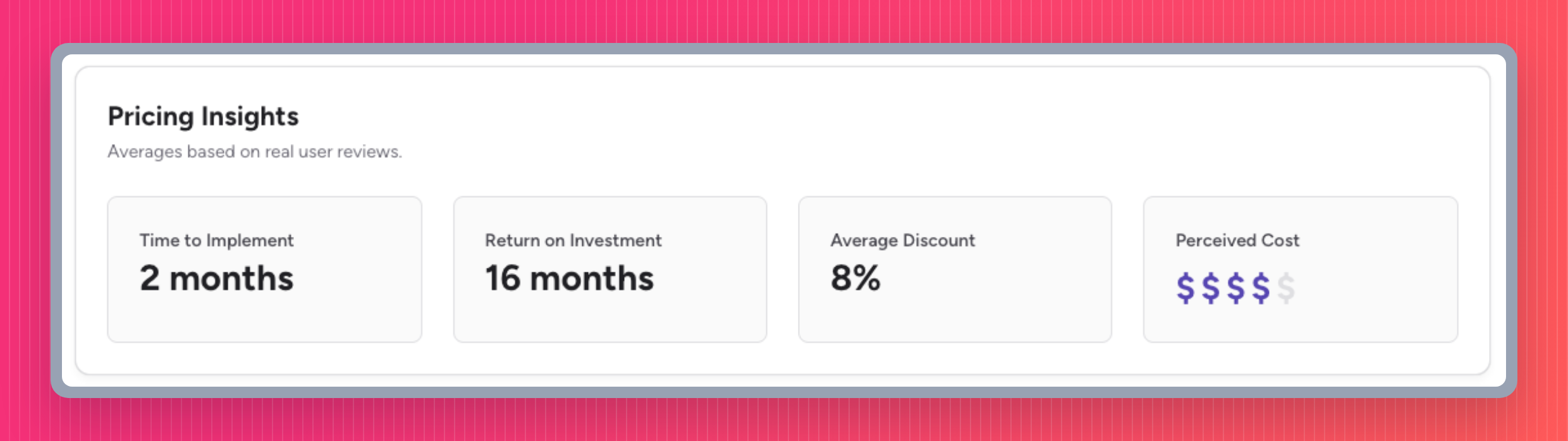
On top of that, G2's buyer panel estimates NinjaCat takes 2 months to implement, 16 months to see a return on investment with an 8% average discount, and buyer-perceived cost rated 4 out of 5.
How NinjaCat pricing is structured: modules, accounts, and AI usage
G2 lists four separately priced plans for NinjaCat, each quoted "Per Year," and each named after a product area rather than a size:
- Reporting
- Data Management
- Call Tracking
- Campaign Monitoring
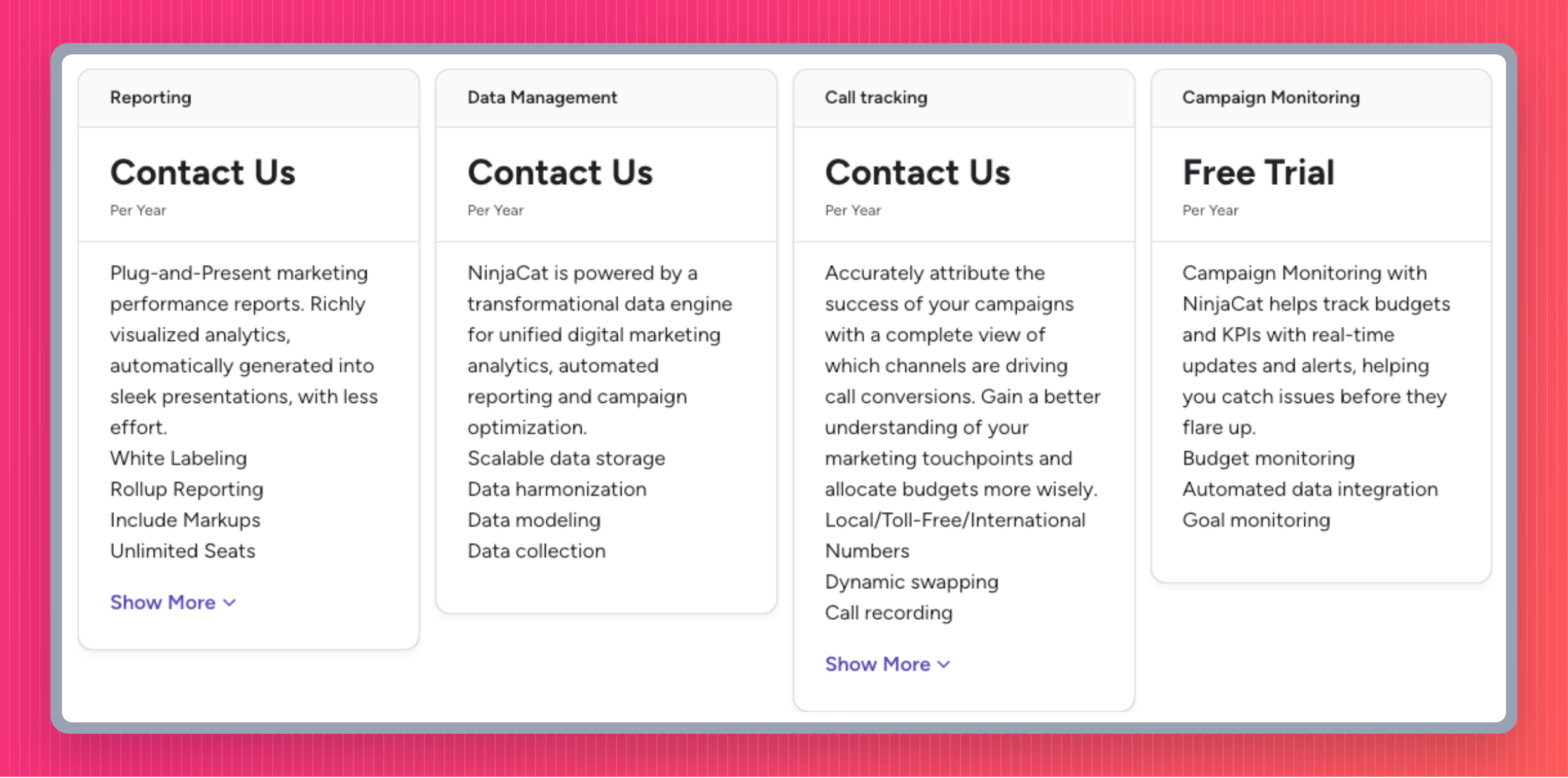
So what does the number actually depend on?
From what I've seen, it depends on these three layers:
- Layer one is the modules you buy (reporting, data management, e.t.c.)
- Layer two is the accounts and data volume you connect.
- Layer three is how much your AI agents actually run, measured in tokens, billed on top.
Layer one: which of the four modules are you actually buying?
Here's what G2 says sits inside each one:
| Module | What's inside it |
|---|---|
| Reporting | White labelling, rollup reporting, markups, unlimited seats, PDF and PPT export, dashboards |
| Data Management | Data collection, harmonisation, modelling, scalable data storage |
| Call Tracking | Local, toll-free and international numbers, dynamic number swapping, call recording, advanced reporting, spam control, API access integrations, custom notifications |
| Campaign Monitoring | Budget monitoring, goal monitoring, automated data integration |
Layer two: how many accounts, and how much data?
NinjaCat supports 150+ pre-built connectors, and by their own account the platform runs over 150,000 automated reports a month across roughly $4 billion in annual media spend. Nothing at that volume gets priced on a flat fee.
Several third-party analyses describe NinjaCat as running a per-client or per-account model. That's consistent with everything else about the platform, but NinjaCat doesn't confirm it publicly, so treat it as a question for your quote rather than a fact.
Layer three: the AI agents, and the token meter behind them
Two things to understand here.
First, AI agents appear to be sold as an add-on rather than bundled into the initial licence for NinjaCat.
We don't know this for sure, but this came from our internal sales conversation with a marketing agency, who trialled NinjaCat in July 2026.
They told us that NinjaCat's AI capability is a separately priced add-on that costs "a lot more."
Second, agent usage is metered in tokens on top of whatever you pay for access.
NinjaCat's own blog on token usage in marketing, published in July 2026, walks through input tokens, output tokens and cache tokens, explains that model choice changes cost, and shows screenshots of their AI usage dashboards.
Their homepage lists reducing token spend as a customer benefit. NinjaCat's CEO Paul Deraval argues in that post that “optimizing for cost is the wrong starting point with AI.”
Every agent run costs tokens. NinjaCat ships 340+ pre-built starter agents across 15 categories, and the whole pitch is that agents run continuously across every account you manage.
Continuous agents mean your AI bill can easily bloat up if you have hundreds of accounts connected.
With that being said, if you're evaluating NinjaCat for the agents specifically, get answers on three things in writing:
- Is agent access included in the licence, or priced separately?
- Is token usage capped, pooled, or billed as consumed?
- What does a realistic month look like for an agency my size, in dollars?
What are the extra costs on top?
At its core, NinjaCat is an enterprise-level tool, and that means a lot of onboarding and setup fees and time, on top of the sticker price.
How long does NinjaCat take to get live?
Two months, according to G2's buyer panel.
That's not the vendor's estimate. That's what buyers reported, and it's the number your finance team should be modelling against, because it's two months where you're paying for NinjaCat and still producing reports the old way.
Onboarding itself is guided, which is a genuine plus. It's also real time out of your team's week. One Software Advice reviewer described being fully onboarded across three one-hour sessions and said they'd rather log in and explore than run two workshops to get a team set up.
What one-off fees should I expect?
Nobody publishes these, so treat what follows as directional and get every line itemised in writing.
SoftwareFinder's April 2026 estimate breaks the extras out like this:
| One-off cost | Estimated range |
|---|---|
| Implementation and onboarding | $1,000 to $10,000, depending on setup complexity |
| Custom integrations and connectors | $500 to $5,000+ each |
| Data migration and historical data setup | $1,000 to $7,000 |
| Training and enablement | $500 to $5,000 |
Improvado's 2026 NinjaCat alternatives article goes further, citing viewer licence fees for read-only stakeholders, per-connector setup fees, and a premium support uplift.
They mentioned that an agency calculating $14,000 in one-off fees for NinjaCat just to add three niche platforms.
Whether or not that number is right, the principle holds. If your client mix depends on a platform outside the standard 150+ connector library, find out what a custom connector costs before you sign, not in month three when a client asks for it
What does the total cost involve? 9 items
Based on all we've seen, NinjaCat's total cost of ownership come down to these nine items:
- Licence
- Implementation and onboarding fees
- Data migration and historical backfill
- Training and enablement for the wider team
- Custom connector builds for any platform outside the standard library
- Viewer and read-only seats, internal and client-side
- Premium support or SLA uplifts
- AI agent access, if it's priced separately from the licence
- AI token usage, and whether it's capped, pooled, or billed as consumed
The Whatagraph advantage: Onboarding, a dedicated Customer Success Manager, every Data Hub transformation and Whatagraph Storage are included on both Max and Prime pricing plans.
Is there a NinjaCat free trial?
Not one you can sign up for. There's no trial button, no free tier you can self-serve into, and no sandbox. The only route in is a demo request.
The sources disagree on this, which is why the question keeps getting asked. G2 states plainly that NinjaCat doesn't offer a free trial. TrustRadius says a free trial is available. GetApp carries an older reviewer comment referencing trials of about 30 days.
They're probably all describing something real.
Look closely at G2's four editions and one of them, Campaign Monitoring, is listed at $0 with a free trial attached. So there does appear to be a free entry point, just to the budget and goal monitoring piece rather than to the reporting and data platform most people are evaluating.
So can you actually test it before you buy?
Yes, if the deal is big enough to justify it.
Trials and proof-of-concept periods clearly do get granted through sales. I know this because an agency running roughly 200 to 240 clients told our team in July 2026 that they were finishing a NinjaCat trial that same day.
This wasn't a self-serve trial signup, but more negotiated as part of an evaluation.
The practical takeaway: don't assume you have to buy blind. Ask for a scoped trial with your own data connected, and make replicating two or three of your existing reports the success criteria. If a vendor won't let you test at a $30,000-plus commitment, that itself is information.
Does NinjaCat run discounts or promotions?
No public ones. There's no promo page, no annual-prepay discount published, nothing seasonal.
The most honest number available is from G2's buyer panel, which puts the average discount at 8%.
Is NinjaCat worth it? What users actually say
I only looked at reviews from 2025 onwards for this section.
NinjaCat shipped a major repositioning in 2026. A review from 2019 is describing a PPC reporting and call tracking tool. A review from late 2025 is describing an AI agent platform. They are not the same product, and averaging them together is how you end up with a rating that tells you nothing.
| Platform | Rating | Reviews | Most recent review I could find |
|---|---|---|---|
| G2 | 4.2 / 5 | 316 | January 2026 |
| Capterra | 4.4 / 5 | 89 | March 2024 |
| TrustRadius | 8 / 10 | 12 | 2021 |
Something to notice before you read a single review: all the recent activity is on G2. The newest Capterra review I could find dates to March 2024, and TrustRadius has twelve reviews total with nothing recent. If you're researching NinjaCat, G2 is effectively your only current source.
What do the most recent reviewers actually praise?
The agents. Consistently, and it's the clearest pattern in the recent set.
Every G2 review from October 2025 onwards that I read mentions AI in the value it describes.
Every G2 review from October 2025 onwards that I read mentions AI in the value it describes.
- Quoc Nhat T., Digital Business Analytics Manager at a mid-market company, 5 stars, 7 October 2025: credits the agents with cutting the manual data analysis his team had to do, freeing people up for strategy and upsell work.
- Kevin G., President of Technology and Operations at a small business, 4.5 stars, 29 October 2025: describes the agents letting them analyse large volumes of data quickly.
- Verified user in marketing and advertising, mid-market, 5 stars, 20 October 2025: using AI assistants specifically to shorten the team's workload.
The non-AI praise is what you'd expect from a mature platform: connector breadth, dashboards clients can log into themselves, and campaign budget pacing.
A small-business reviewer in January 2026 singled out the pacing system as something they use every day, which is a detail you don't get from a marketing page.
Support comes up repeatedly and warmly, across every year I looked at. That's consistent enough to treat as a genuine strength of NinjaCat.
What are they complaining about?
Two things.
The platform is…a lot. The January 2026 reviewer, who gave five stars, still described NinjaCat as "a bit overwhelming with all of the features." They meant it kindly. It's still a warning about ramp time.
Sophistication has a cost in stability. Kevin G., a President of Technology and Operations reviewing in October 2025, gave four and a half stars and put it plainly: the technology does a lot, and because of that "things can break down from time to time."
The third one is the most relevant to this article, because it's about the thing you're paying extra for. The October 2025 analytics manager, a five-star reviewer, said that making it easier to “configure the AI agent would help increase adoption.”

Read that alongside the pricing structure from earlier. If agents are an add-on, and agent adoption depends on configuration your team finds fiddly, you can end up paying for capability that isn't being used yet. Ask about configuration support in the same conversation as the agent pricing.
Why does the same platform get called both easy and overwhelming?
Because the people reviewing it aren't the people it's sold to.
NinjaCat markets itself to enterprise multi-account teams. Capterra's own analysis notes that 91% of its NinjaCat reviewers come from small businesses, and G2's segment data puts small business at roughly 55% of reviews.
That gap explains most of the contradictory feedback in one go. A platform built for an agency with 300 accounts and a dedicated ops function will feel powerful to that agency and overwhelming to a three-person team, and both reviews are honest.
It also explains the affordability complaints, which cluster hard at the small end. If you're a one-person digital team, the problem isn't that NinjaCat is bad. It's that you're buying an enterprise platform's cost structure to solve a small team's problem.
Check your own numbers against G2's comparison scores too. NinjaCat sits at 7.5 for ease of setup and 7.8 for ease of use, against AgencyAnalytics at 9.2 and 9.3. That difference isn't a quality judgment. It's a complexity one, and complexity is what you'd expect from a platform doing more.
So is it worth it?
It depends on what you're comparing it against, and most people compare it against the wrong thing.
Agencies instinctively compare reporting platforms to other reporting platforms. That's not the real comparison.
As one operations lead put it to us, the aim is making internal reporting efficient rather than having teams gather everything manually and then write the commentary on top. The alternative to NinjaCat isn't a cheaper tool. It's people-hours.
So run the maths that way. G2's buyers put return on investment at 16 months and perceived cost at 5 out of 5. If NinjaCat removes two days a month of analyst and account manager time across your portfolio, price those days at your blended rate and see whether they clear the licence inside 16 months.
Above a certain account volume, they usually do. Below it, they usually don't, and no amount of negotiating fixes a maths problem.
Who NinjaCat pricing makes sense for (and who it doesn't)
NinjaCat's price is roughly fixed at the bottom and scales from there, so the number of accounts you spread it across decides whether it's a bargain or a bad decision. Same platform, same quote, completely different verdict depending on your book.
Who gets clear value from the price?
Teams running enough accounts that the licence disappears into the per-client cost.
NinjaCat's own site sorts its customers into three shapes, and they're a good filter:
- Agencies with hundreds of client accounts. Their example customers here are large: VML, Wpromote, Amsive, Seer Interactive.
- Portfolio companies overseeing dozens of brands, where each operating company runs its own stack and someone has to roll it all up.
- Multi-location brands with thousands of locations, reporting per location and per region and per brand.
Who should probably not be on this call?
Anyone whose per-client tooling cost would raise eyebrows in a retainer conversation.
Run the number yourself. At the reported $1,500 to $3,000 a month, you're looking at $18,000 to $36,000 a year. Spread across 15 clients, that's $100 to $200 per client per month in reporting tooling alone. Spread across 200 clients, it's $7 to $15.
I'd put the rough dividing line somewhere around 40 to 50 accounts, and lower than that if your clients are large or your reporting is unusually complex. That's a judgment, not a published threshold, and your retainer sizes should move it.
Below that line, three groups should look elsewhere:
- Small agencies and freelancers. The affordability complaints in the review data cluster here, and they're not complaints about quality. One-person and small teams are buying an enterprise cost structure for a small-team problem.
- Single-brand in-house marketing teams. Most of what you're paying for is the ability to template, roll up and rebrand across many clients or locations. One brand, one market, and that capability sits unused.
- Anyone who needs to be live next month. G2's buyers report two months to implement. If you have a client reporting deadline in six weeks, this is the wrong purchase regardless of budget.
Whatagraph vs NinjaCat: pricing and features side by side
We make one of these two products, so read this section with that in mind. I've tried to make it the version I'd want to read if I were the one holding two quotes.
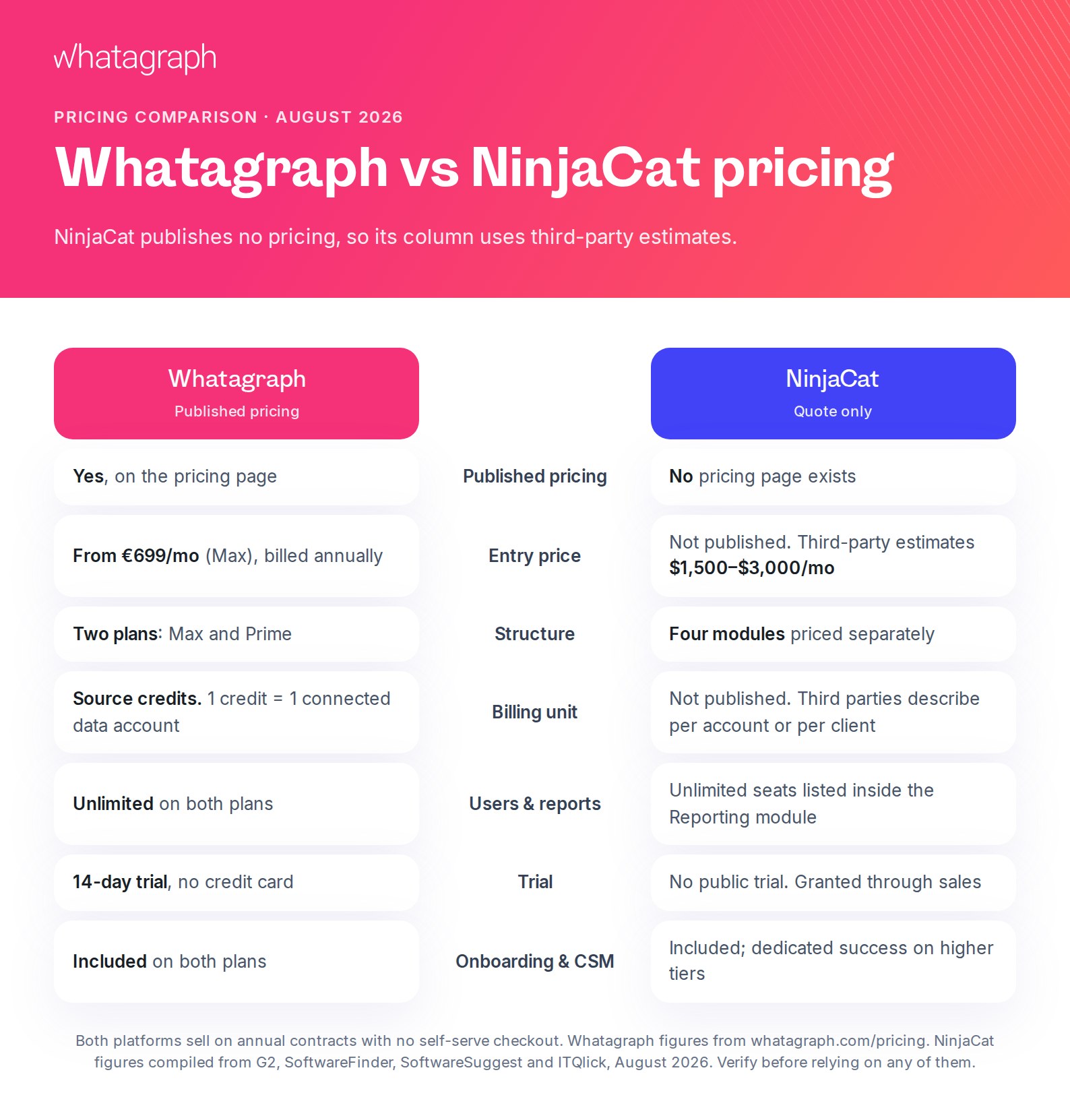
How do the pricing models compare?
| Whatagraph | NinjaCat | |
|---|---|---|
| Published pricing | Yes, on the pricing page | No |
| Entry price | Max from €699/month, billed annually | Not published (third-party estimates $1,500 to $3,000/month) |
| Plan structure | Two plans: Max and Prime | Four modules: Reporting, Data Management, Call Tracking, Campaign Monitoring |
| Billing unit | Source credits. 1 credit = 1 connected data account | Not published. Third parties describe per-account or per-client |
| Credits included | From 50 on Max, custom on Prime | Not published |
| Users | Unlimited, both plans | Unlimited seats listed inside the Reporting module (according to G2, not verified) |
| Reports | Unlimited, both plans | Not published |
| Contract | Annual | Annual |
| Free trial | 14-day Max trial, no credit card | No public trial. Granted through sales |
| Self-serve checkout | No, book a call from inside the app | No, demo request |
| Onboarding | Included on both plans, tailored onboarding on Prime | Included, multi-session. Third parties cite separate implementation fees |
| Dedicated CSM | Both plans | Enterprise tiers |
Note: Soon AI agents will be available on Whatagraph in the same breadth and capabilities. Request early access to be the first to try.
Whatagraph's advantage
Not that we're cheaper because I honestly don't know that for sure.
The argument is forecastability.
With Whatagraph you count one thing. A source credit is one connected data account, and everything you build on top of that connection is in the plan: unlimited users, unlimited reports, every Data Hub transformation, storage, and Whatagraph IQ.
Your bill doesn't change because you hired three account managers, built forty more reports, or had a month where the team asked a lot of questions.
NinjaCat pricing vs. the alternatives
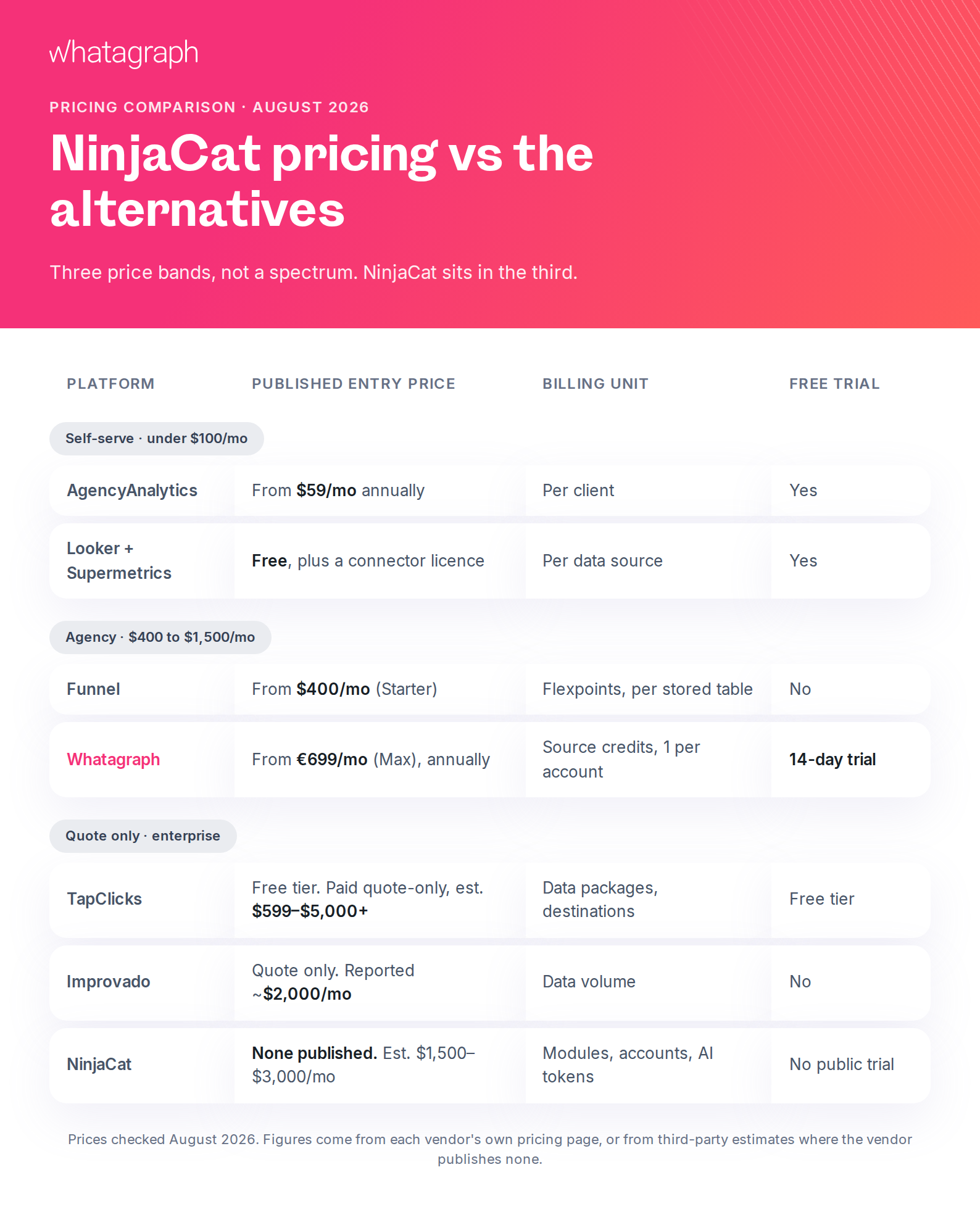
Zoom out and this category splits into three price bands, not a spectrum.
There's a self-serve band under about $100 a month, an agency band roughly between $500 and $1,500, and a quote-only enterprise band above that.
NinjaCat sits firmly in the third. Comparing it to a tool in the first band tells you almost nothing, which is why so many listicle comparisons feel useless.
| Platform | Published entry price | Billing unit | Free trial | Best fit |
|---|---|---|---|---|
| NinjaCat | None published. Third-party estimates $1,500 to $3,000/mo | Modules, accounts, plus AI token usage | No public trial | Enterprise multi-account teams, call tracking bundled |
| Whatagraph | From €699/mo, billed annually (Max) | Source credits. 1 credit = 1 connected account | 14-day Max trial | Mid-size agencies and multi-location operators |
| TapClicks | Free tier (5 clients). Paid plans quote-only, third-party estimates ~$599 to $5,000+/mo | Data packages plus destinations | Free tier | Large agencies with complex data operations |
| AgencyAnalytics | From $59/mo billed annually (5 clients) | Per client | Yes | Smaller, SEO-led agencies |
| Improvado | Quote only. Reported entry around $2,000/mo | Data volume | No | Enterprise attribution and data pipelines |
| Funnel | From $400/mo (Starter) | Flexpoints, consumed per stored table | No | Data teams feeding an existing BI tool |
| Looker Studio + Supermetrics | Looker Studio is free, plus a connector licence | Per data source | Yes | Teams with a data-skilled owner and time to maintain it |
Prices checked August 2026. Every one of them may have changed by the time you read this, so treat the table as a map of the bands rather than a quote sheet.
Which platform should you choose?
If you're under about 20 clients on mostly standard channels, the self-serve and low-agency band will serve you longer than you expect, and AgencyAnalytics or a Looker Studio setup is the honest answer.
If you're past 50 accounts, or you need blends, aggregations and templated rollups across many clients, Whatagraph is the best choice.
If your requirement is specifically pipelines into a warehouse or BI tool you already own, Funnel and Improvado are built for that.
For a fuller breakdown of each of these platforms rather than just the price band, we've written that up separately: 11 best NinjaCat alternatives.
Published on Aug 14 2026
WRITTEN BY
YamonYamon is a Senior Content Marketing Manager at Whatagraph. With an eye for detail and a knack for always considering context, audience, and business goals to guide the narrative, she's on a mission to create genuinely helpful content for marketers. When she’s not working, she’s hiking, meditating, or practicing yoga.