







Free Semrush Report Template

Stop wasting hours exporting and stitching together Semrush data.

Use a ready-made Semrush report template that turns raw data into stunning visualizations and actionable insights.

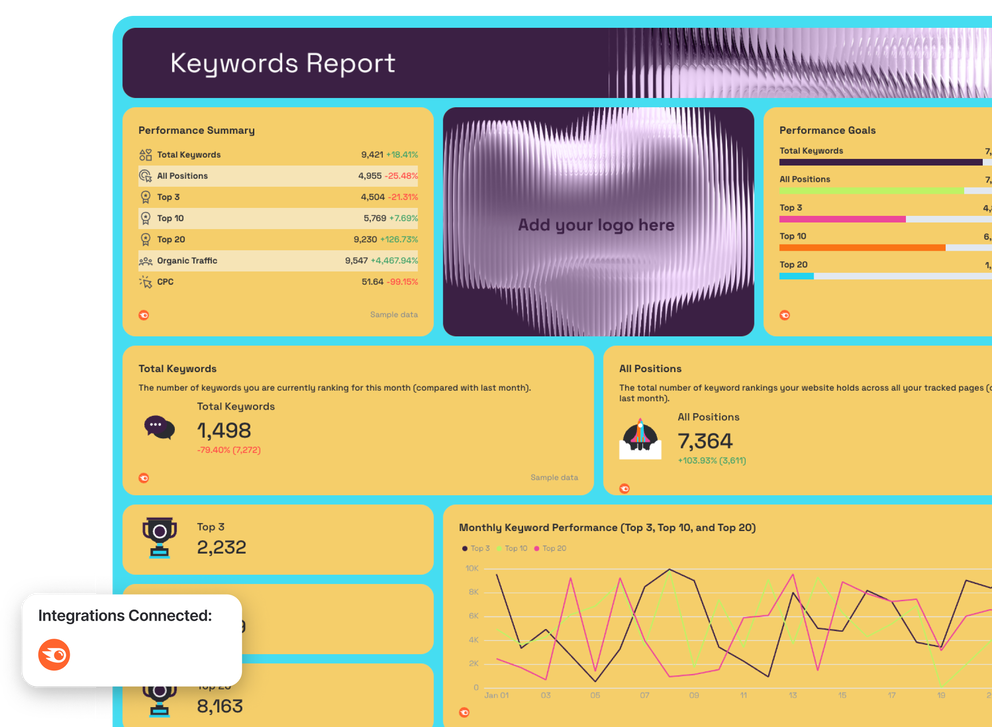
Semrush Report Template - A dashboard showing keyword performance, positions, and traffic data.

Create Custom Semrush Report Templates in Seconds

With Whatagraph IQ, just tell us what you need, and we'll build a stunning Semrush report for you. No templates or manual setup needed.

How To Use Whatagraph’s Semrush SEO Report Template

What to Include in a SEO Report Template for Semrush

Based on how SEO specialists build Semrush reports in Whatagraph, a solid Semrush report template should answer one question clearly:

Is our SEO actually moving the needle, and where should we optimize next?

That’s why our template is structured into three focused sections: Traffic, Keywords, and Backlinks. Each one tracks the SEO metrics that matter most for decision-making, not vanity numbers.

Here’s how we recommend structuring it.

1. Traffic Overview
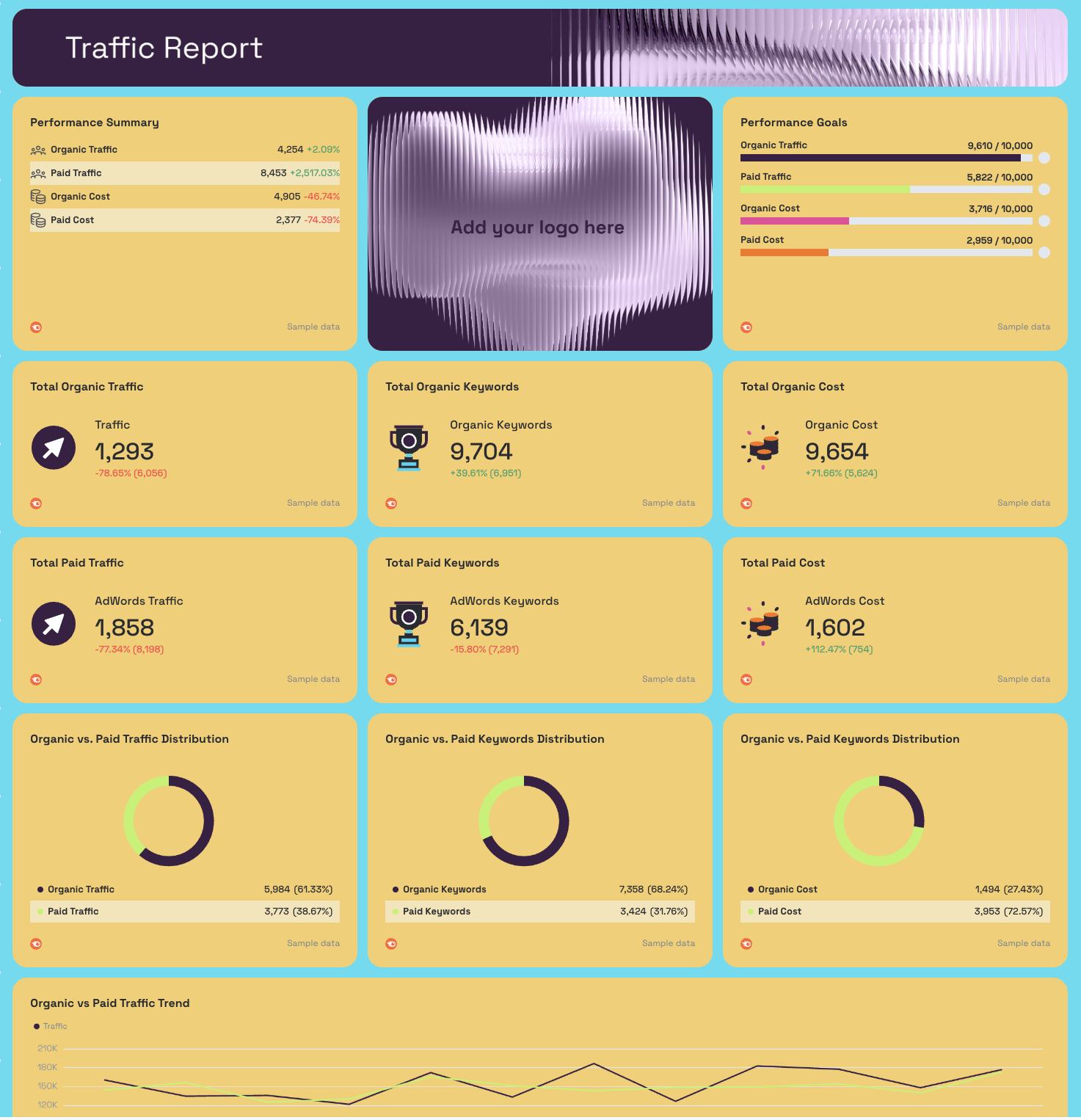
Semrush Report Template - Dashboard with charts and key metrics about traffic performance.Start with a traffic report that shows how organic search is performing alongside paid channels.

Key metrics to include:

  • Total organic traffic
  • Organic traffic growth over time
  • Total organic keywords
  • Estimated organic cost
  • Organic vs paid traffic distribution

Recommended visuals:

  • Line charts for organic vs paid traffic trends
  • Distribution charts for traffic, keywords, and cost
  • Tables for top organic keywords by traffic

Why this matters:

Traffic alone doesn’t tell the full story. By pairing organic traffic, keyword growth, and cost metrics, stakeholders can see whether SEO performance is scaling sustainably, or if paid search is doing most of the heavy lifting.

This is especially useful for monthly reporting, client reports, and showing SEO ROI next to Google Ads or PPC data.

2. Keyword Performance
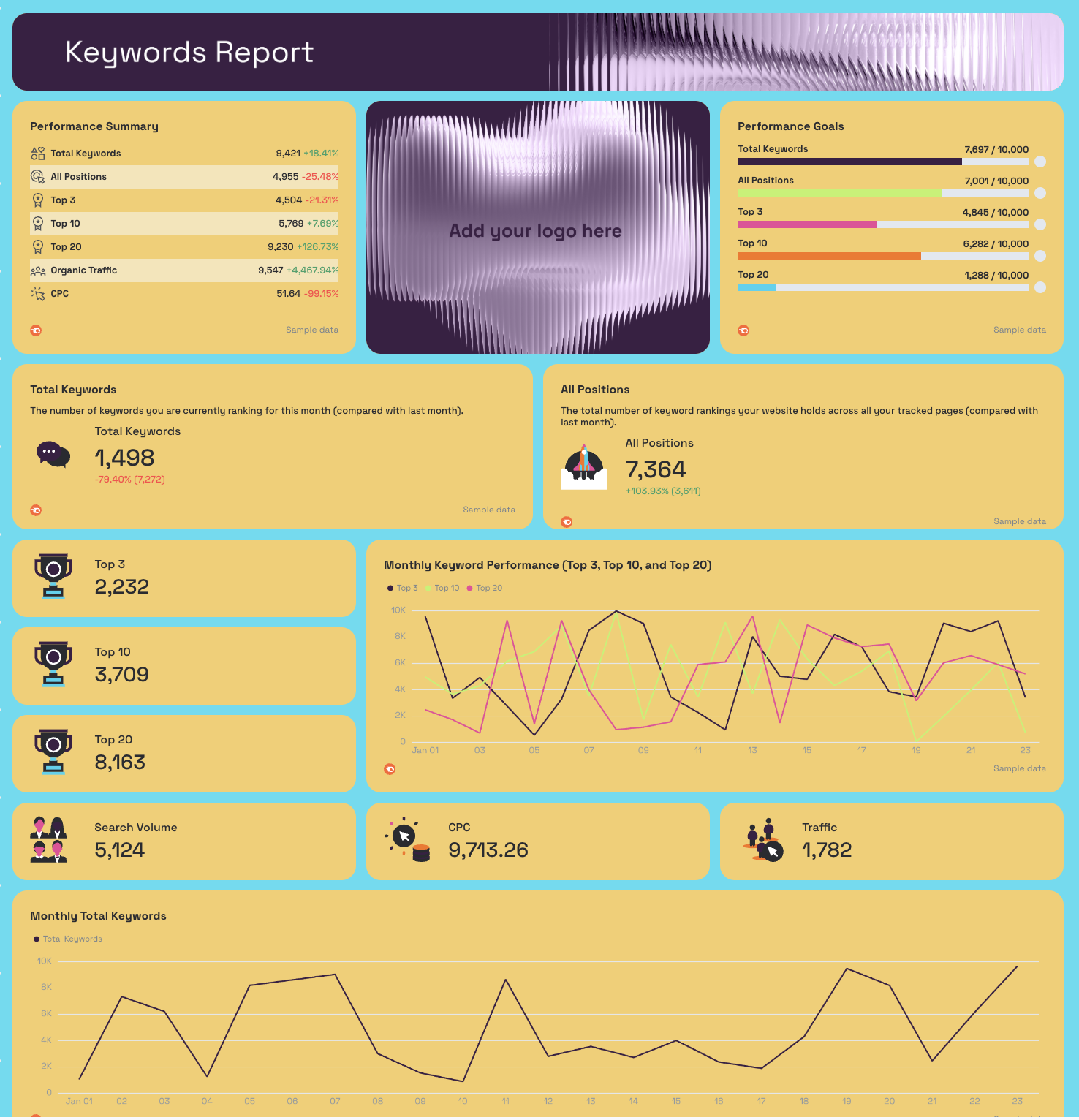
Keywords Report - A data dashboard showing charts and performance metrics.

Next, zoom in on keyword rankings and visibility.

Key metrics to include:

  • Total tracked keywords
  • Keywords in Top 3, Top 10, and Top 20
  • Keyword position trends over time
  • Search volume and CPC
  • Keyword difficulty
  • Keyword-to-landing-page mapping

Recommended visuals:

  • Trend graphs for Top 3, Top 10, and Top 20 positions
  • Visibility trend charts across the selected timeframe
  • Tables showing top-performing keywords and landing pages

Why this matters:

This section connects keyword rankings to organic traffic and landing pages, making SEO data actionable.

Instead of just tracking positions, SEO teams can quickly spot:

  • Keywords close to page one
  • Pages that need optimization
  • Gaps in organic research and content coverage

It’s the backbone of any SEO strategy review.

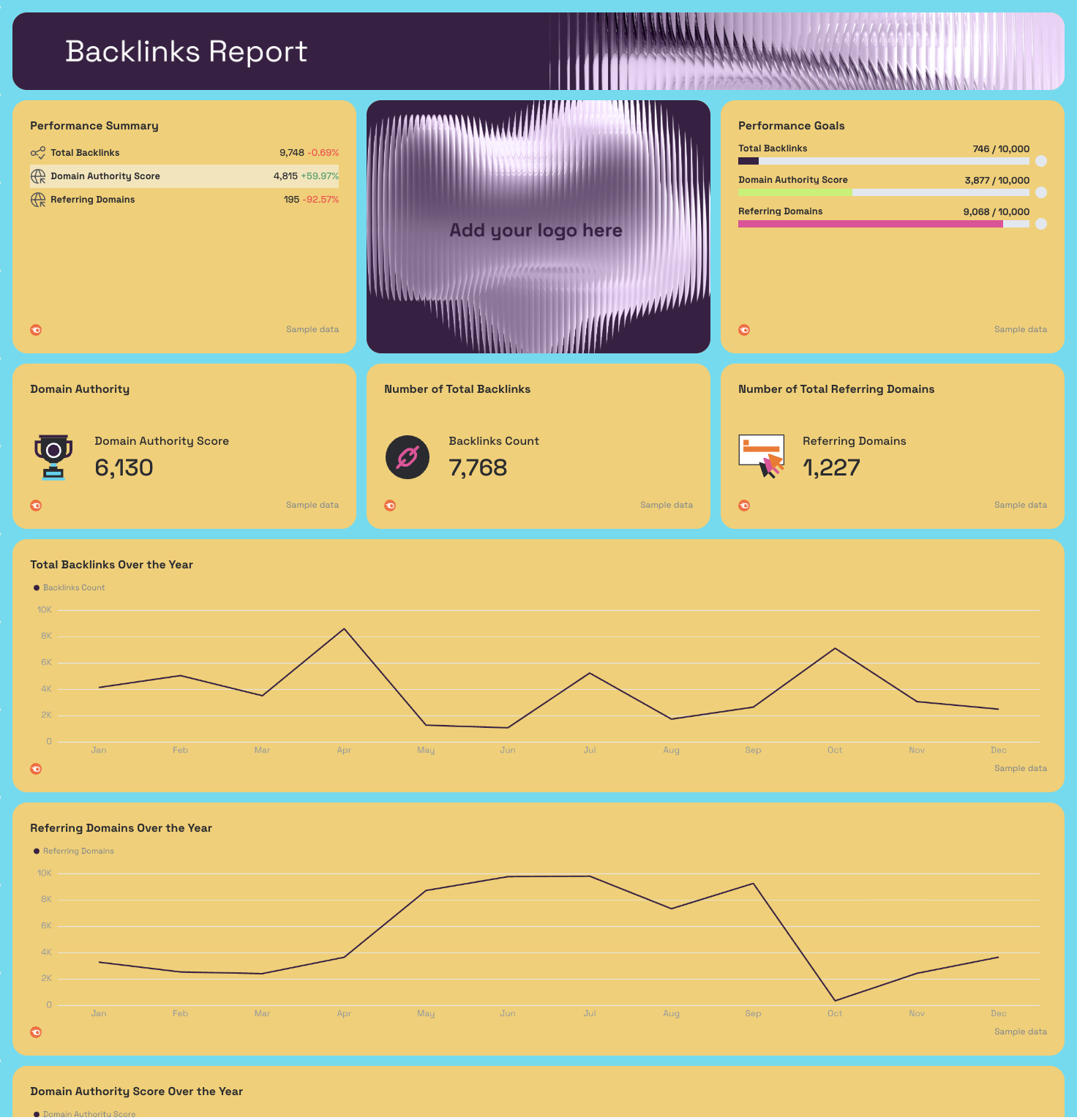
Semrush Report Template - Backlinks Report - Backlinks report with charts, graphs, and performance data.

Finally, include a backlinks report to track authority growth.

Key metrics to include:

  • Total backlinks
  • Referring domains
  • Domain Authority score
  • New backlinks acquired
  • Follow vs nofollow links
  • Top anchor texts

Recommended visuals:

  • Trend charts for backlinks, referring domains, and domain authority
  • Tables for new backlinks and anchor text distribution

Why this matters:

Backlinks directly influence SEO performance, especially for competitive keywords.

Tracking both referring domains and anchor texts helps SEO specialists:

  • Measure link-building effectiveness
  • Avoid over-optimized anchor profiles
  • Benchmark authority growth over time

This makes backlink reporting easier to explain to stakeholders who care about outcomes, not raw link counts.

Connect All Your SEO Channels and Sources in One Place

Bring all your SEO and other marketing data into one place with no-code, stable connectors that you don't need to babysit. 

Why Marketers Love Reporting on Whatagraph

Whatagraph's AI is saving so much time and energy for our marketing specialists. We now have more time to focus on strategic things that help both our agency and our clients grow.

Lars Maat

Lars Maat

Co-Founder @ Maatwerk Online

StarStarStarStarStar

Whatagraph is easy to use, visually attractive, and much smoother compared to tools like Looker Studio. It helped us not only get clients on board but also keep them within the agency.

Stef Oosterik

Stef Oosterik

Quality Manager @ Dtch. Digitals

StarStarStarStarStar

Whatagraph took us to the next level with our clients and within our team. Our relationships with clients have been amazing, and we’ve even been able to retain them longer.

Kim Strickland

Kim Strickland

Digital Marketing Specialist @ Peak Seven

StarStarStarStarStar

Whatagraph has become an essential partner for scaling our reporting, and my teams love it because it saves so much time. We’d recommend it to any team looking to automate data reporting and use AI for insights.

Danielle Roberts

Danielle Roberts

Director of Implementation & Support @ Rentable

StarStarStarStarStar

Frequently Asked Questions

Have more questions? We answered them here.

What is a Semrush report?

A Semrush report is a structured SEO report that pulls Semrush SEO data, such as organic traffic, keyword rankings, backlinks, site health, and other SEO metrics—to evaluate SEO performance across search engines and share results with stakeholders.

How to download Semrush report?

In Semrush:


1. Open the tool you want (e.g. Organic Research, Position Tracking, Backlinks).


2. Click Export.


3. Choose a format (PDF, Excel, CSV).


Download or schedule it to send by email.


Downloaded reports usually require manual cleanup and don’t combine other data sources like Google Analytics 4 or Google Search Console.


In Whatagraph, you can just simply press “Download PDF” and that's it. You can also share live links that update automatically with stakeholders and teams. 

How to make a SEO analysis report?

Create an SEO analysis report in Whatagraph is as easy as 1-2-3. 


Here’s how SEO teams actually do it:


1. Connect your SEO data sources


Connect Semrush, Google Analytics 4, and Google Search Console as data sources. This gives you access to organic traffic, keyword rankings, backlinks, CTR, and landing page performance in one place.


2. Choose a SEO report template that includes: 


- Organic search traffic and trends


- Keyword performance (Top 3, Top 10, Top 20, position tracking)


- Backlinks, referring domains, and domain authority


- Top landing pages driving organic traffic


3. Add custom visualizations and widgets


Use drag-and-drop widgets to add:


- Line graphs for organic traffic and keyword trends


- Tables for keyword rankings and backlinks


- Charts comparing organic vs paid search performance


4. Turn data into insights


Add written summaries and recommendations directly into the report, tying metrics back to your SEO strategy and optimization actions. 


Ask any questions you want about your SEO data directly in the report and get accurate answers in seconds. 


5. Automate reporting


Set a timeframe, schedule delivery, and reuse the report for monthly SEO reporting—no manual exports or copy-pasting.

How to prepare a report template?

To prepare an SEO report template:


1. Define your core KPIs and key metrics together with your client or stakeholder


2. Group widgets by Traffic, Keywords, and Backlinks


3. Use consistent graphs, visualizations, and tables


4. Turn the report into a template


5. Reuse the template across websites or clients


A template helps streamline data collection and reporting.

What is a Semrush SEO report template?

A Semrush SEO report template is a reusable layout designed to automatically visualize Semrush SEO metrics like organic research, position tracking, backlinks, and site audit data for ongoing SEO reporting.

Who are SEO reports for?

SEO reports are built for:


- SEO specialists tracking SEO efforts


- Digital marketing teams measuring organic traffic


- Agencies producing client reports


- Stakeholders reviewing SEO performance and benchmarks


- Ecommerce and B2B teams monitoring organic growth

Why do you need an SEO report template?

An SEO report template helps you:


- Automate monthly reporting


- Reduce manual data collection


- Track SEO metrics consistently


- Present clear actionable insights


- Scale reporting across multiple websites or clients


Without templates, SEO reporting becomes slow and error-prone.

Can you customize the Semrush report template?

Yes, you can customize Whatagraph's Semrush report template:


- Customize the fonts and colors of your report manually or with Whatagraph IQ (just upload a screenshot of your brandbook or type in a specific prompt, and Whatagraph automatically applies the fonts and colors to your report)


- Drag and drop widgets you want to add easily 


- Add icons to widgets and change titles and descriptions 


- Add new rows in your report


- Add headers, footers, and any images you want anywhere in your report


- Filter your data by campaign, audience segment, or data source


- Create custom marketing metrics, dimensions, and blends


This makes it easy to tailor reports for different stakeholders without rebuilding them from scratch.

What other campaign metrics can you track and visualize with Semrush?

With Semrush and connected tools, you can track:


- Keyword rankings


- Organic vs paid traffic


- CTR and click-through rate


- Technical SEO and site health


- Backlinks data 

How do I create a Semrush report template for my website?

Simple - just use Whatagraph’s free Semrush report template. All you need to do is connect your Semrush account and you’ll get a stunning, white-labeled report in seconds.