





Free White Label SEO Report Template

Stop wasting hours compiling SEO data across tools.

Visualize all your SEO metrics in one place, get actionable insights, and wow clients and stakeholders in this white label SEO report template.

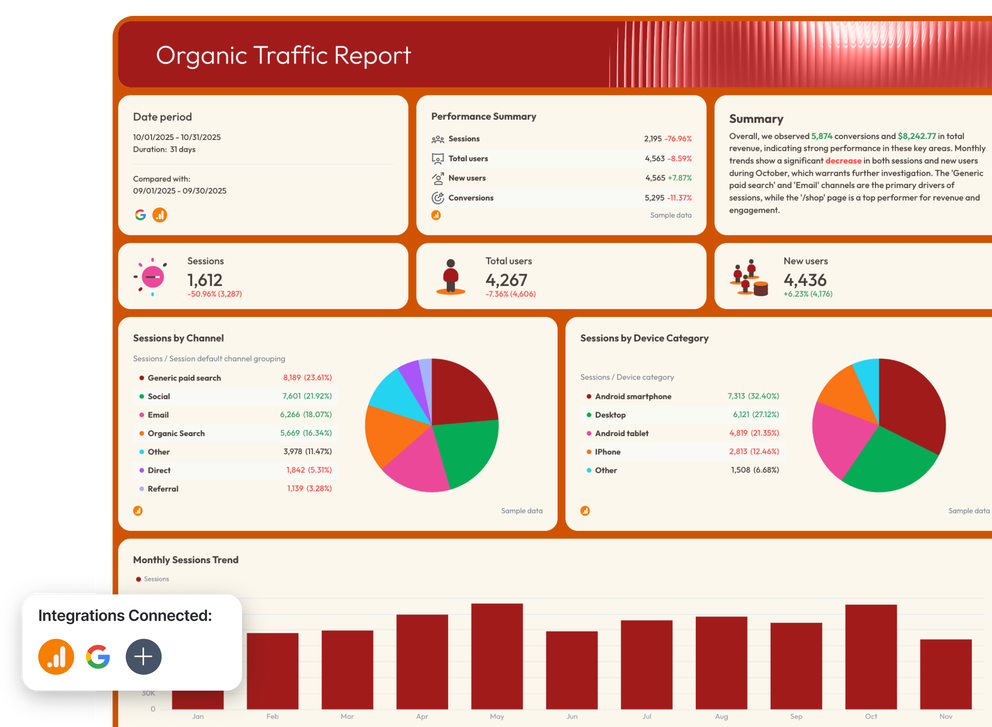
White Label Seo Report Template - Dashboard showing website traffic report with charts and data.

How To Use Whatagraph’s White Label SEO Report Template

Create Custom White Label SEO Reports in Seconds

With Whatagraph IQ, just tell us what you need, and we'll build a stunning white label SEO report for you in seconds. No templates or manual setup needed.

What To Include in a White Label SEO Report Template

Based on real client reports created by marketers using Whatagraph, these are the must-have sections you should include in your white label SEO report template.

Whether you're reporting to clients as an agency or to stakeholders as part of an in-house team, these sections help you communicate the value of SEO clearly, consistently, and at scale.

1. Performance Summary
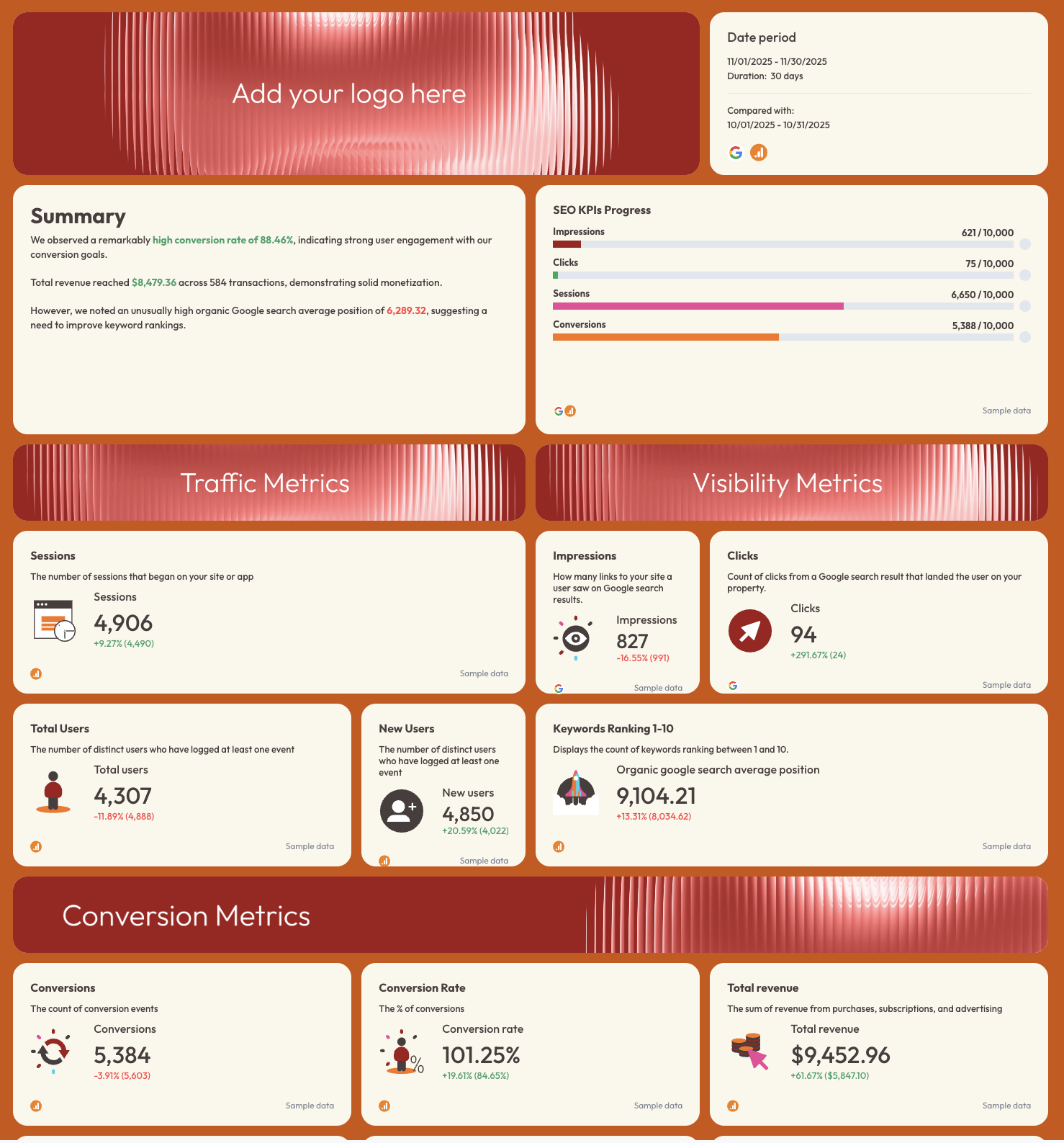
White Label Seo Report Template - A report with charts, data, and KPI progress.The Performance Summary provides a top-level snapshot of how your SEO strategy is performing and where optimization is needed. It helps clients and internal stakeholders quickly assess progress without getting lost in the details.

What to include:

  • Time period with comparison to the previous month
  • KPI summary list from Google Analytics showing:
    • Sessions
    • Users & new users
    • Conversions
    • Ecommerce transactions
    • Revenue
  • SEO KPIs in widgets and progress bars
  • Conversion rate and average revenue per purchase
  • Automated summary and recommendations (use AI tools like Whatagraph IQ)
  • Branding: agency or team logo, fonts, and colors for a fully white-label experience

This section is key for building trust and making your report readable even for non-technical stakeholders.

2. Organic Visibility
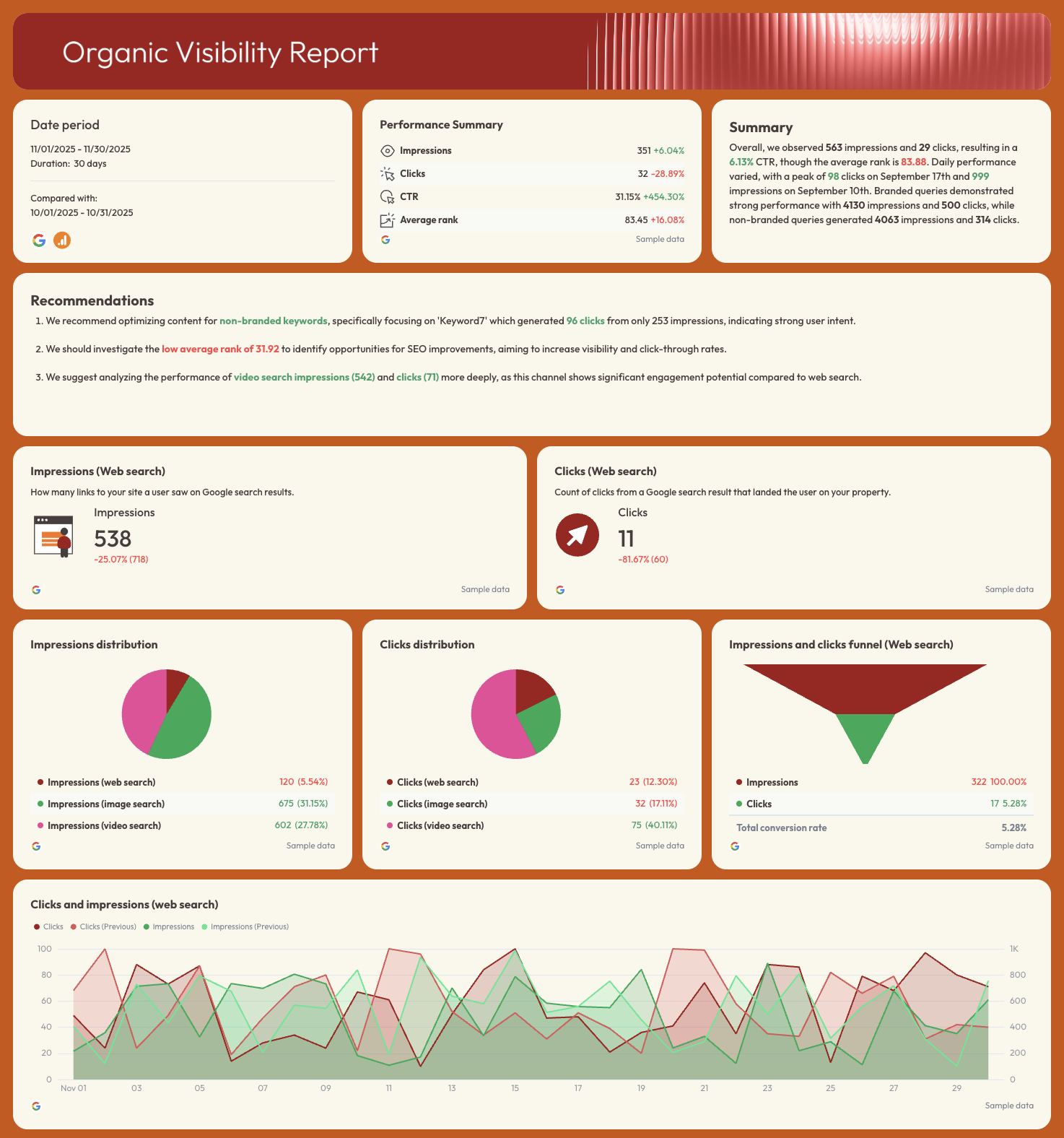
Organic Visibility - SEO report dashboard showing charts and performance data

Organic Visibility shows how the website appears in search engines. It focuses on search impressions, clicks, and keyword rankings to show whether your SEO efforts are gaining traction.

What to include:

  • Google Search Console data:
    • Impressions
    • Clicks
    • CTR
    • Average position
  • Daily trends for impressions and clicks
  • Branded vs. non-branded keyword tables from Semrush or Ahrefs:
    • Keyword
    • Impressions
    • Clicks
    • CTR
    • Change from last month
  • Funnel chart showing impressions → clicks → conversions
  • Rank tracking for priority keywords

This section helps both clients and stakeholders understand visibility gains in real-time, without needing to log into GSC or spreadsheets.

3. Organic Traffic
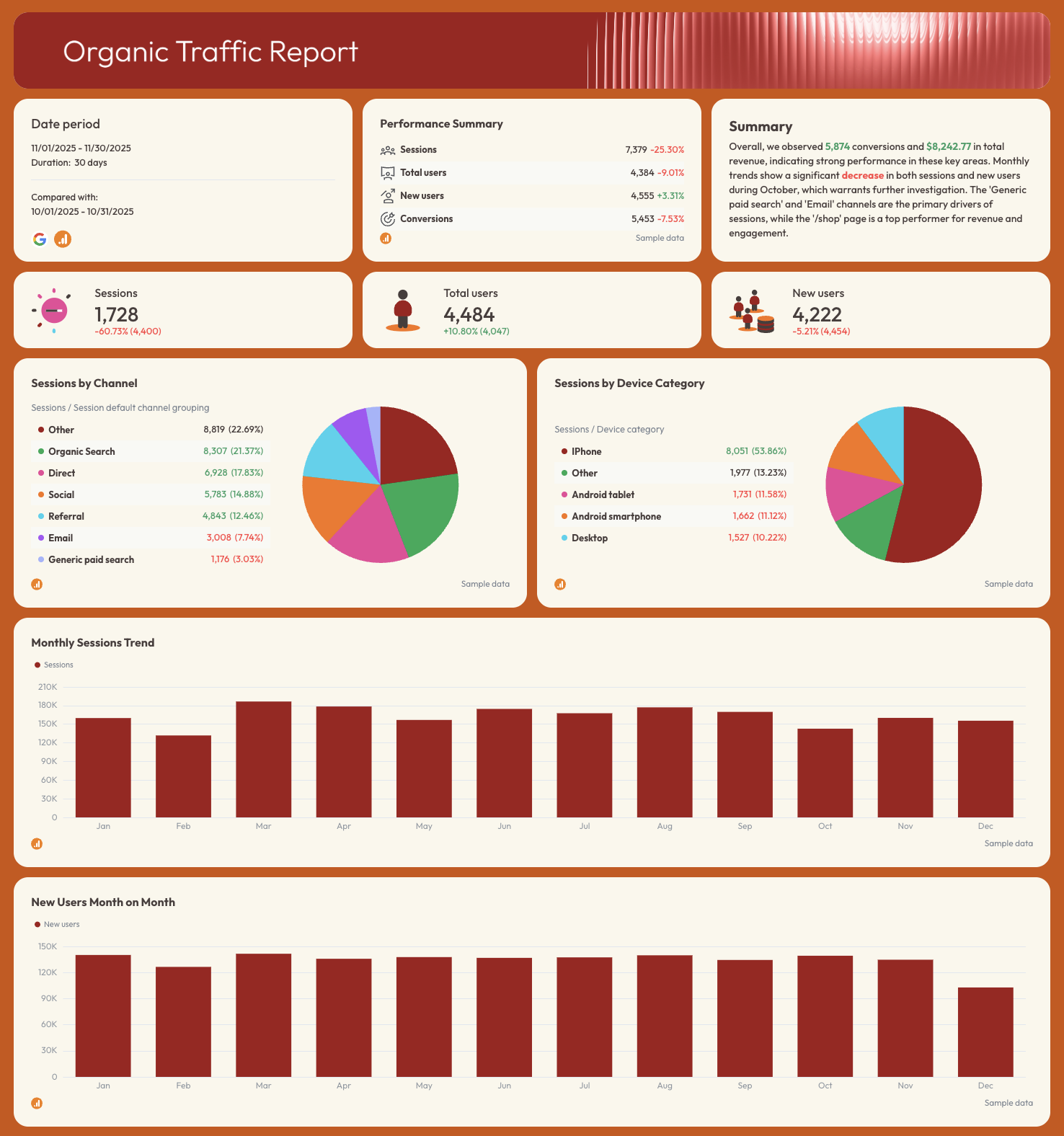
Organic Traffic - Dashboard with charts showing website traffic metrics.

Organic Traffic explains who is visiting the site from search engines and what they do once they arrive. It connects your keyword and content work to actual on-site behavior.

What to include:

  • Summary KPIs:
    • Sessions
    • Users
    • New users
  • Traffic by source and medium:
    • Organic
    • Referral
    • Email
    • Social media
    • Paid search
  • Sessions by device (desktop, mobile, tablet)
  • Monthly trends in sessions and new users
  • Top landing pages by:
    • Sessions
    • Engagement rate
    • Traffic source

In-house marketers use this to validate their content strategy, while agencies use it to show ROI from SEO work.

4. Organic Conversions
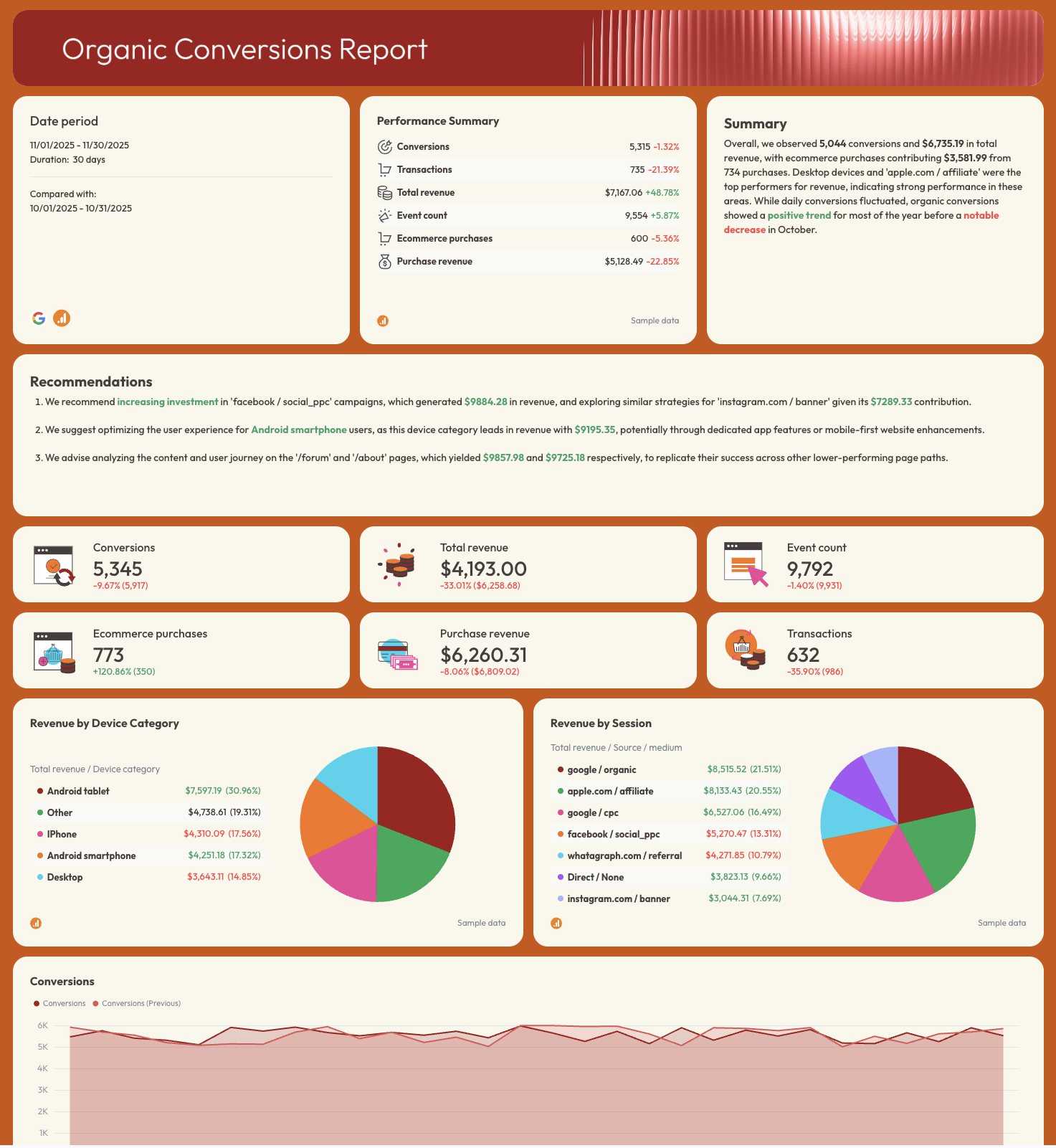
White Label Seo Report - Organic conversions report showing charts, metrics, and recommendations.

This section ties everything back to the bottom line. It focuses on SEO’s impact on leads, purchases, and revenue—making it critical for both retention and growth.

What to include:

  • Conversion KPIs:
    • Total conversions
    • Transactions
    • Revenue
  • Trends over time:
    • Daily and monthly conversions
    • Revenue growth charts
  • Breakdown by:
    • Device
    • Channel
    • Landing page
    • Demographics (city, age, gender)
  • Content performance grouped by:
    • Page path
    • Content type
  • Recommendations and annotations explaining spikes or dips

This section ties SEO metrics to business outcomes, proving value to CFOs, CMOs, and clients alike.

Connect All Your SEO Accounts and Data Sources in One Place

Bring all your SEO and marketing data into one place with no-code, stable connectors that you don't need to babysit. 

Why Marketers Love Reporting on Whatagraph

Whatagraph's AI is saving so much time and energy for our marketing specialists. We now have more time to focus on strategic things that help both our agency and our clients grow.

Lars Maat

Lars Maat

Co-Founder @ Maatwerk Online

StarStarStarStarStar

Whatagraph has become an essential partner for scaling our reporting, and my teams love it because it saves so much time. We’d recommend it to any team looking to automate data reporting and use AI for insights.

Danielle Roberts

Danielle Roberts

Director of Implementation & Support @ Rentable

StarStarStarStarStar

Whatagraph took us to the next level with our clients and within our team. Our relationships with clients have been amazing, and we’ve even been able to retain them longer.

Kim Strickland

Kim Strickland

Digital Marketing Specialist @ Peak Seven

StarStarStarStarStar

Whatagraph is easy to use, visually attractive, and much smoother compared to tools like Looker Studio. It helped us not only get clients on board but also keep them within the agency.

Stef Oosterik

Stef Oosterik

Quality Manager @ Dtch. Digitals

StarStarStarStarStar

Frequently Asked Questions

Have more questions? We answered them below.

Why is white label SEO reporting important?

White label SEO reporting allows agencies and in-house teams to present results under their own brand instead of exposing third-party tools. 
 

It helps communicate SEO performance clearly using branded reports that include organic traffic, keyword rankings, backlinks, and conversions. 
 

This makes reporting more credible, easier to understand, and better aligned with business outcomes. It also reduces time spent maintaining spreadsheets and manual reporting workflows.

What is a Semrush report template?

A Semrush report template is a pre-built reporting layout that pulls SEO data directly from Semrush. It typically includes keyword rankings, referring domains, backlink data, site audit findings, and visibility metrics. 


These templates are often used as a starting point for SEO analysis and can be combined with other data sources inside a broader reporting setup.

What are the benefits of using a Semrush report template?

A Semrush report template saves time and keeps SEO reporting consistent for your SEO agency or in-house SEO team. 


It provides structured access to keyword research, rank tracking, and backlink insights without rebuilding reports from scratch. 


When used inside a white label SEO reporting tool, it becomes easier to turn raw SEO data into clear visualizations and client-ready PDF reports or dashboards.

How can white label SEO reports benefit digital marketing agencies?

White label SEO reports help digital marketing agencies deliver professional, branded client reports that reinforce perceived value. 
 

They allow agencies to show SEO performance, technical SEO progress, and campaign results in a consistent format across all clients. 
 

Automated reports reduce manual work, improve accuracy, and free up time for strategy, optimization, and client communication. This directly supports retention and upsell conversations.

How do I choose the best white label SEO reporting tool for my agency?

The best white label SEO reporting tool supports direct integrations with Google Analytics, Google Search Console, Semrush, and Ahrefs. 


It should allow full branding control including logos, fonts, headers, and a custom domain. 


Look for automated report delivery, real-time dashboards, reusable report templates, and the ability to manage multiple SEO clients in one place. Strong visualization and reliable data syncing are also critical.


Some of the best SEO reporting tools include:


- Whatagraph


- Looker Studio


- Databox 


- AgencyAnalytics


- DashThis

What key features should a white label SEO report template include?

A strong white label SEO report template should include sections for organic traffic, keyword rankings, backlinks, technical SEO, and conversions. 


It should highlight key metrics such as impressions, CTR, rankings, and revenue impact using clear graphs and tables. 


Essential features include branded reports, automated reporting, flexible customization, and integrations with core SEO tools. The goal is to simplify SEO data while still supporting detailed analysis and actionable insights.