



- Key takeaways
- What is agency client onboarding, and how does it help with retention?
- Agency client onboarding checklist: how to effectively onboard a new client from signed contract to day 90
- What are the best practices for agency client onboarding, and what are common mistakes to avoid?
- How do you measure client onboarding success and collect client feedback?
- How do you scale client onboarding as your agency grows?
- Final thoughts
Client onboarding at your agency isn’t just an admin task you need to check off your list.
It’s the most important factor that influences whether a new client stays for years or churn by the 6-month mark.
At least that’s what eight marketing agency leaders told us. In this article, we share their insights on:
- A 24-step agency client onboarding checklist, from signed contract to day 90
- 7 best practices agency leaders recommend
- How to tell whether onboarding worked, and how to scale it as your agency grows
Want something tangible right away? Use this free interactive client onboarding portal (built with Whatagraph) to onboard your new client. Or skip to the best practices.
Key takeaways
TLDR
- Agency client onboarding is where a new client decides whether to trust you. In the first few weeks, they find out whether you understand their business, whether your team is prepared, and whether you can deliver value, fast.
- The right onboarding process can help with client retention. In Setup's 2025 Marketing Relationship Survey, clients cite dissatisfaction with delivery (61%), dissatisfaction with value (61%), and “agencies don’t understand our business” (44%) as the top reasons why they churn. A structured onboarding addresses all three.
- We asked eight agency leaders their onboarding process and most say there are four stages: before the kickoff, kickoff and discovery, first 30 days, days 31 to 90.
- Agency client onboarding best practices include briefing your team about the new client before the kickoff, asking for access on day 1, treating the kickoff as a working session, learning how the client makes money, verifying conversion tracking, building reporting for each stakeholders, and setting expectations about pace, then delivering one early win.
- Most onboarding mistakes come from rushing (pitching the agency in the kickoff, relying on an intake form, or launching campaigns before you understand how the client makes money).
- You can tell onboarding is successful when the client goes live quickly, trusts the numbers you report and stays past the first 90 days.
- To scale onboarding, write the process down, automate the setup that repeats (like connecting accounts and building the first reports) with Whatagraph IQ Agents, and keep the conversations with the client personal.
What is agency client onboarding, and how does it help with retention?
Agency client onboarding is the process of welcoming a new client into your agency, understanding their business, getting access to platforms, agreeing on goals, and creating reports for stakeholders.
It's also the client’s first taste of how it feels like to work with you and a great opportunity to build trust.
Gareth Bull, Founder of Bulldog Digital Media says:
“Onboarding is a vital step for retention and client happiness as it’s their first actual experience after signing the agreement they will get."
However, onboarding is also where things can go wrong. Jessica Bettis, Director of Strategy at Candour, says the first months of starting with a new client carry the most risk:
“Churn risk is typically highest in the first six months, and a rushed or narrow start is a big reason why.”
In fact, Setup's 2025 Marketing Relationship Survey found that 79% of agencies think clients churn because of “budget cuts” (the largest reason), whereas only 39% of clients say this is the case.
The biggest reasons clients give for churning are:
- Dissatisfaction with delivery (61%)
- Dissatisfaction with value (61%)
- “Agency didn’t understand our business” (44%)
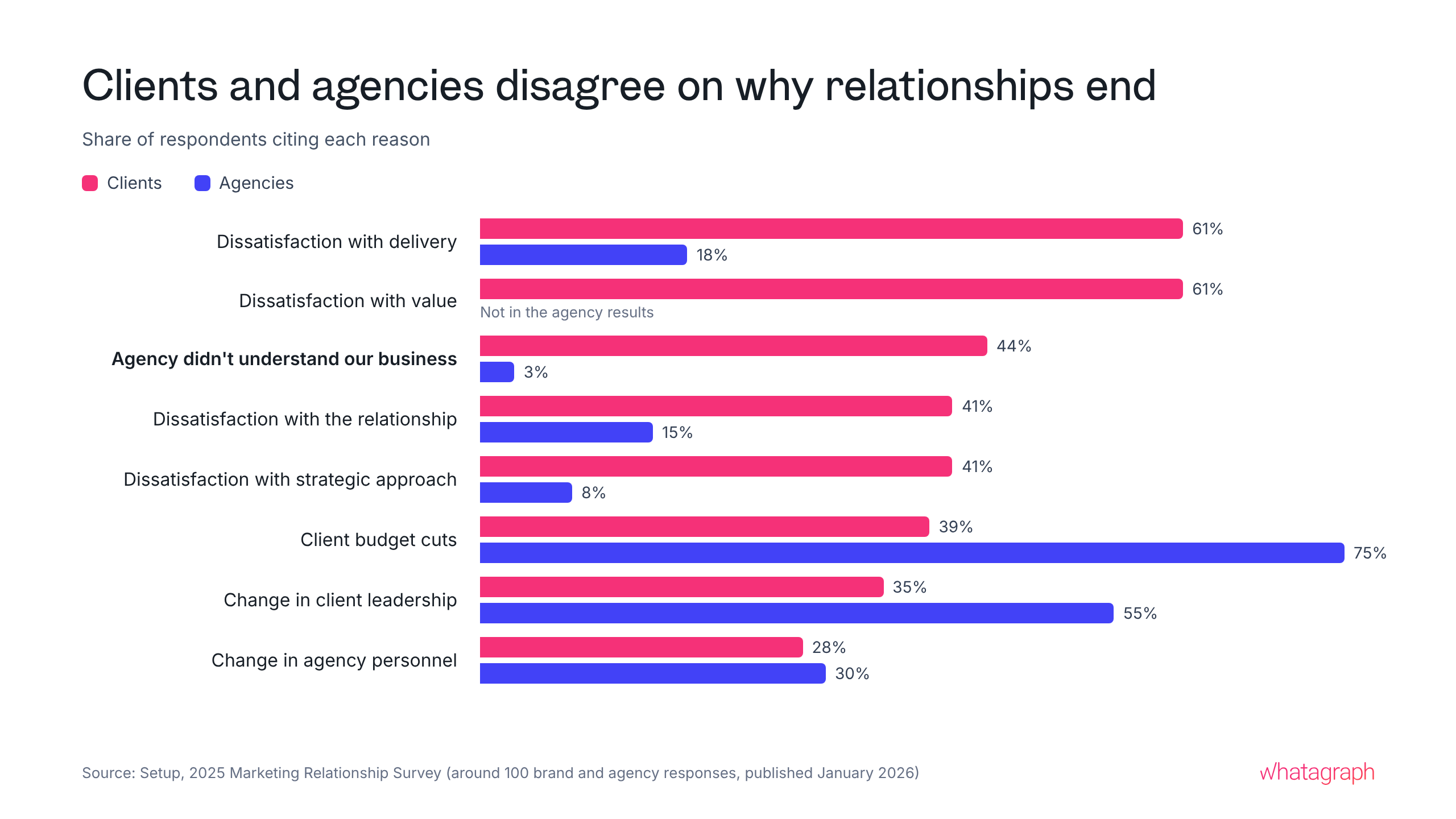
All three of these reasons can be mitigated by a client onboarding process that covers all these grounds in the first 30 days of signing a new client.
Robin Dimond, CEO & Founder of Fifth & Cor, says it best:
“The strongest client relationships aren't built on deliverables alone. They're built on trust, transparency, shared accountability, and a genuine investment in each other's success. This is why we take the time to understand not just what a client wants to accomplish in onboarding, but why those goals matter and how their business actually operates.”
In the following section, we’ll share insights on how to do exactly this so you successfully onboard a new client (or clients), and keep them at your agency.
Agency client onboarding checklist: how to effectively onboard a new client from signed contract to day 90
We asked eight agency leaders how they onboard new clients so they can prove they understand their business and can deliver value. The process typically runs in four stages:
- Preparing before the kickoff call
- The kickoff itself
- setting up tracking and reporting in the first 30 days
- showing progress in days 31 to 90
| Stage | When | Owner | Done when |
|---|---|---|---|
| Before the kickoff | Week 0 | Account lead, with sales | The team knows what sales learned, and access requests are out |
| Kickoff and discovery | Week 1 | Account lead and the account team | The client has confirmed your notes on their goals, sign-off and how they make money |
| First 30 days | Weeks 1 to 4 | Channel specialists | Tracking is verified, a baseline is recorded and the first report is built |
| Days 31 to 90 | Months 2 and 3 | Account lead | The client has seen an early win and reviewed the first reports with you |
Every step on this checklist does one of two jobs: it shows the client you understand their business, or it gets them value early (and proves it), which builds trust, which then leads to retention.
Here’s a checklist compiled from what they told us:
Before the kickoff call
- Record every client call, including the sales calls, and save the transcripts where the whole account team can read them
- Brief the delivery team on everything sales learned during the sale (the sales handoff)
- Set up the project, folders and Slack channel from the signed scope of work
- Send access requests for ad accounts, analytics, billing and verification with the welcome email or welcome package
- Send the client the names of their team and a timeline for weeks 1 to 4
- Invite everyone who'll work on the account to the kickoff meeting
Kickoff and discovery
- Ask who signs off on your work on the client side
- Ask what a good month looks like for the client's CFO
- Ask what went wrong with the client's last agency
- Ask how the client makes money and how their customers decide to buy
- Map the client's stakeholders: who your contact reports to, who else needs updates, how often and in what format (your communication plan)
- Run a second session on the client's brand, creative and taste, separate from the one on performance and goals
- Summarize what you learned back to the client and get them to confirm it before you start any audit
First 30 days
- Audit conversion tracking: GA4 (Google Analytics 4), Google Tag Manager, cookie windows across ad platforms, and the handoff of leads to the CRM
- Fix broken or double-counted conversions before you change any bids or budgets
- Record a baseline for every agreed goal and the KPIs you'll report on
- Define success for each stakeholder, for example rankings and conversions for marketing, ROI for finance
- Benchmark AI visibility for SEO clients: which sources ChatGPT, Gemini and AI Overviews cite for the client and its competitors
- Build a report view for each stakeholder
- Agree approval routes, including a fast sign-off for anything time-sensitive
Days 31 to 90
- Deliver one early win and show it to the client
- Report leading indicators, not only lagging ones
- Explain which work is foundational, which shows early signals, and when to expect commercial results
- Review the first reports with the client and adjust the setup to the questions they actually ask
- Review the onboarding with your team and update this checklist for the next client
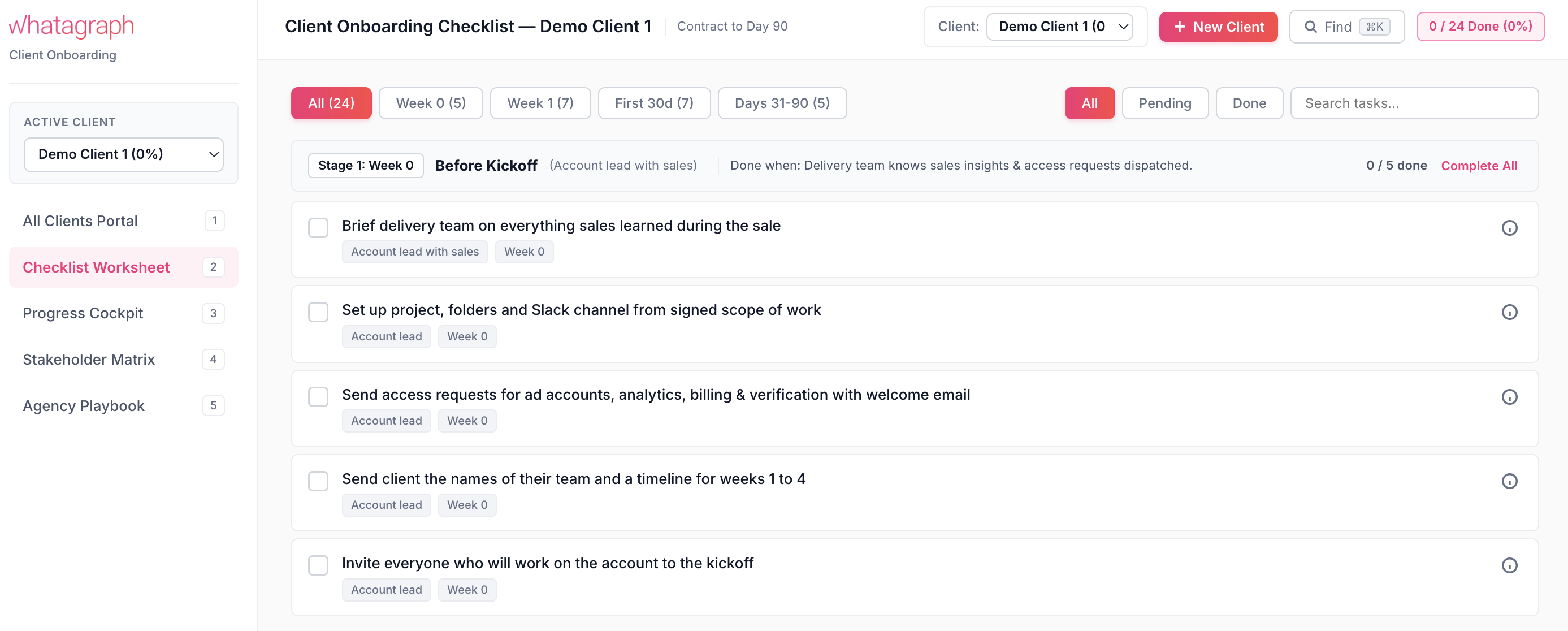
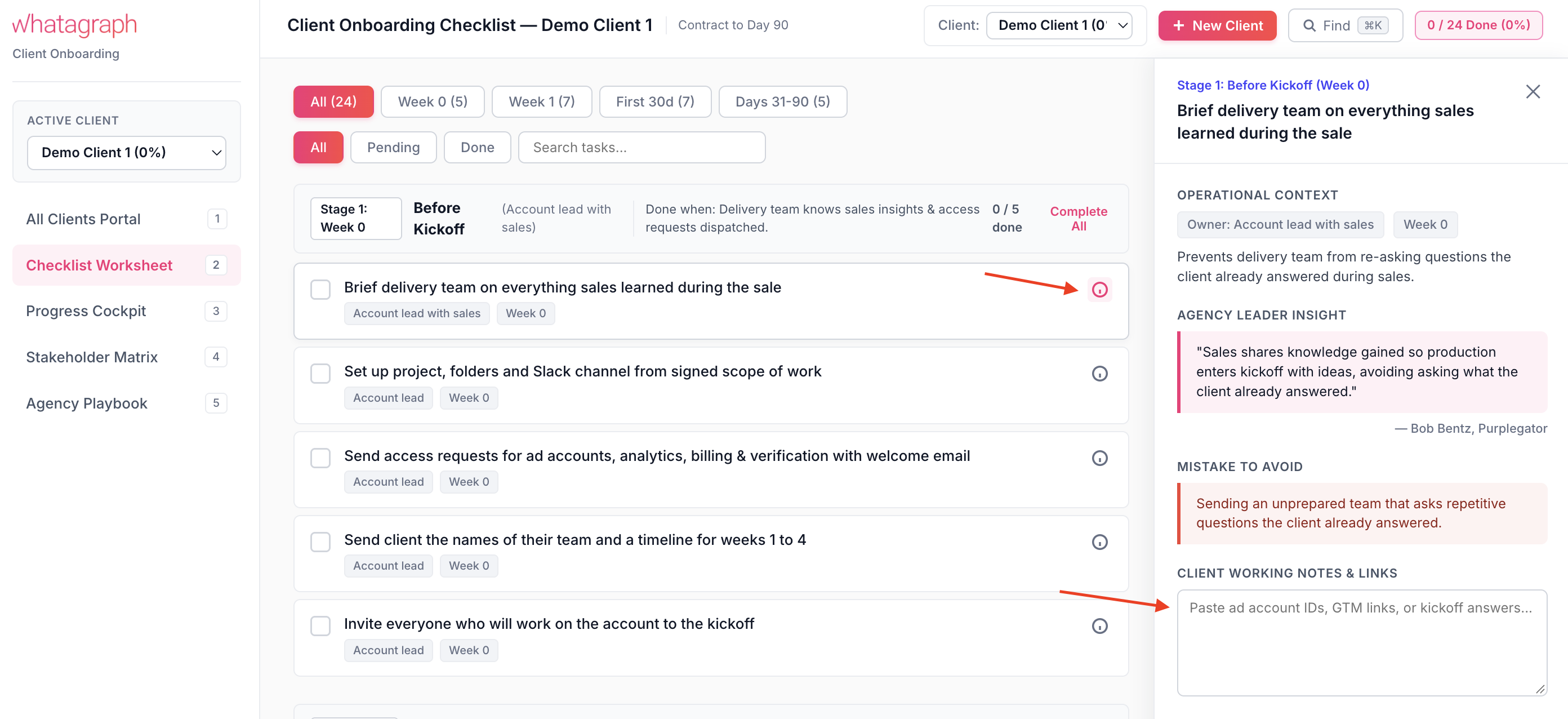
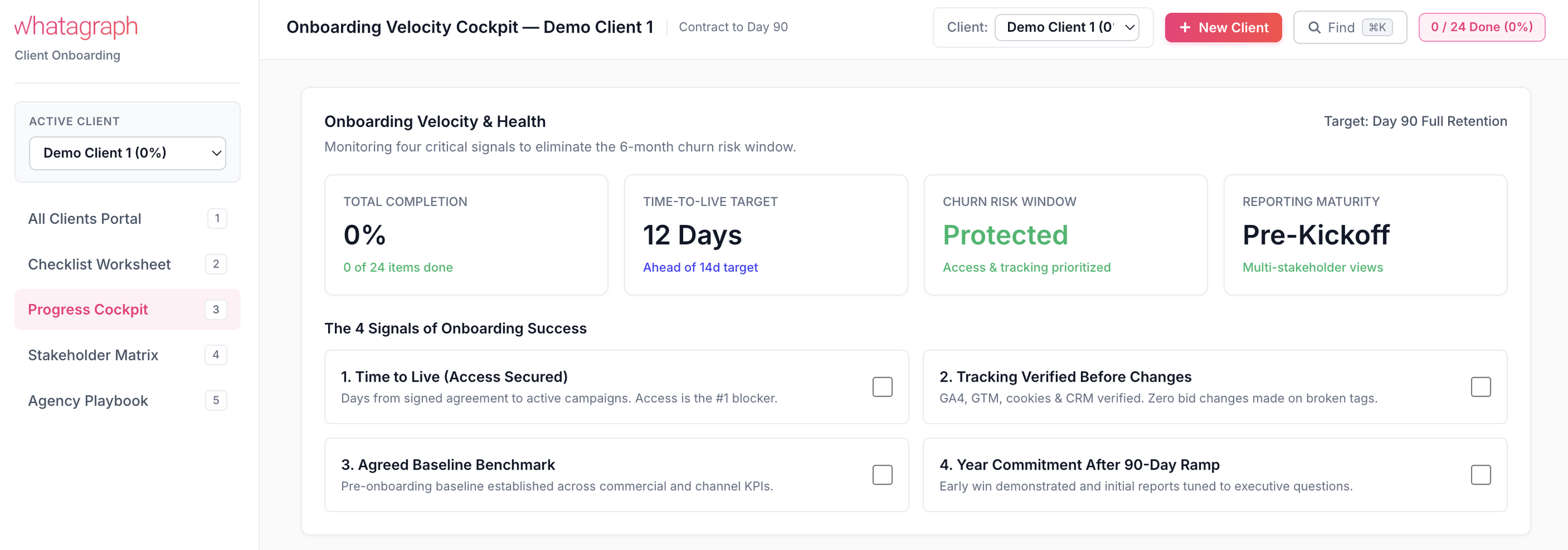
Want something more tangible? I created an entire client portal using Whatagraph IQ Agents where you can:
- See all your clients in one place, with each one's account lead, service scope, current stage and progress
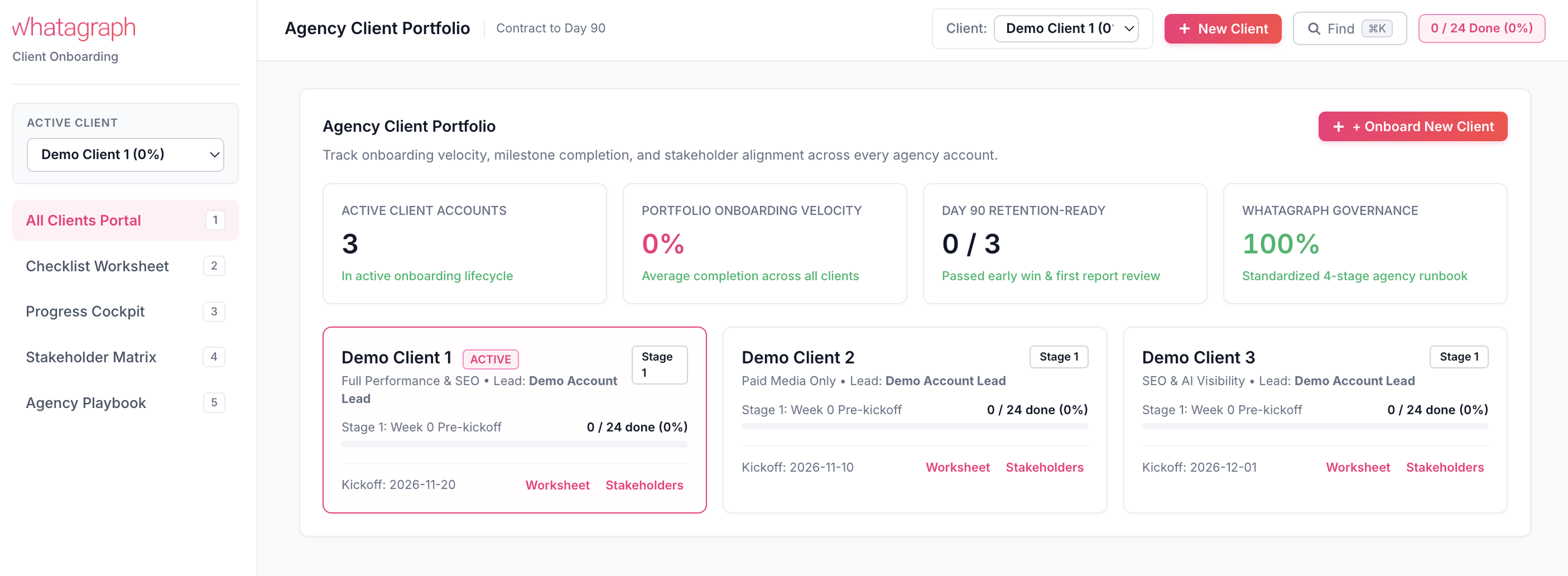
- Check off items on the onboarding list and track your progress
- Click any step to see why it matters, what the agency leaders said about it, the mistake to avoid, and your own notes for that client
- See completion rates and average kickoff timelines across every client, and flag accounts at risk of churning early
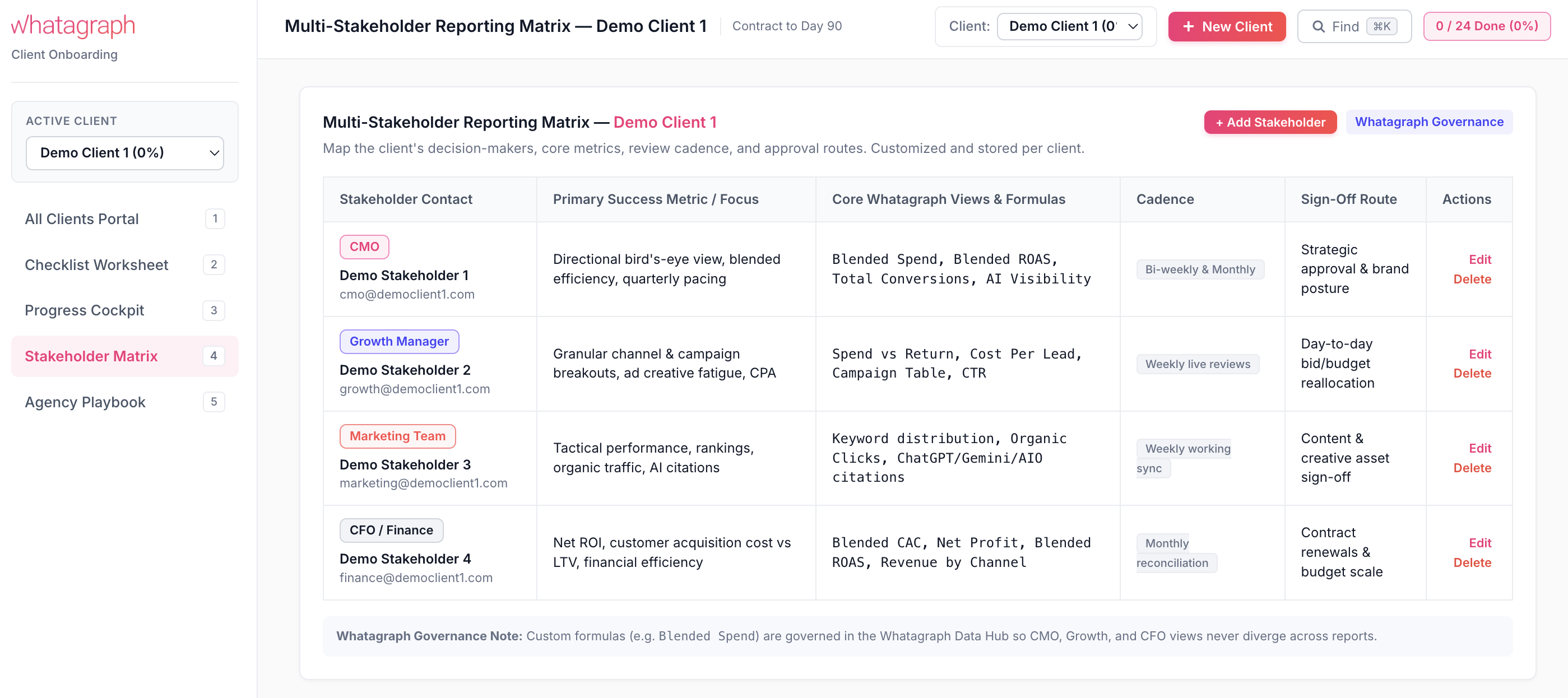
- Plan what each stakeholder (CMO, growth manager, marketing team and CFO) needs to see in their reports, how often they review them and who approves what
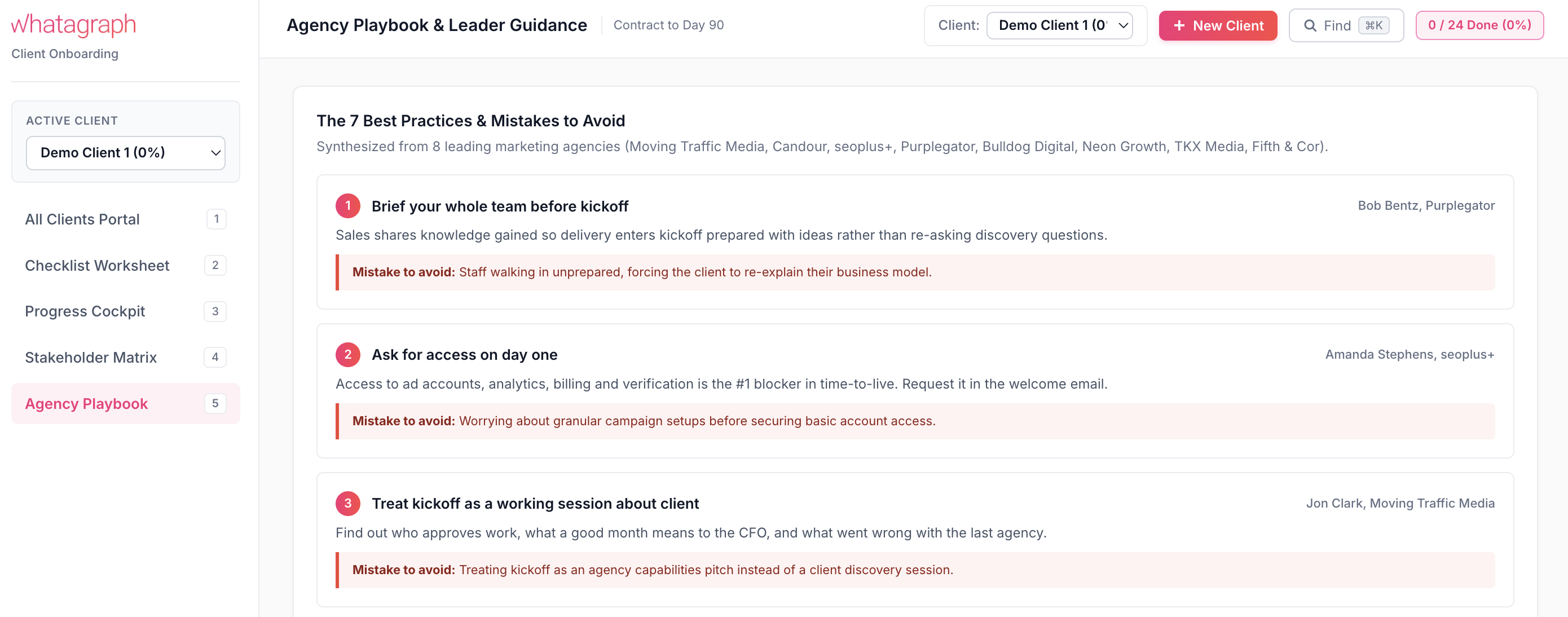
- Read all the agency leaders' advice in one playbook
How long should client onboarding take?
This depends on how much of the client's marketing you're taking on. Here's how three of the agencies we got insights from plan it:
- Four weeks. Bulldog Digital Media gives every new client a timeline of what to expect in weeks 1 to 4.
- Two weeks. Moving Traffic Media gives every new client the same first two weeks, whether or not Jon Clark, its Managing Partner, is in the room.
- 90 days. TKX Media runs a 90-day on-ramp, then asks clients to commit to a year. As Tim Jones, its Co-Founder and CEO, puts it: “Within six months, you should know if this is gonna work.”
Candour agency doesn't set a number of weeks. It splits onboarding into four stages instead: set up and alignment, auditing and discovery, strategy and roadmap, and early delivery and momentum.
Light vs extensive onboarding: which does a client need?
It depends on the client and the service.
seoplus+ is the clearest example. Amanda Stephens, its VP of Operations, says the team auto-deploys an onboarding blueprint “customized to the specific paid ads platform and campaign type,” so a brand-new ad account gets a different set of tasks than a client resuming old campaigns.
Some services add steps of their own. For digital PR clients, Bulldog Digital Media agrees early on who can give expert comments and how they get signed off, because journalist requests usually want comments within hours.
In our view, a client with one channel and one decision-maker can run a lighter version of the checklist: access, tracking, a baseline and the first report. A client with several stakeholders, regions or approval layers needs every step, especially the stakeholder map and the approval routes.
What are the best practices for agency client onboarding, and what are common mistakes to avoid?
Here are the seven best practices agency leaders told us:
- Record every conversation and share it with the whole team
- Ask for access on day one
- Treat the kickoff as a working session about the client
- Learn how the client makes money before you pick tactics
- Verify conversion tracking before you change anything
- Build reporting for each stakeholder
- Deliver one early win, then explain what comes next
Each practice tackles one of the reasons clients gave Setup for leaving: an agency that doesn't understand their business, or not seeing value from the work.
Let’s dig into each.
1. Record every conversation and share the full context with the entire team
44% of clients in Setup's survey said they left because the agency didn't understand their business. The fastest way to show you do, is to have the entire team know the full context before you even go into your kickoff call.
Bob Bentz, President of Purplegator, says the internal brief before the kickoff is often the most important part of onboarding:
“This is where the sales team shares the knowledge they have gained initially so that the production team goes into that kickoff call with knowledge and great ideas.”
Skip it, and you get the mistake Bob sees most, “when the staff is not prepared and they ask the same questions that the client has already heard from the sales team.” The client notices this and thinks “this team isn’t prepared”, and that hurts trust, a lot.
His one piece of advice to agency owners:
“Your staff is busy, but don't ever skip the internal brief prior to the onboarding call. First impressions are incredibly important in this business.”
Make sure you brief everyone who’ll work with the client before going into the kickoff call, and come with a written presentation on what you’re going to work on. As Bob puts it, “That shows that you did your homework and were prepared.”
Jon Clark, Managing Partner at Moving Traffic Media, has built an entire agentic workflow to brief his entire team. The agent:
- Reads the signed scope of work with the client
- Spins up the Asana project from a selection of project templates
- Modifies the options to match the signed SOW line items
- Creates the client folders in Google Drive, the Slack channel, the kickoff deck, and the engagement brief.
Clark says:
“Nobody on our team is guessing what's in scope in week one. More importantly, this has been huge for us in minimizing inconsistencies. All the folder and file names follow the same naming conventions, etc.”
💡Did you know? You can build an entire client onboarding workflow on Whatagraph with IQ Agents. All you need to do is connect Asana, Slack, Google Drive, and any other tool you want to use through our pre-built connectors, and prompt in plain language the workflow you want to build.
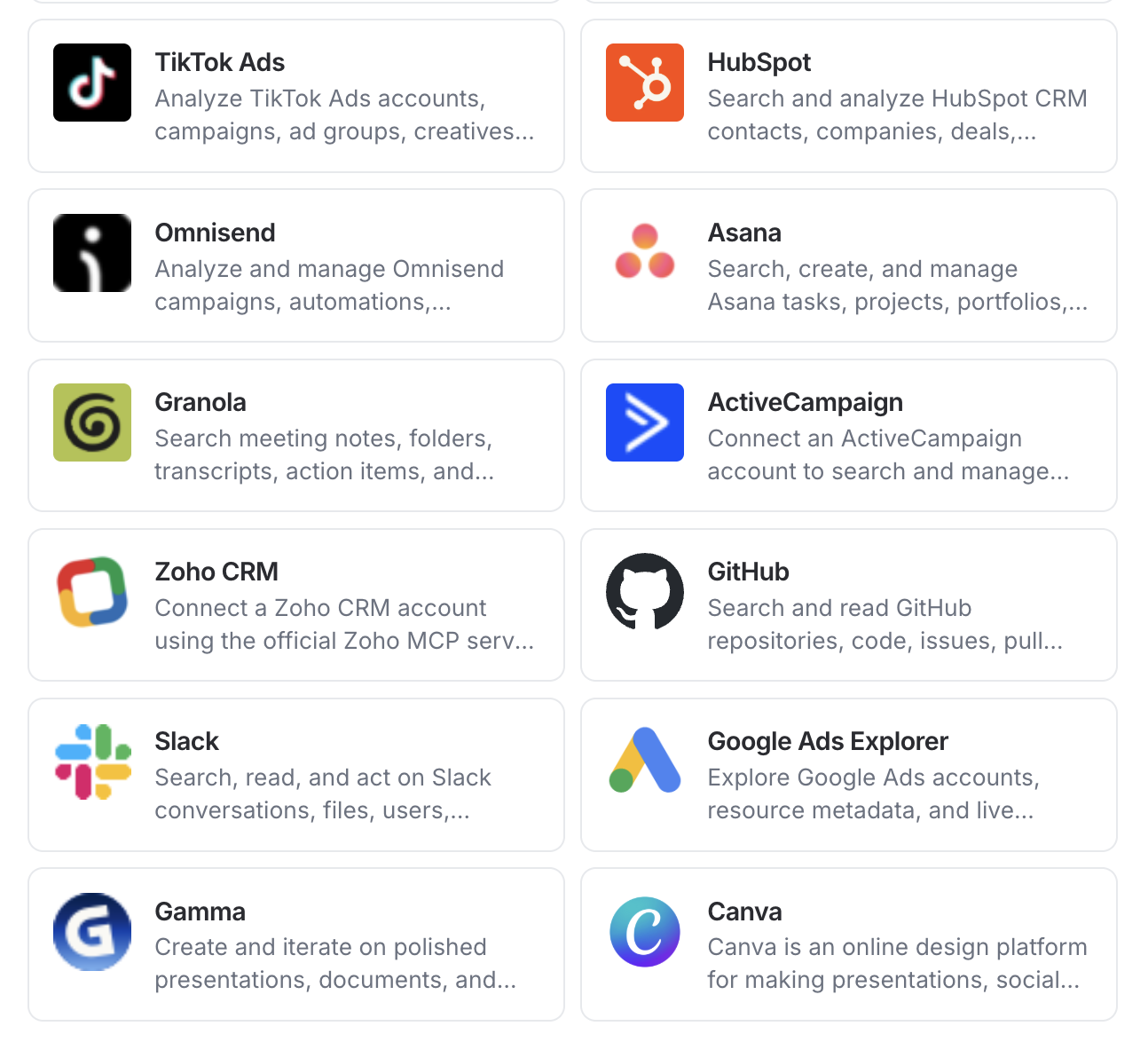
The best part: everything in Whatagraph IQ Agents is shared, conversations, connections, and agents, so your entire team can access them and context is shared instantly.
2. Ask for access on day one
Access seems like a small administrative task until it’s week 2 and you still haven’t moved the needle for the client because you still don’t have access to their platforms.
Amanda Stephens, VP of Operations at seoplus+, calls access to the ad account, billing and verification details “the biggest blocker in time-to-live” and getting it “a high-impact, low-effort way to secure fast wins.” Without a process, she says, “you might still be chasing login credentials or verification details 60 days in.”
She also sees agencies get the order wrong, worrying about “the exact audience profile for campaign #6 when you haven't even secured access yet.”
Gareth Bull, Founder of Bulldog Digital Media, avoids that by asking for access to everything on day one, so he can get to work immediately.
We recommend asking access for all the necessary platforms in your onboarding email and following-up through Slack or any other faster communication channels.
3. Treat the kickoff as discovery, not as admin
Most agencies usually have a kickoff call with a new client and it’s the first time the client sees whether you understand the business well.
Amanda Stephens' rule:
“Make it about the client, not you. Make them feel heard and understood, not like they're about to enter an assembly line, cookie cutter process.”
Jon Clark, Managing Partner at Moving Traffic Media, structures their kickoff calls so he gets three answers:
“The kickoff is where you find out who actually approves things, what 'a good month' means to the CFO, and what got the last agency fired. If we leave the conversation without those three answers, we're not doing our job, and it can lead to tough conversations in month three and beyond.”
But Gareth Bull, Founder of Bulldog Digital Media, sees agencies treat onboarding as admin, when it's the client's first real experience of working with them. His team makes sure “the client knows exactly who to speak to, proper introductions are had, and a timeline of what to expect in weeks 1-4.”
He also asks about the last agency:
“Be confident to add a section to your onboarding to find out what went wrong with their last agency, and why they feel this won't happen again. This will tell you exactly what they're worried about and what they're focused on.”
But how do you get answers like these? Not from a form (or not only from one). Amanda Stephens at seoplus+ stopped relying on questionnaires because “Clients are too busy to fill out a generic questionnaire and give meaningful insights.”
Rosie Osmun, COO at Neon Growth, also warns against “asking clients to submit an onboarding form and assuming the job is done.” As she puts it, “The real gems and insights come from collaborative discussions.”
If you do send a form, use it for the basics and save the important questions for a call or a face-to-face meeting.
For instance, Candour agency sends a business context questionnaire, then holds a discovery session where the team plays back what it understood and the client confirms it before the audit starts.
And Neon Growth has two separate conversations with each client: one session on performance history and goals, and a second on creative, brand and taste.
4. Learn how the client makes money before you pick tactics
This is a continuation of #3, kickoff and discovery.
Understanding the client's business means knowing how it makes money, so every piece of work you plan ties back to a business result. As Jessica Bettis, Director of Strategy at Candour, puts it, “Search performance only matters if it supports revenue, growth or efficiency.”
Robin Dimond, Founder and CEO of Fifth & Cor, has one piece of advice for agency owners:
“Stop onboarding clients into your services and start onboarding your agency into their business.”
Candour treats onboarding as “the first phase of discovery, not admin.” The team starts with what Jessica calls “the business behind the brief”:
- how the client makes money
- the journeys their customers take to buy
- where the pain points are
- who they're up against
When agencies skip this step, they fill the first weeks with work the client didn't need. “Agencies often confuse activity with progress,” says Robin. “They rush to demonstrate value by launching campaigns, producing content, or generating reports before establishing whether those activities actually support the client's business objectives.”
Robin adds:
“A campaign can generate impressive impressions, clicks, or engagement while contributing very little to meaningful business growth. If an agency hasn't established what success looks like during onboarding, it becomes incredibly difficult to demonstrate its value later.”
Jessica sees the same thing in agencies that “collect access, run the audit and talk to the developers, but never understand how the business makes money or who inside it can speak to the customer. The result is recommendations that are technically right but commercially thin.”
5. Verify conversion tracking before you change anything
You can't prove the value you deliver if the numbers are wrong, and in a lot of accounts they are (double-counted conversions are a classic).
“We don't touch a single bid or budget until we've verified conversion tracking,” says Jon Clark. He'd bet half of the “optimizations” his team makes in month one are fixes for broken or double-counted conversions. In the first 30 days, they audit:
- GA4
- Google Tag Manager
- Cookie window consistency across the ad platforms
- The handoff of leads into the client's CRM
Gareth Bull sees the same thing: “It's common that accounts we look at will have broken conversion tracking, and if we don't work on getting that fixed early on, every report you send for the next year is built on bad data.” Fixing it first also means the client and the agency look at the same numbers from the start.
For SEO and digital PR clients, Gareth's team also benchmarks AI visibility in the first month: which sites ChatGPT, Gemini and AI Overviews cite for the client's competitors. Those become the first publications they go after for links and coverage.
6. Build reporting for each stakeholder
Value only counts if the right people see it, and different people on the client side look for it in different numbers. One report rarely answers what each of them needs to know, which is why it’s important to build separate reports for each stakeholder.
Rosie Osmun, COO at Neon Growth (a Whatagraph customer) builds a separate view for each one:
“The CMO might want the directional bird's eye view while the Growth Manager wants detailed channel/campaign breakouts, while the CFO wants ROI-focused reporting. We make sure we understand exactly what key stakeholders need to see and build custom views.”
Neon Growth builds these views in Whatagraph. In Rosie's words, Whatagraph makes it possible “to build a full suite of dashboards as simple or complex as our clients need them across every channel and data slice we can think up.”
In Whatagraph, you define a metric like ROAS once as a custom metric, and every report and dashboard built on it uses the same formula. You can also keep each client's reports updating on a schedule, with a person signing off before anything goes out.
Rosie's goal is what she calls “decision grade data”: reporting about “not just what happened but where to go next.”
This guide on marketing agency reporting dives deeper into which metrics to report and how to structure a high-value report.
7. Deliver one early win, then explain what comes next
Clients judge your value long before the big results arrive. Bob Bentz puts it plainly:
“Let's face it. [Clients] are nervous about hiring an agency and winning early is very important.”
An early win gives the client confidence while the bigger work takes shape:
- Purplegator looks for a win like fixing title tags and showing first-page rankings, or getting the client cited by AI.
- TKX Media aims to “deliver one high impact outcome fast,” and reports leading indicators that show what's likely to come, not only lagging ones.
Then explain what comes next. Jessica Bettis says that if the agency hasn't explained “the difference between foundational work, early signals and commercial outcomes, the client starts doubting the work just when it matters most.”
Candour also tells clients up front that some of the most valuable early work happens behind the scenes, so the first months don't feel like a black box.
Where agencies go wrong here is in what they don't show. “The most common mistake is a lack of transparency, and most clients will cancel when they can't clearly see what they're getting month to month,” says Tim Jones.
Jessica adds that clients feel the pressure early: “Clients are making an upfront investment, stakeholders are watching, and results haven't had time to compound.” So report progress every month, including the foundational work the client can't see yet.
How do you measure client onboarding success and collect client feedback?
Onboarding has worked when the client goes live quickly, trusts the numbers, and stays past the first 90 days. From the seven practices we saw, this means:
✅ You went live within two to four weeks of signing.
✅ You have access to every ad account, analytics tool and billing setup you need.
✅ Conversion tracking is verified, so you and the client look at the same numbers.
✅ You have an agreed baseline of what success looks like and what are the north-star metrics you’ll track and report on.
✅ You’ve delivered and proven one small win within the first 60 days.
✅ The client has confirmed your notes on their goals, who signs off and how they make money.
✅ The client has committed past the first 90 days (TKX Media asks clients to commit to a year after its 90-day on-ramp).
But the best way to understand how the onboarding process went is to ask the clients directly. You can collect feedback in conversation, at two points:
- During onboarding, play back what you learned and get the client to confirm it, the way Candour does before its audit starts.
- After onboarding, review the process with the client and your team. As Amanda Stephens says, “Don't assume you have the perfect onboarding process. Talk to Clients and talk to your team.” Then update the process: “Remove tasks that don't move the needle. Push up activities that do.”
How do you scale client onboarding as your agency grows?
When we asked how onboarding changed as they grew, four of the eight agencies gave the same answer: it moved out of people's heads and into documented, templated and automated processes.
Robin Dimond, Founder and CEO at Fifth & Cor, says:
“Scaling an agency requires repeatable processes, clear internal communication, and accountability, but clients should never feel like they're being pushed through a standardized system.”
But automating processes shouldn’t be at the expense of losing personalization and that “human touch”. According to Dimond:
“As agencies grow, the challenge is maintaining the same level of strategic attention and relationship-building while introducing the systems necessary to support a larger team and client portfolio. Processes should make the client experience more thoughtful and efficient, not less personal.”
Manual vs automated client onboarding: what changed as these agencies grew
This is why the best agencies automate the setup that repeats for every client, and keep people on the conversations (the kickoff, the playback, the first report review). Here's how they do it:
- Moving Traffic Media wrote it all down. At three or four people, Jon Clark says onboarding “mostly lived in our heads.” At 20+ people, it's “written down, highly templated with detailed SOPs, and automated when possible.” An agentic workflow now reads the signed scope of work, sets up the Asana project from a template, and creates the client's Google Drive folders, Slack channel, kickoff deck and engagement brief. “Nobody on our team is guessing what's in scope in week one.”
- seoplus+ automated its task list. Amanda Stephens' team used to assign onboarding tasks by hand, which led to missed tasks and wrong due dates. Now they auto-deploy a blueprint with every task, subtask and dependency in order. She calls the change “nearly unrecognizable.”
- Candour documented what it learns. Jessica Bettis' team stores onboarding knowledge in Scoro, “so that knowledge isn't lost in inboxes or one person's head.”
- TKX Media records every conversation. Each call transcript goes into a project knowledge base, with a separate project for each service the client buys.
The data and reporting setup is the part of onboarding that repeats the most: connect the client's ad accounts, tag them, build the report from your template and file it. In Whatagraph, an IQ Agent can set up a new client's data and reports from one prompt.
A UK PPC agency onboarded a client this way in one minute on the first run, and a specialist still checks the report before the client sees it. Because IQ Agents are shared across the whole team, the setup doesn't live in one person's head either.
Which tools help agencies onboard clients?
These are the tools the agencies we spoke to use, by the job they do:
| Job | Tools | Who uses them |
|---|---|---|
| Project setup and task tracking | Asana, Scoro | Moving Traffic Media, Candour |
| Files and communication | Google Drive, Slack | Moving Traffic Media |
| Tracking and measurement | GA4, Google Tag Manager, Search Console | Moving Traffic Media, Bulldog Digital Media, Candour |
| Client knowledge | Call transcripts in a project knowledge base | TKX Media |
| Client reporting, marketing analytics, and optimizations | Whatagraph | Neon Growth |
If you're comparing onboarding software, most tools do one of three jobs:
- Task lists and SOPs: project management tools like Asana, ClickUp and Monday.com for task management
- Access and documents: tools like Leadsie for ad account access, and Content Snare or Typeform for intake forms
- Data and reporting: platforms like Whatagraph that connect the client's accounts and build the first reports
Whichever client onboarding software you choose, check that it connects to the rest of your tech stack, like your project management software, Slack and your reporting platform, so tasks and data don't have to be copied between tools by hand.
For a wider comparison, see our guide to marketing agency reporting tools.
Final thoughts
Onboarding is how a new client finds out whether they can trust you. Get access early, ask about the business before the tactics, fix the tracking, report to each stakeholder, and show one early win by day 90.
Jessica Bettis sums up why it matters:
“Clients trust an agency that gives them the honest answer rather than the easy one, and that trust is what creates a sustainable long term partnership.”
Once onboarding is done, monthly reporting takes over. GKV's two-person analytics team uses IQ Agents to draft monthly reports for 12 clients, and now gets them out in 1 to 2 weeks instead of 3 to 4.
If you want to see how agencies set up new clients and automate reporting on one governed data foundation, get a demo.