Marketing data governance: how to get numbers you can trust
Marketing data governance is how you make sure you can trust your marketing data, and that nothing along the way breaks that trust.
This guide covers how it differs from the enterprise version, where it breaks for agencies, how to build a framework, how to check it's working, and which tools do which job.

Sep 01 2026●13 min read


- What is marketing data governance, and how is it different from data governance in general?
- Where does marketing data governance break?
- How to build a marketing data governance framework
- How do you know if your data governance strategy is working?
- Which tools are most effective for marketing data governance?
- The end goal is a number you can use
When two people on the team pull the same metric, why do they get different numbers, and whose definition wins?
You need a piece of paper.
That’s where Arturas Lazejevas, CTPO at Whatagraph, would start with marketing data governance. Before the framework, before the tooling, get everyone to agree on what a conversion means. Or spend. Or an MQL.
Because once those definitions wobble, the numbers do too. Arturas says many discrepancies start with ill-defined agreements inside the business about how to measure a metric in the first place.
Take Google’s reporting taxonomy. Google Ads and Google Analytics can report different conversion totals because attribution settings, lookback windows, and reporting timelines don’t always line up. Both numbers can be valid, and often are. Your team still has to decide which one to use, and when.
Now those dubitable definitions are being handed to AI. Validity’s 2026 State of CRM Data Report found that 78% of C-suite respondents and 92% of SVP/VPs had acted on an AI recommendation they later suspected was wrong because of bad underlying data.
So this guide starts before the policy document. We’re looking at how marketers decide what their numbers mean, then make those decisions survive contact with the rest of the business.
What is marketing data governance, and how is it different from data governance in general?
You're running campaigns across multiple ad accounts and multiple channels, with different account managers touching each one. There's a naming convention somewhere. Most of those campaigns will still end up named differently, or named wrong.
Marketing data governance is the layer that sits over that: it's how you make sure the data is correct and the campaign names match.
For Arturas Lazejevas, CTPO at Whatagraph, the test is trust:
That is data governance for me: whether you can actually trust the data, and how do you ensure that the trust is not broken there, and how do you ensure that it is being managed correctly.
That’s the version of data governance in marketing we’re talking about here. On the other hand, enterprise data governance has a much wider remit; Gartner describes it in terms of the decision rights and accountability used to manage data across an organization.
For agencies, one gadfly has a habit of following you around. The data you govern often originates in accounts you don’t own.
| Enterprise data governance | Marketing data governance | |
|---|---|---|
| What does it govern? | It governs data across the organization. | It governs marketing performance data across channels and accounts. |
| What risk is it trying to manage? | It helps the business control and govern company data consistently. | It helps prevent decisions being made from metrics that different people define differently. |
| Who usually owns it? | A central data function often owns it. | The person responsible for marketing reporting or data often owns it. |
| What tools does it use? | You may use data catalogs and lineage platforms such as Collibra or Alation. | You may use marketing data platforms, internal systems, or spreadsheets. |
| Where is the data created? | Much of the data is created inside systems the organization controls. | The data often originates inside ad platforms or client-owned accounts. |
| How are the rules enforced? | You can often enforce rules before the data moves downstream. | You may have to standardize the data after it’s already arrived. |
I want you to look at that last row in the table again.
A corporate data team may be able to control how data enters its systems. An agency can send a client a naming convention, but try as we might, we cannot reach through the screen and stop them from ignoring it.
And this is where governance starts to part ways with marketing data management. While marketing data management covers the operational work of collecting, storing, cleaning, and moving data, governance decides what that data is supposed to mean and who gets to make that call.
In 2026 and beyond, the onus is on us marketers. Google now describes data governance as a marketing skill and recommends agreeing on the definitions of critical KPIs across the people who use them.
A number drives every performance decision. But there's no way to defend the decision if nobody agrees what that number means.
Where does marketing data governance break?
The trouble with marketing data governance is that it frays at the edges. The irritating and accurate answer is wherever somebody else gets to touch the data you’re reporting on.
- The naming convention stops at your client’s portal: You may have a beautiful taxonomy, but your client, or clients, are under no obligation to admire it. Focal found the same boundary in ad creative workflows: agencies send assets using their own naming systems, and the receiving team ends up translating them by hand. The convention, therefore, has “no grip on what happens outside the team.”
- The campaign gets a new name halfway through its life: Now the historical reporting may be joining on something that no longer exists. In fact, one technical lead at a multi-channel agency we talked to had built a “campaign name substitute” dimension because renamed campaigns still needed to match their old data.
- You have two conversion numbers, and both are defensible: Now somebody has to decide which one the business means by conversion. In Nielsen’s 2025 Global Annual Marketing Survey, 22% of marketers named stakeholder alignment across key metrics as a top ROI-measurement challenge; 19% pointed to unclear KPIs.
- The reporting setup lives in one person’s head: A small-agency founder we talked to told us training somebody else would be a “time suck we can’t afford.” At another agency, one technical lead owned the reporting setup alone. Let someone else take over, and there'll probably be years of undocumented decisions to reconstruct.
- Your next client arrives with their own version of margin: Then the reporting structure gets rebuilt around it. An agency analyst summed up the recurring problem as figuring out how to handle different margins for every client. Whenever a definition is attributed to the client instead of the agency's broader data model, you’re onboarding their definition of the numbers too.
- The definition debate has money attached to it: Arturas points out that some teams have commissions tied to results: “Why would I give my conversion?” That means a conversation about attribution can also be a conversation about who gets credit.
There’s one branch of marketing data compliance we’re knowingly leaving outside this guide. The rights to personal information, consent, and privacy are all subject to their own legal obligations.
In the EU, the GDPR governs personal data collection, including giving people the right to object to direct marketing. The US is messier. There’s still no single comprehensive federal privacy law; marketers work across federal rules enforced by bodies such as the FTC and a growing patchwork of state laws. California’s CCPA, for example, gives consumers rights over the personal information businesses collect and lets them opt out of its sale or sharing for cross-context behavioral advertising.
We’re staying with the campaign and reporting data marketers use to explain performance.
How to build a marketing data governance framework
Before we build anything, a small mercy. You absolutely do not need to memorize somebody else’s five Cs of data governance.
The common enterprise framing gives data governance four pillars: people, policies, processes, and technology. You’ll see variations on the model. Deloitte, for example, folds policies and processes together and gives metadata its own pillar.
However, the fundamentals are the same: decide the rules, decide who owns them, then give those decisions somewhere to live.
1. Settle the definition before you scale it
Arturas has already given us the first step, and it costs nothing. Remember the piece of paper?
Sometimes just a piece of paper is necessary, just to really align in the room between people in the company, in the business, on what do we call a conversion, what do we call a spend.
He sees teams reach for the grand machinery of data governance while still disagreeing over something as basic as an MQL. “What’s an MQL, right? How do we define an MQL?”
So don’t start by documenting every metric you’ve ever reported. Start with the ones people argue about. The conversion metric, as we’ve seen, is an obvious candidate. So is CAC if one team includes agency fees and another doesn’t; margin gets interesting when every client calculates it differently.
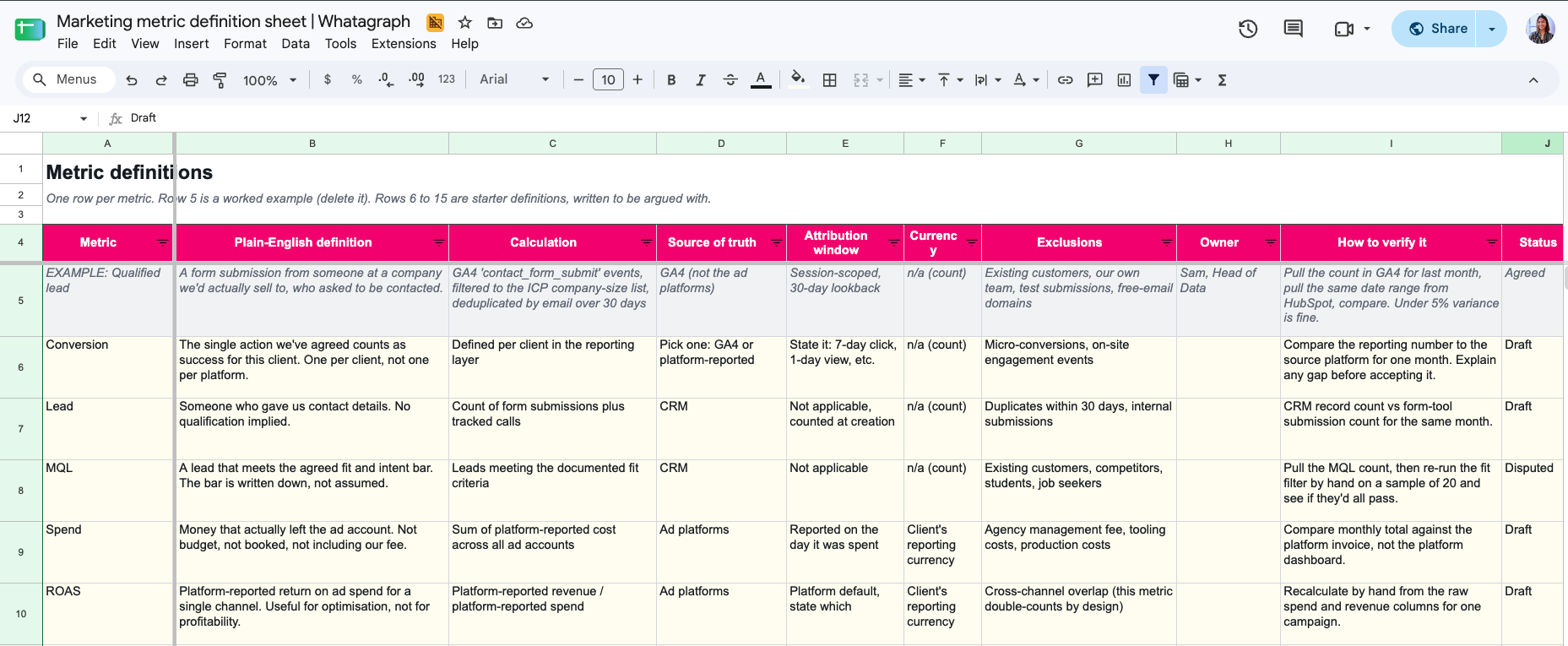
For each one, write down enough that somebody else could reproduce it without asking what you meant. That typically includes the calculation, where the number comes from, the attribution window, which currency you report in, and anything you purposely exclude.
And source of truth does not have to mean one source forever, by the way. An agency technical lead we spoke to defaults to GA4 conversions for reporting, then switches to platform attribution when the commentary calls for it. The governance is in making that switch on purpose, and recording when you do it.
Arturas says that discrepancies often begin with “unclear agreements within the business” about how something should be measured.
💡Pro tip: We’ve turned that exercise into a Metric Definition Sheet you can use to write down the calculation, source, attribution rules, and exceptions for the metrics your team keeps debating.
2. Decide who owns each definition
And here comes the enterprise playbook: data stewards, a RACI matrix, perhaps a committee for good measure.
At a 60-person agency, there may be no steward. There may be one person who knows why ROAS is calculated that way and what will break if you touch it. If you ask us, that’s less a governance structure than a bus-factor problem.
So when you’re assigning data governance roles and responsibilities, you have three broad ways to do it:
- A centralized governance model puts the definitions with one person or team: You get consistency, but you also get a queue. Snowflake notes that centralized models can become bottlenecks as more teams need decisions from the same authority.
- A decentralized governance model lets account teams decide for themselves: This is handy until three regions are all reporting conversion and none of them mean quite the same thing.
- A federated governance model splits the difference: The agency owns the shared definitions; account teams decide how they apply to individual clients. You keep a common language without routing every reporting question back through one person.
For an agency, that can be as straightforward as this: you decide what CAC means once. The account team works out what belongs in the calculation for Client A.
And no, the person owning that definition does not need to be a data engineer. The harder skill, we think, is getting a room full of people to stop circling the same metric and write down what everyone agreed to.
3. Encode the definitions into the data layer
Now remember the client account you cannot reach through the screen and fix. That’s why agency governance has to do so much work downstream. The campaign name has already been created; the account manager has already used their own taxonomy.
Our CTPO, Arturas, puts this a little more colorfully:
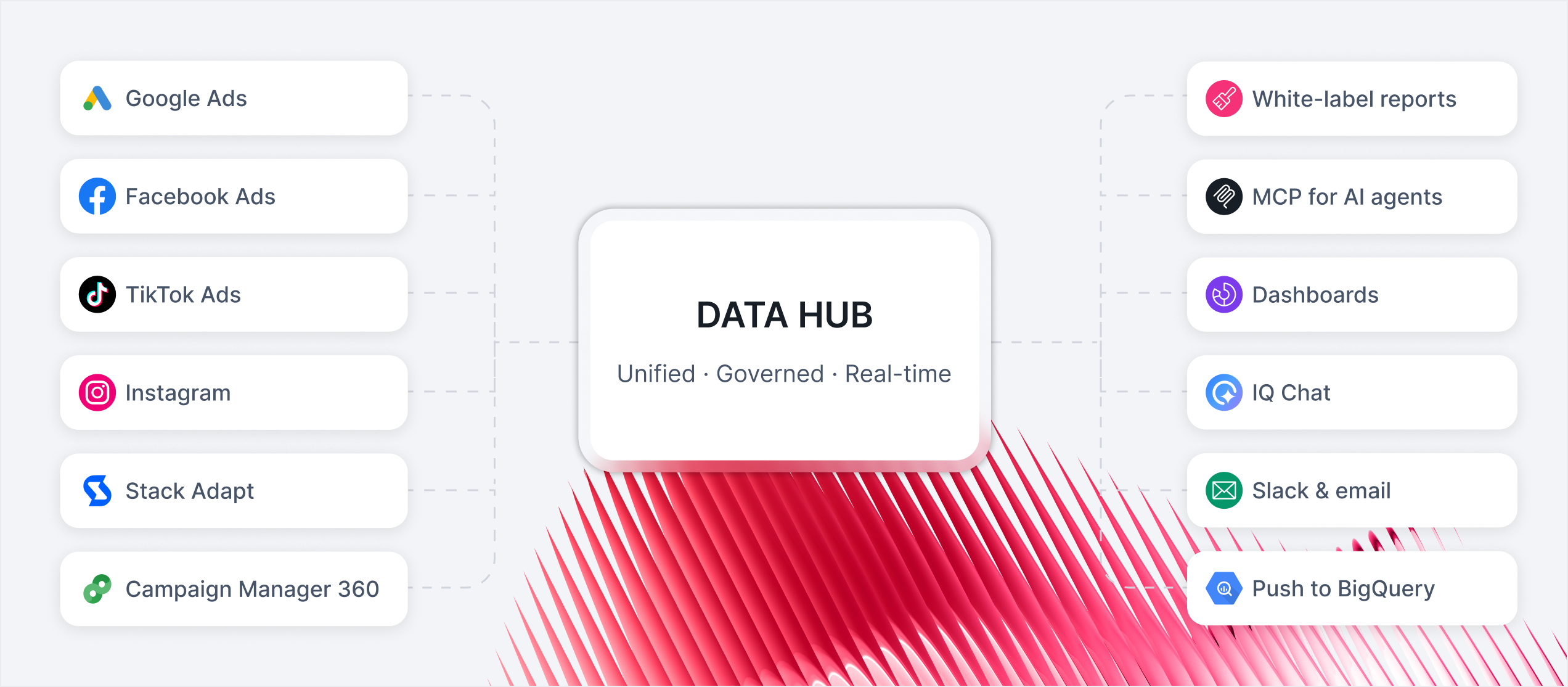
What’s powerful with Whatagraph, you can do full data governance, meaning you can build an accurate dimension on top. No matter if the campaign names are messed up in a way unimaginable and unreadable, it can still figure it out. You can build trusted metrics as custom metrics that are pre-approved; these are to be used in all the reports and all the campaigns, and all the alerts.
- Custom Dimensions can standardize inconsistent values across channels.
- IQ Dimensions let you describe the rule in plain language.
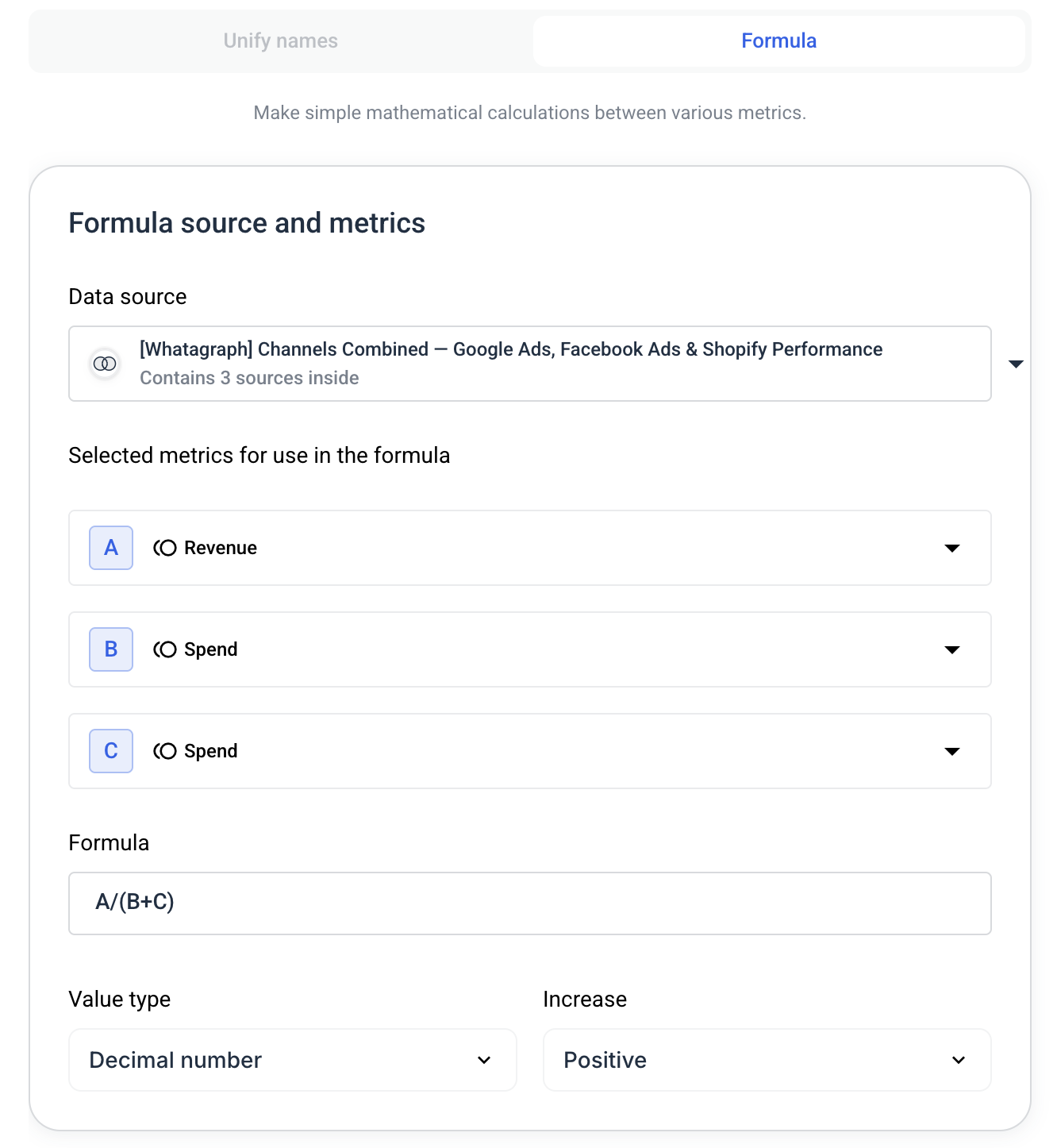
- Custom Metrics give a calculation one reusable definition.
- Source Groups can pull multiple accounts into the same structure.
- Blends join data across channels using a shared key.
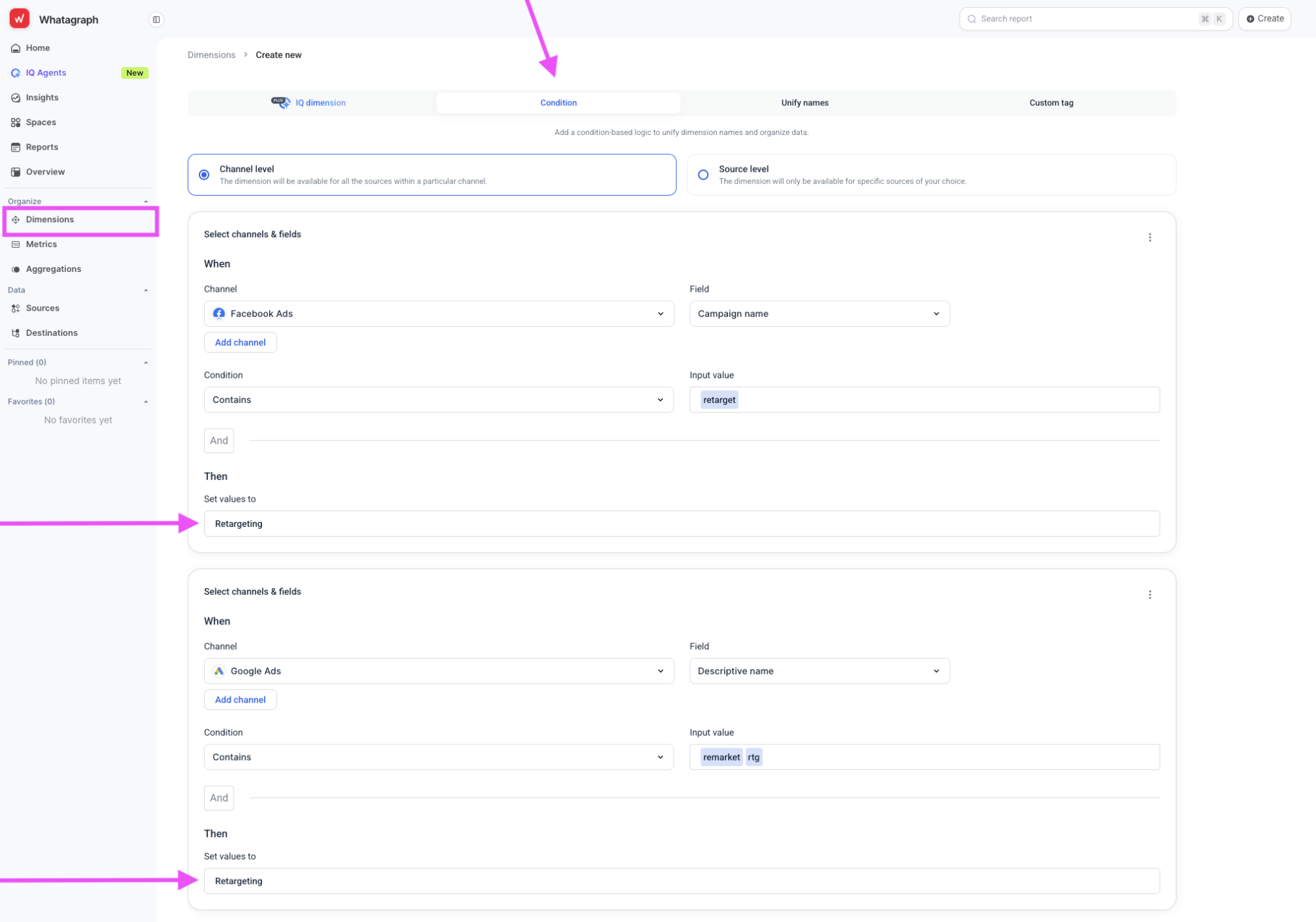
For example, in the screenshot below, Facebook Ads can contain “retarget,” while Google Ads might use “remarket” or “rtg.” A Custom Dimension maps those variations to the same Retargeting value before they reach reporting:
With Whatagraph IQ Agents, you can just ask an agent to build custom metrics, dimensions, and blends on your behalf – and build a cross-channel marketing report from this governed data.
For example, you can just write a plain-language prompt like:
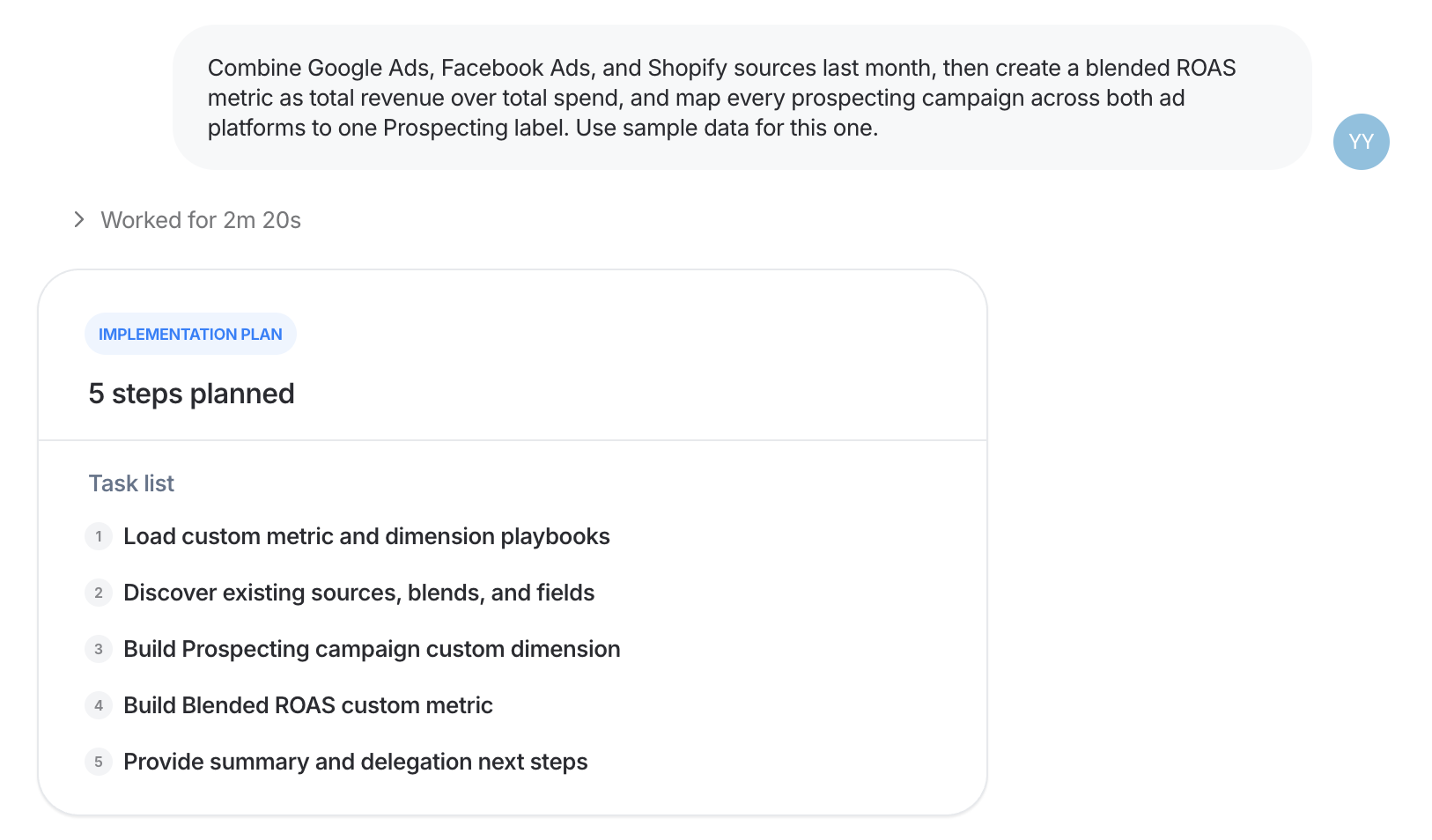
The agent builds it on your behalf (even with your laptop closed):
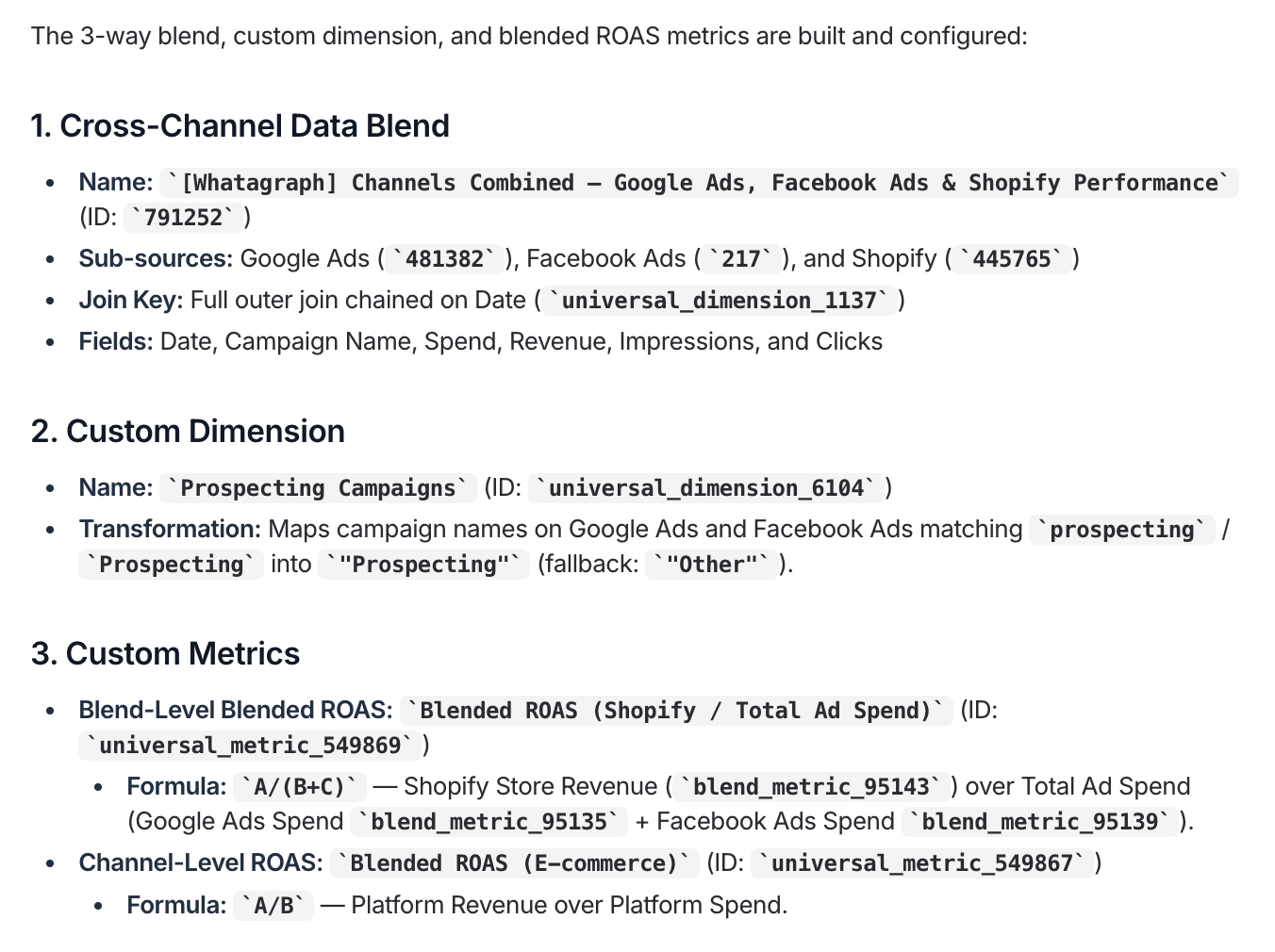
And this is the result:
Next, ask the agent to build a fully branded cross-channel marketing report with the exact same custom metrics, dimensions, and blends it created earlier.
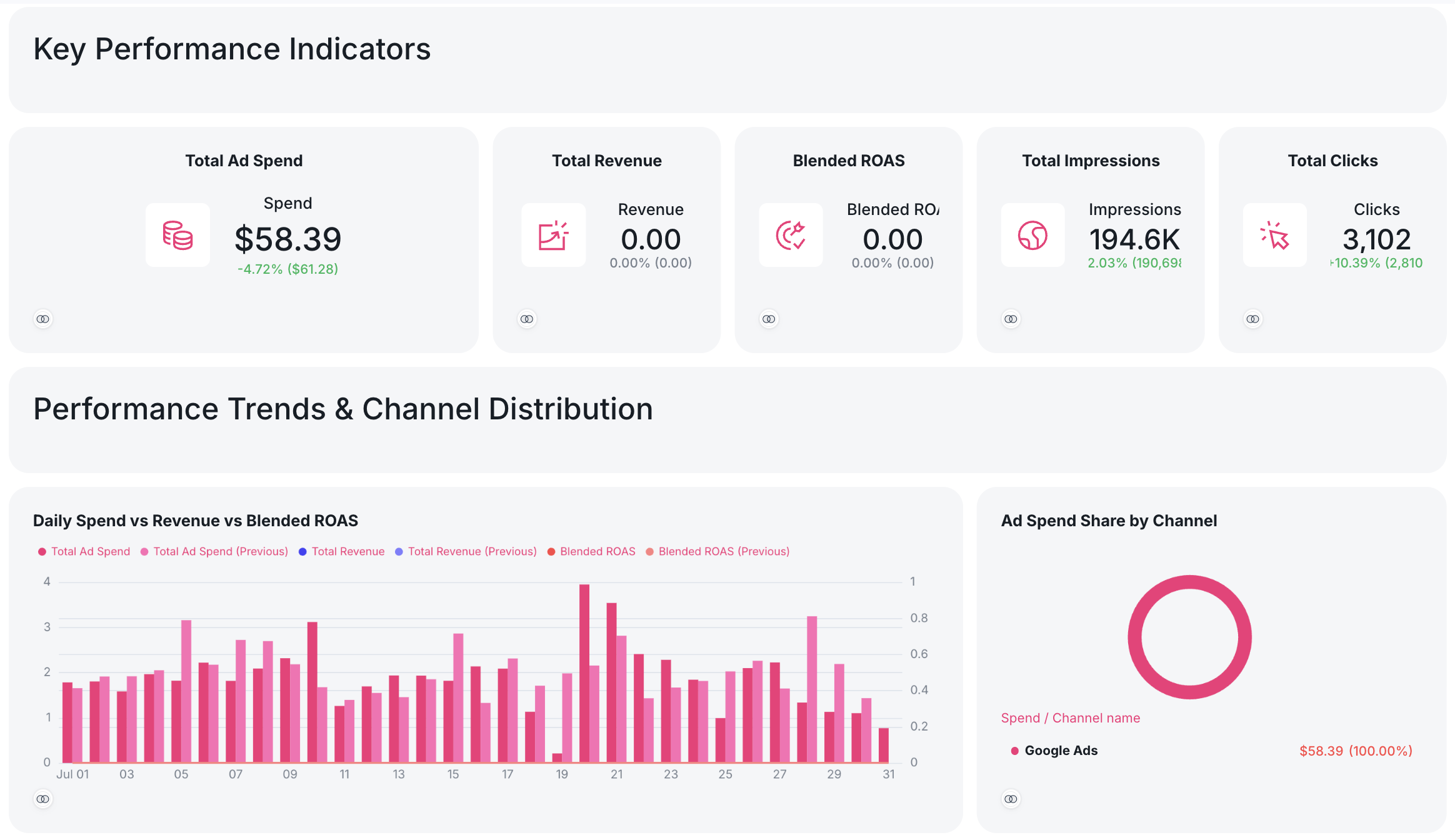
You can then get the agent to:
- Automate the delivery of this report to your client every week or month
- Write an email to your client based on the governed data on the report and your business context
- Set up an alerts system that emails you or sends a message in Slack when performance dips or flies off the charts
The possibilities are endless.
Let’s put that into agency terms. If CAC has an agreed calculation, you shouldn’t have to rebuild that calculation every time Client 30 arrives. If campaign naming differs across accounts, the reporting structure shouldn’t have to inherit every variation either.
Every definition you rebuild for every client takes work to maintain again later. And Arturas is quite candid about the difficult bit:
That kind of semantic layer is probably one of the most difficult to get right, especially if you work across many channels with many different people.
That gets us back to the piece of paper. The data layer can enforce the definition, but you still have to decide what the definition is.
How do you know if your data governance strategy is working?
Say you’ve agreed on what an MQL means and encoded that definition into your reporting layer. The dashboard now says 100. How do you know the 100 is right?
Arturas recommends checking the governed number against the place it came from:
If you just plug in to Whatagraph, but you don’t have, let’s say, 100 MQLs, how do you know if the 100 is right? You need to compare it with something, right? You need to go into the actual source of what is generating those MQLs and check whether that data matches.
Run the same short check on the handful of metrics you would least like to explain incorrectly to a client:
- Pull the metric from your reporting layer.
- Pull the equivalent figure from the source platform.
- Compare the two using the definition you agreed on earlier.
- If they differ, check whether the definition accounts for the gap before declaring the data broken.
If the figures disagree, don’t skip straight to “the data is broken.” Check whether the definition explains the gap first. If the definition checks out and the number still doesn’t, you’ve crossed into marketing data quality.
👉 Take our AI readiness quiz to see where your data stands.
And if your team accepts some variance, write that down too. IBM Think’s Alice Gomstyn and Alexandra Jonker describe data contracts as formal agreements between data producers and consumers that codify expectations around data quality and meaning. Those contracts can include rules for accuracy, completeness, validity, or custom quality checks.
In other words, yes, “close enough” is allowed to exist. You just shouldn't invent it on the spot.
Then track whether governance is getting easier to live with. You need five data governance metrics:
- The share of priority metrics with an agreed definition tells you how much of the reporting layer is actually governed.
- The variance between governed and source-platform numbers shows whether your top metrics still reconcile.
- The hours spent reconciling discrepancies each month tell you whether the system is reducing manual investigation.
- The share of campaigns resolving cleanly to your taxonomy shows how much naming drift is still getting through.
- The age of each definition tells you which agreements have been sitting untouched while the business around them changed.
And they will change.
Arturas gives an example of a metric that “showed numbers previously” and has now started showing zero. Maybe tracking changed. Maybe the metric did. Either way, you want to know before the zero turns up in somebody’s monthly report.
Definitions don't stay put. Tracking breaks, a client renames a campaign, and a metric that showed numbers last month starts showing zero.
With Whatagraph's IQ Agents, you can put that check on a schedule instead of hoping somebody spots it.
You describe the audit once and tell the agent when to run it, like so:
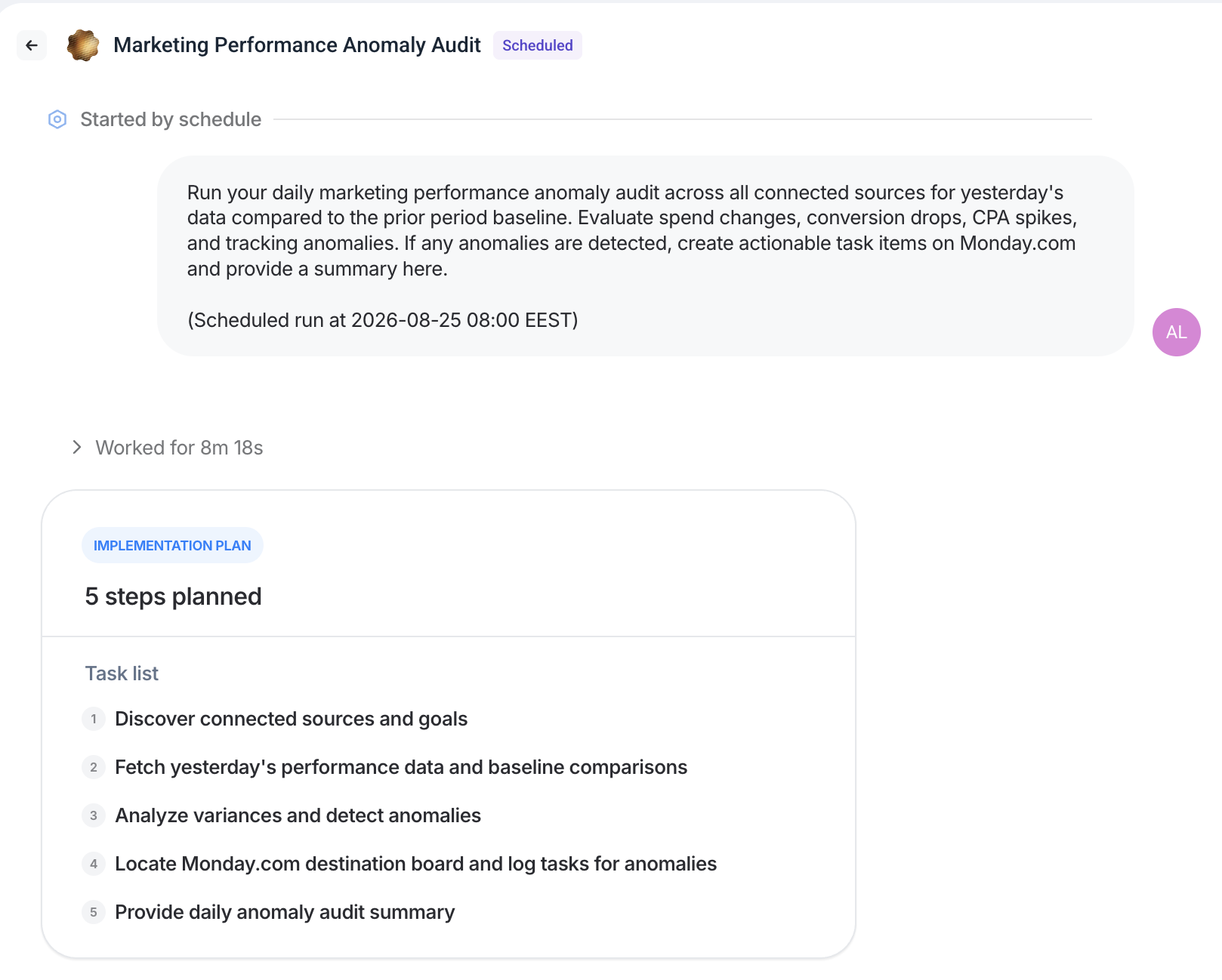
The agent came up with an implementation plan that includes:
- Discovering the connected sources and goals
- Fetching yesterday's performance data and the baseline comparison
- Analyzing variances and detecting anomalies
- Locating the destination board and logging a task for each anomaly
- Posting the daily audit summary
The result is a list of what moved, which campaign it came from, and what to do about it:
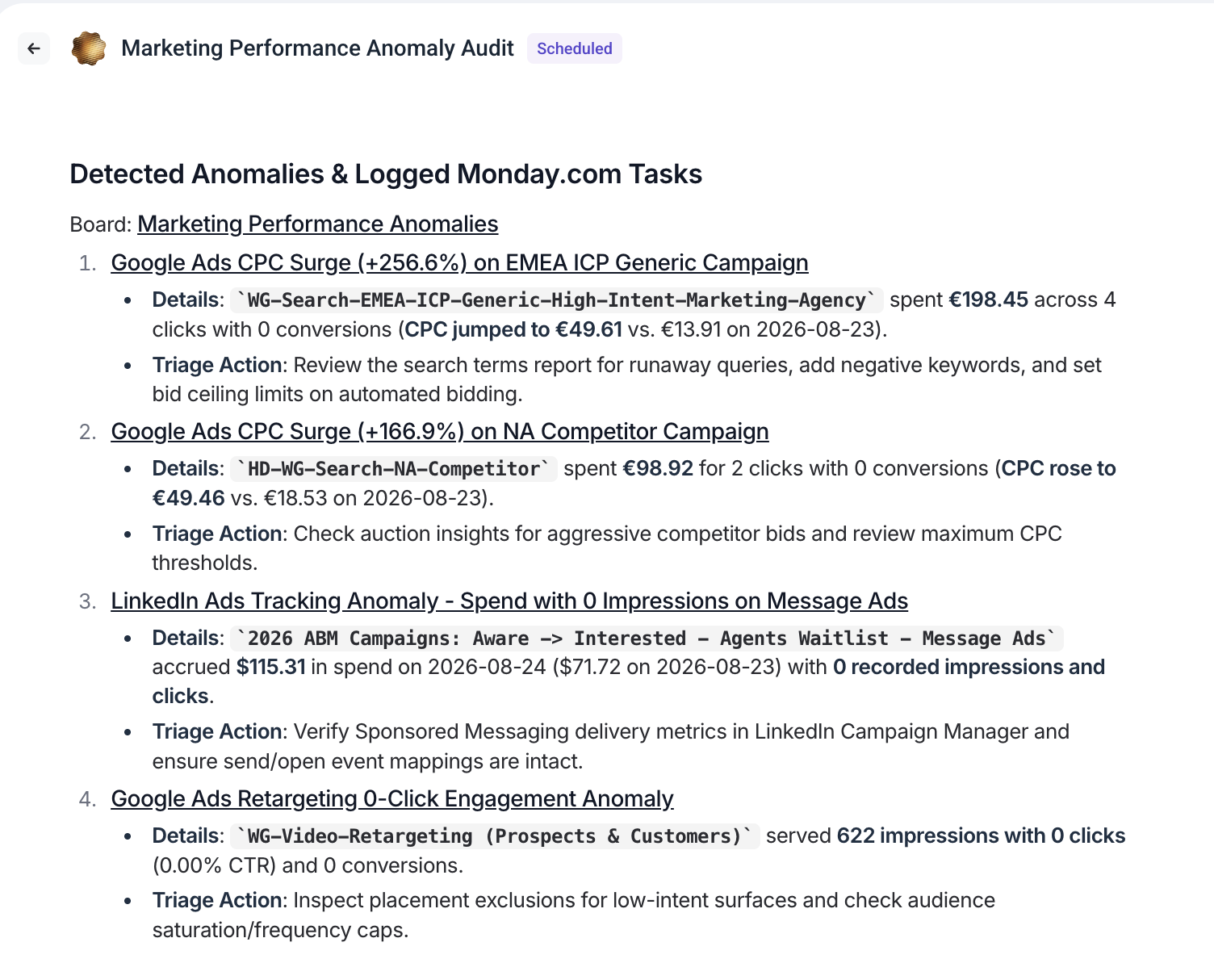
Look at the third one. A LinkedIn message ad campaign accrued spend two days running with zero impressions and zero clicks recorded. That isn't a performance problem. It's a tracking problem, and without the audit it sits in the client report as a real number.
Set the schedule to fit your reporting rhythm: daily before standup, or Monday morning so the week opens with a clean list. You can send the summary in Slack with the tasks already created in a project management tool you use.
Want to try out IQ Agents? Get early access here.
Which tools are most effective for marketing data governance?
In my research, data governance software has come out as a terrible shopping category. For instance, Collibra and Camptag can both end up under the same umbrella while solving almost none of the same problem.
So before you compare products, separate the jobs.
| Category | Best for | Does it assume you control campaign creation? | Does it assume you have a data team? | Where does the governed number end up? |
|---|---|---|---|---|
| Enterprise data catalogs and governance platforms | Organizations governing metadata, lineage, access, and compliance across a large data estate. | Not necessarily; they govern data once it enters the organization’s wider systems. | Usually, yes; they’re built around dedicated data functions and governance roles. | In the catalog or governed data estate, before another analytics or BI tool presents it. |
| Taxonomy and naming-convention tools | Teams that want campaign names and metadata standardized at creation. | Yes, or close to it; their value is strongest when you can enforce the rules upstream. | No; marketing or operations teams can usually own the taxonomy themselves. | In cleaner campaign metadata that then travels into your reporting stack. |
| Marketing data platforms with governance features | Teams governing campaign and performance data across marketing sources | Not always; some can validate upstream; others standardize what arrives downstream. | It depends; warehouse-centric setups assume more data infrastructure than agency reporting platforms do. | Depending on the platform, in a warehouse, governed marketing layer, or directly in client-facing reporting. |
| DIY stack | Agencies with bespoke client logic and someone capable of maintaining it | No; lookup tables and transformation logic can clean up what arrives later. | Not officially; somebody has to understand the spreadsheet, Regex, SQL, or warehouse holding it together. | Wherever that custom setup feeds next; usually a spreadsheet, warehouse, dashboard, or BI tool. |
The top marketing data platforms with governance features
Improvado, Adverity, and Whatagraph are built much closer to the campaign data marketers work with every day.
The differences are in where governance happens and how much data infrastructure they expect you to have.
- Whatagraph is built for agencies and multi-location teams that need the governed number to make it all the way into the report a client or stakeholder sees: The definitions you standardize in Data Hub can be reused across accounts, while Source Groups let you aggregate multiple sources under the same reporting structure. So the governed version of CAC, ROAS, or campaign type doesn’t have to be rebuilt every time another account joins the fold. Those same definitions can then surface directly in client-facing reports.
- Improvado is especially strong on campaign setup and QA: Their governance product can monitor campaigns against a pre-built rule library, flag naming or configuration problems, and validate setup before those problems reach reporting.
- Adverity leans further into the data infrastructure that supports marketing: Adverity Connect pulls and harmonizes data from 600+ sources before sending it into a warehouse, while Atlas sits above the warehouse as a governed marketing knowledge layer. That makes it a better fit for teams that already have a warehouse and want marketing definitions, lineage, and AI context to live around it.
The top enterprise data catalogs and governance platforms
Collibra, Alation, Atlan, and Informatica are good products aimed at somebody else.
Their natural habitat is the enterprise data estate:
- Collibra centralizes policies and business terminology.
- Alation combines governance with cataloging, lineage, and compliance controls.
- Atlan builds a metadata layer across warehouses, pipelines, and BI tools.
- Informatica catalogs and traces data across cloud and on-premises systems.
That remit makes sense when you have a data office asking where a field came from or what happened to it on the way to a dashboard.
But as an agency, you may need to reconcile campaign data from accounts you don’t own, then get the governed number into something a client can read.
So if your governance problem starts with “retarget,” “remarket,” and “rtg,” Collibra is not where I’d start.
The top taxonomy and naming-convention tools
Claravine and CampTag tackle governance closer to the point where campaign data is created.
- Claravine is built around marketing taxonomy: The Data Standards Cloud lets teams define approved campaign metadata, naming conventions, and validation rules before campaigns move downstream. Claravine also supports integrations that can audit campaign data against those standards and apply naming conventions inside platforms such as LinkedIn Campaign Manager.
- CampTag is narrower and very literal about the job: You define the dimensions, naming formats, and constraints; CampTag then uses them to generate standardized campaign names and UTMs.
This is the upstream half of governance, and it works best when you control campaign creation.
But agencies don’t always own that job. A naming tool can make every campaign your team launches beautifully compliant. It can’t, however, stop a client from opening their own ad account and improvising.
The DIY stack a lot of agencies already have
Then there’s the stack nobody bought as a stack.
Your spreadsheets hold the definitions, lookup tables translate campaign names, and Regex patches whatever the lookup table missed. A warehouse may or may not sit underneath the whole thing if somebody on the team knew enough SQL to build one.
The appeal is obvious: it’s cheap, flexible, and you can bend it around every odd client requirement that turns up.
An agency founder we spoke to had taught himself the reporting setup because training somebody else was a “time suck we can’t afford.” At another agency, one technical lead owned the setup alone.
So the DIY stack can work very well…just check how much of its logic would leave with the person who built it.
The end goal is a number you can use
Our fearless CTPO, Arturas Lazejevas, doesn’t stop at whether the number is right:
“Data governance is going to be much more about security and understanding whether the metrics that we track actually make sense for the business. And whether they are not just right, but enough and enriched enough and have enough signals, qualitative and quantitative, to really provide the answers the company needs, rather than just a grounded, trusted data layer that doesn’t mean anything for the business.”
That last bit is the one I’d keep pushing on: correct is not the same as useful to the business.
At Maatwerk Online, four reusable reporting templates cover 90% of the agency’s 100+ clients, and Whatagraph saves the team 100 hours a month.
"Templates save so much headspace—you don’t have that negative energy of thinking, ‘Ugh, I have to build a report again.’,” says Lars Maat, Co-Founder at Maatwerk Online.
That’s a much nicer place for governance to end up, isn’t it? The agency has room for client differences without rebuilding the reporting logic every time one signs on.
Published on Sep 01 2026
WRITTEN BY
Brinda GulatiBrinda Gulati is a fractional content marketer and freelance writer who specializes in data-driven storytelling and writing easy-to-understand, informative content for humans. She has two degrees in Creative Writing from the University of Warwick, and believes that above all, stories are a deeply human endeavor. She has two dogs, knows thrifting spots, and loves afternoon naps.