












Free Marketing KPI Report Template

Still stitching together KPIs from GA4, ads, social, and spreadsheets?

This marketing KPI report template gives you one clear, goal-aligned view of marketing performance, ready to share with leadership or clients.

Marketing KPI Report Template - A digital marketing report with charts, graphs, and performance metrics.

Create Custom Marketing KPI Reports in Seconds

With Whatagraph IQ, just tell us what you need, and we'll build a stunning marketing KPI report for you in seconds. No templates or manual setup needed.

How To Use Whatagraph’s Marketing KPI Report Template

A good marketing KPI report template should do three things well:

  1. Focus on the right KPIs
  2. Show progress against goals
  3. Make results easy to act on

At a minimum, it should include a clear executive summary with 5–7 core key performance indicators tied to business objectives, such as conversions, revenue, cost per lead, and return on investment.

From there, the report should break performance down by funnel stage—awareness, engagement, lead generation, and revenue—so stakeholders can see how marketing efforts translate into outcomes.

The best templates also combine website, SEO, paid ads, social media, and email marketing into one centralized view, using simple charts and graphs to show trends over time, not just raw numbers.

Finally, every marketing KPI report should leave room for insights and next actions, turning marketing data into clear guidance for decision-making, not just a collection of metrics.

We break down which sections, metrics, and charts to include based on our marketing KPI report template created by marketers on Whatagraph.

1. Marketing Summary
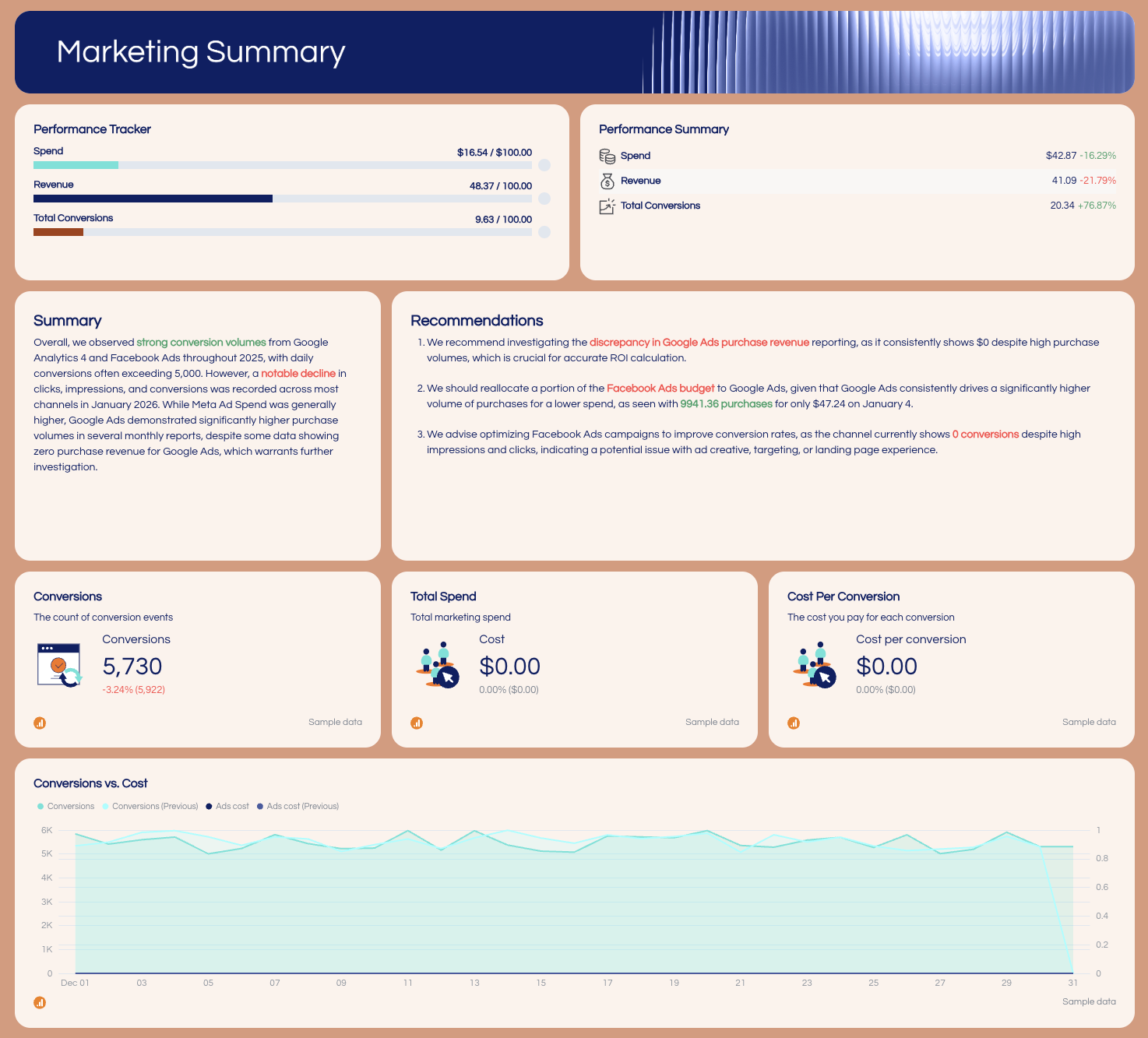
Marketing Kpi Report Template - A dashboard displaying marketing summary with performance metrics.

Purpose: Executive-level overview that answers “Is marketing working?” for stakeholders and supports fast decision-making.

Structure

  • Written marketing summary with insights and next actions
  • High-level marketing KPI tiles
  • Cross-channel performance dashboard view
  • Spend vs outcome comparisons tied to business objectives

Key metrics

  • Total conversions (key performance indicators)
  • Total marketing spend
  • Revenue / purchase revenue
  • Cost per conversion
  • Clicks, impressions, and campaign performance by channel
  • Organic social followers
  • ROAS / return on ad spend

Charts & visuals

  • KPI scorecards (marketing metrics with MoM change)
  • Time-series line charts (conversions vs cost, real-time trends)
  • Stacked bar charts by marketing channels
  • Comparative bar charts (Google Ads vs Facebook Ads spend & purchases)

2. Website Performance
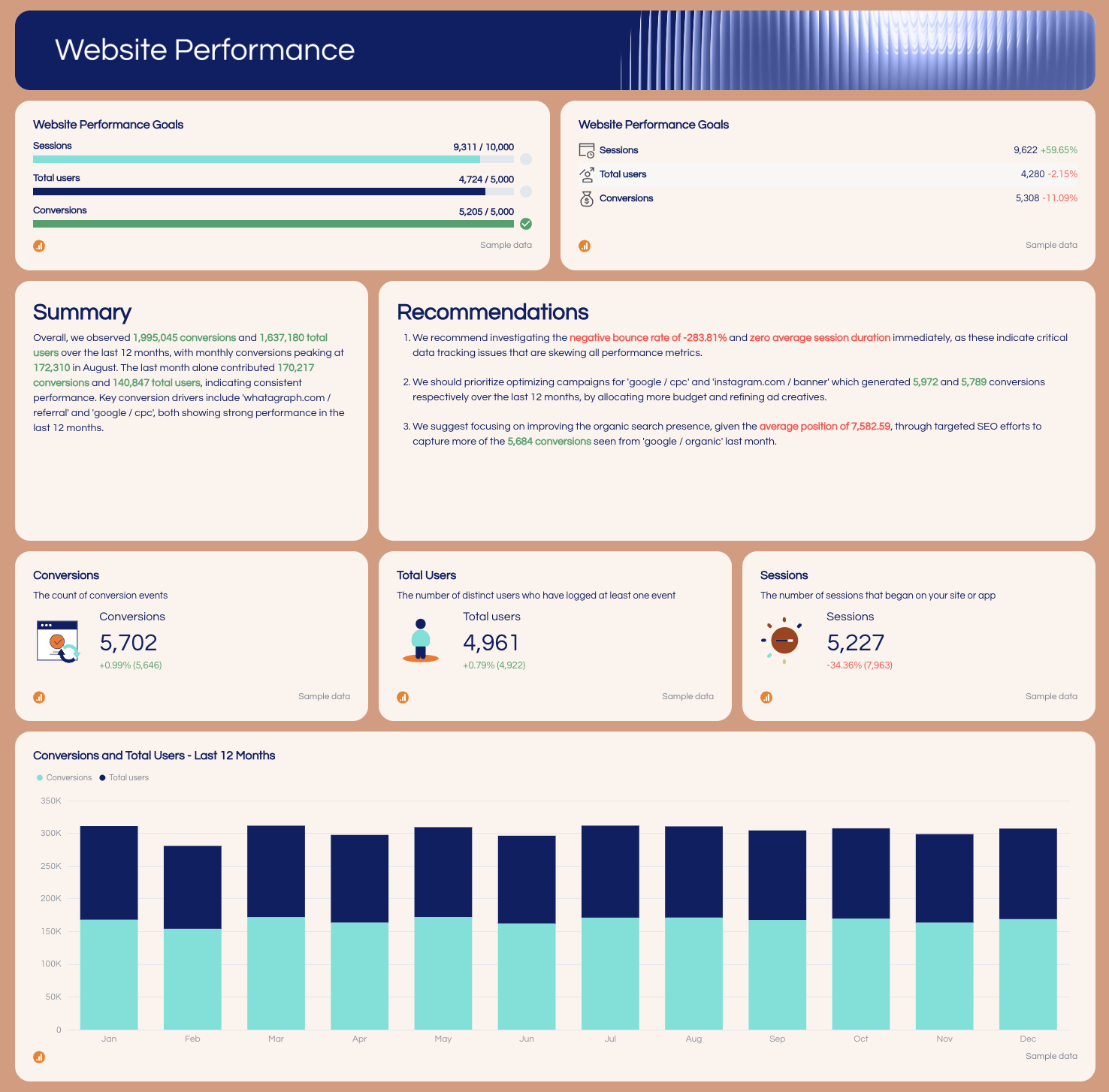
Marketing KPI Report Template - Website Performance - KPI report showing website traffic and conversion data.

Purpose: Show how website traffic quality supports conversions and overall marketing performance.

Structure

  • Summary + recommendations
  • Website KPI tiles
  • Traffic and conversion trends
  • Source, device, and page-level breakdowns
  • Goals vs actuals tracking

Key metrics

  • Users & new users
  • Sessions & website traffic
  • Conversions & conversion rate
  • Bounce rate
  • Average engagement time
  • Page views
  • Sessions and conversions by source (organic, PPC, social media)

Charts & visuals

  • Line charts (users & conversions over time)
  • Bar charts (sessions by marketing channels)
  • Comparison charts (new users vs conversions)
  • Tables for page-level and source-level performance metrics

3. SEO Performance
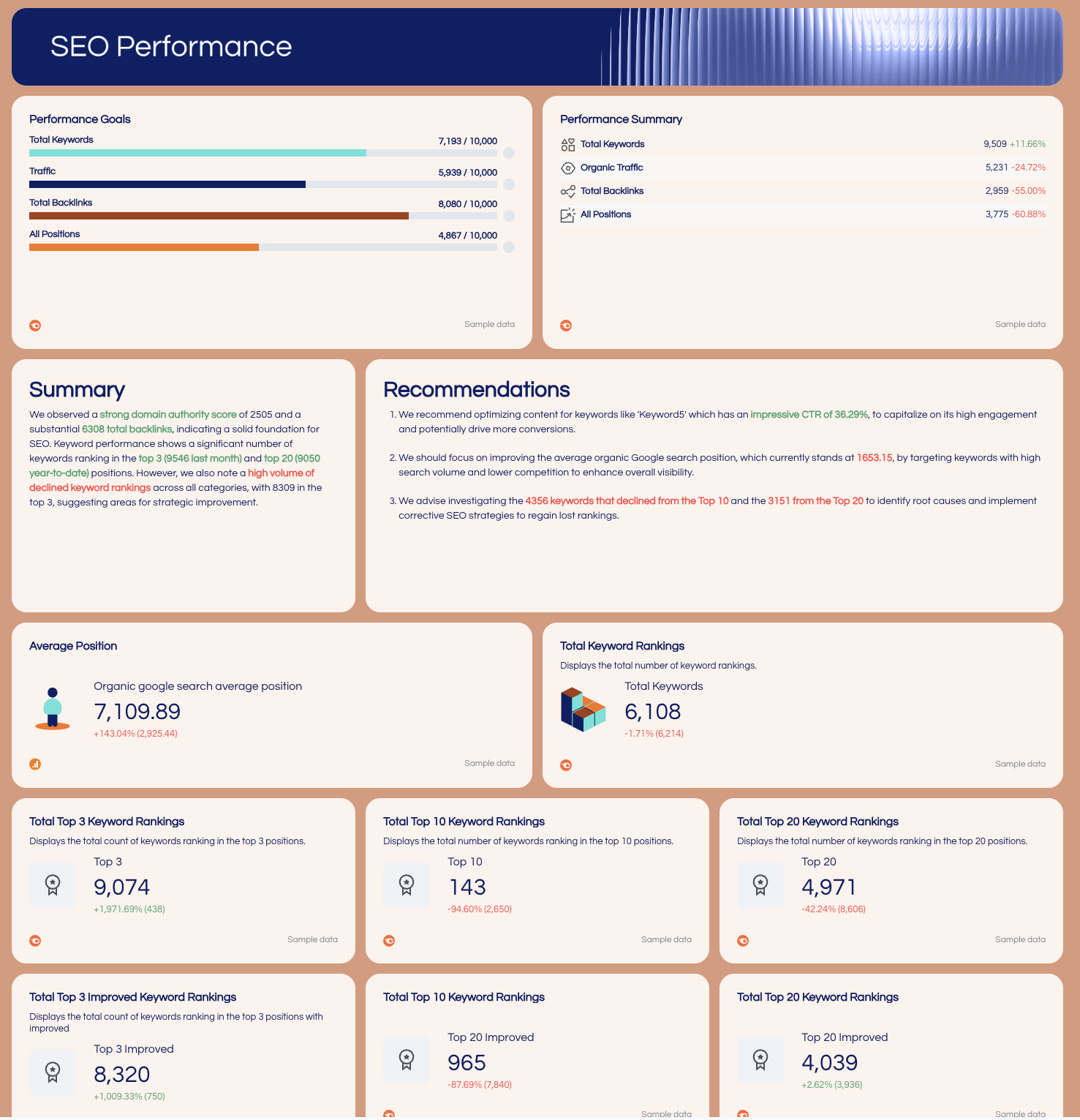
SEO Performance - KPI dashboard showing performance goals, summary, and recommendations.

Purpose: Track organic visibility, rankings, and SEO impact on marketing results.

Structure

  • SEO summary + recommendations
  • Core SEO KPI tiles
  • Keyword distribution and movement
  • Keyword-level tables
  • Backlink and authority tracking

Key metrics

  • Organic traffic
  • Average position & rankings
  • Total keywords
  • Top 3 / Top 10 / Top 20 rankings
  • CTR (click-through rate)
  • Backlinks and referring domains
  • Domain authority

Charts & visuals

  • KPI tiles for SEO report health
  • Pie charts (keyword distribution)
  • Time-series graphs (rankings & backlinks over time)
  • Tables with keyword impressions, clicks, CPC, and performance metrics

4. Google My Business
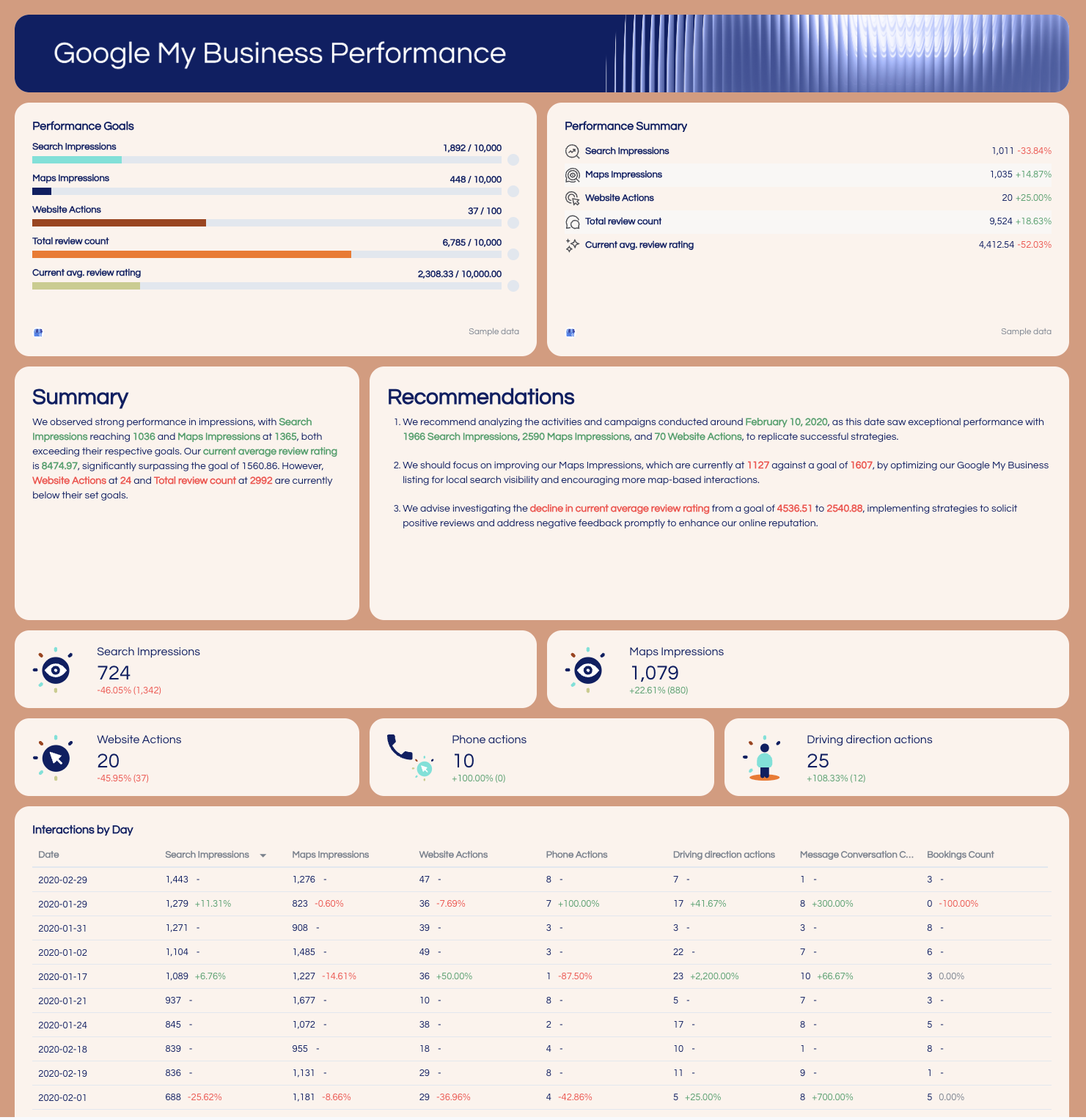
Marketing KPI Report Template - GMB Performance - Performance metrics from a Google My Business dashboard.

Purpose: Measure local SEO visibility and high-intent actions.

Structure

  • Local performance summary
  • KPI tiles
  • Daily interaction breakdowns
  • Device-level splits
  • Review performance section

Key metrics

  • Search impressions
  • Maps impressions
  • Website actions
  • Phone calls
  • Direction requests
  • Review count & average rating

Charts & visuals

  • KPI scorecards
  • Line charts (local impressions trends)
  • Daily interaction bar charts
  • Tables for review performance and device usage
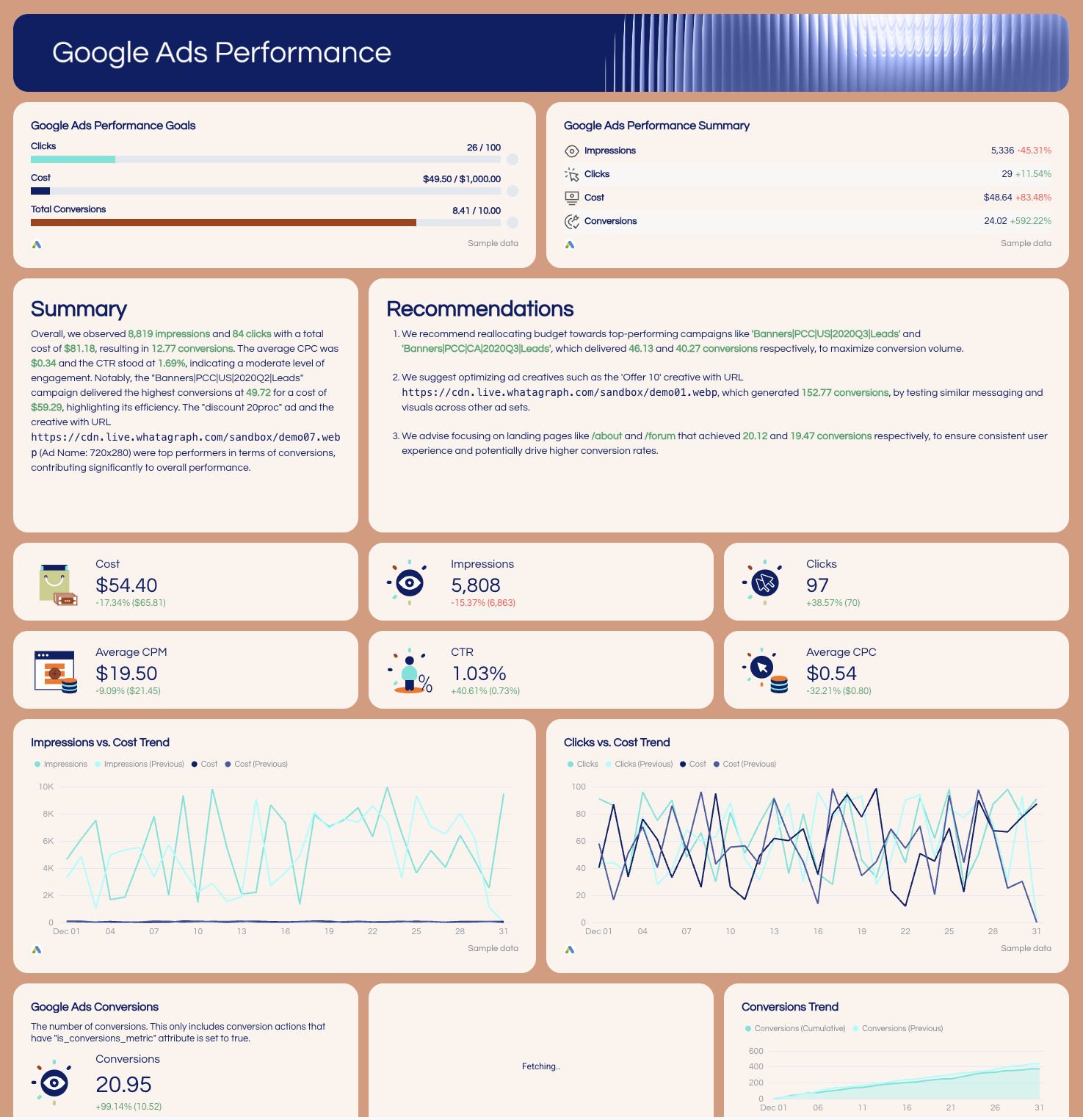
Marketing Kpi Report Template - Google Ads Performance - A data visualization report showing charts and metrics.

Purpose: Deep performance view for PPC and paid search optimization.

Structure

  • Summary + recommendations
  • Paid media KPI tiles
  • Conversion funnel
  • Trend analysis
  • Multi-level breakdowns

Key metrics

  • Spend
  • Impressions
  • Clicks
  • CTR
  • CPC & CPM
  • Conversions
  • Cost per lead
  • ROAS

Charts & visuals

  • Line charts (impressions, clicks, cost trends)
  • Funnel charts (impressions → clicks → conversions)
  • Tables for campaigns, ads, keywords, and landing pages

6. Facebook Ads
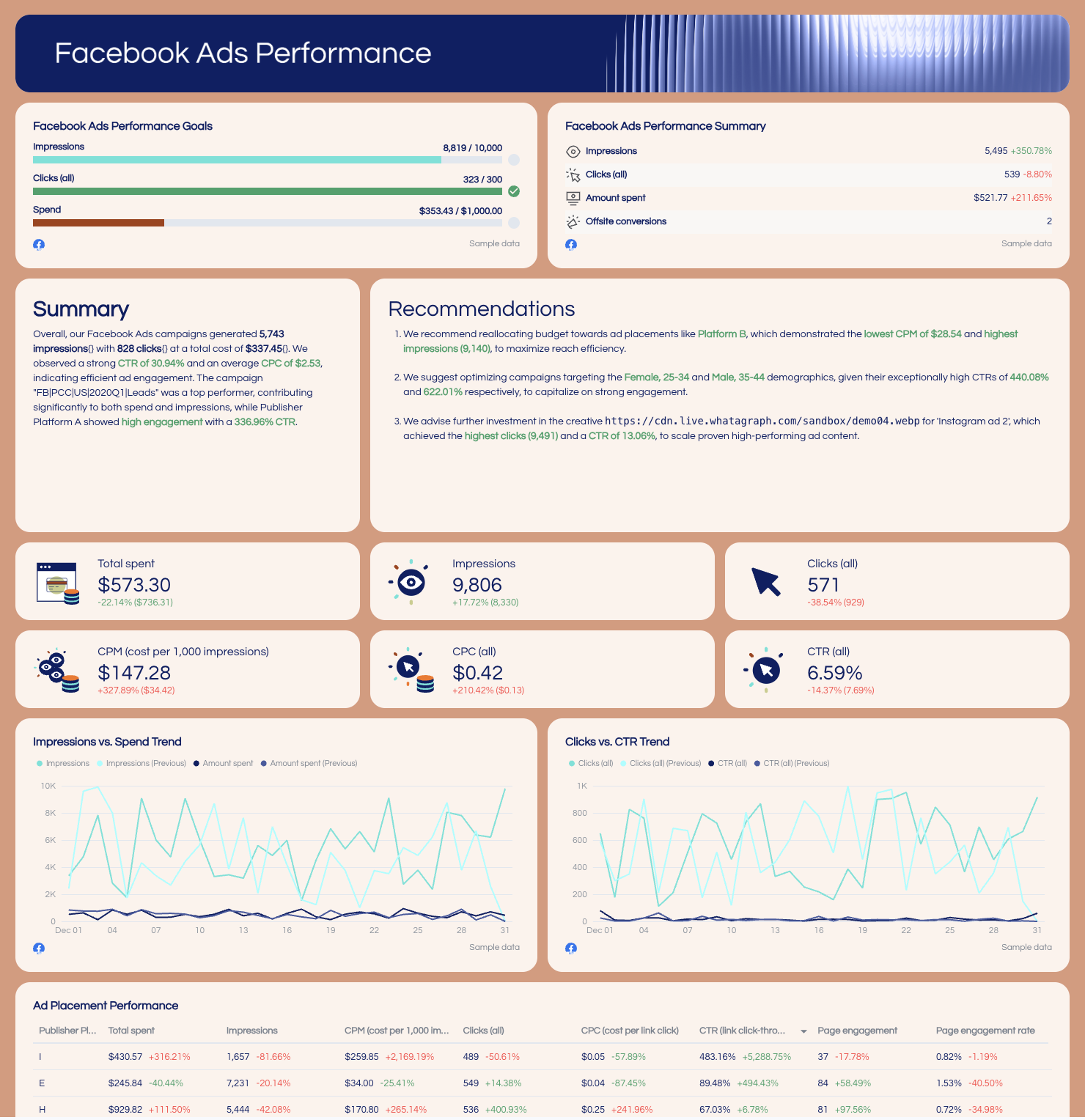
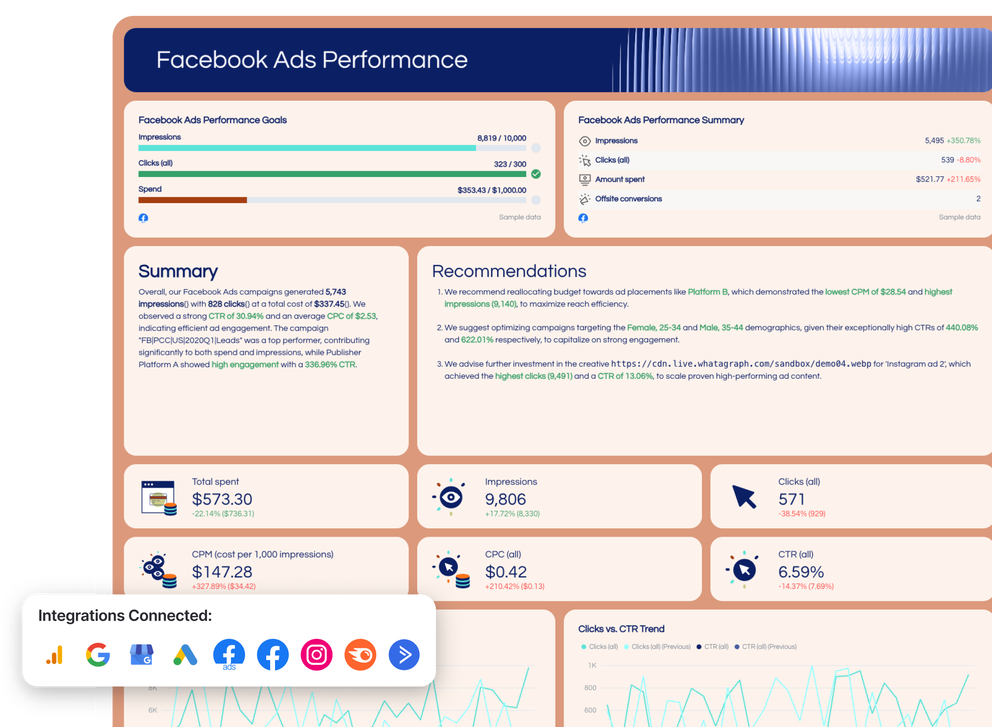
Marketing Kpi Report Template - Facebook ads performance report with charts and key metrics.

Purpose: Measure paid social efficiency, reach, and engagement.

Structure

  • Summary + recommendations
  • KPI tiles
  • Spend & engagement trends
  • Demographic analysis
  • Creative and campaign breakdowns

Key metrics

  • Impressions
  • Reach
  • Clicks
  • CTR, CPC & CPM
  • Spend
  • Offsite conversions
  • Engagement rate

Charts & visuals

  • Line charts (spend vs impressions)
  • Funnel chart (reach → clicks)
  • Bar charts by age and gender
  • Tables for creative, campaign, and demographic performance

7. Organic Social Media
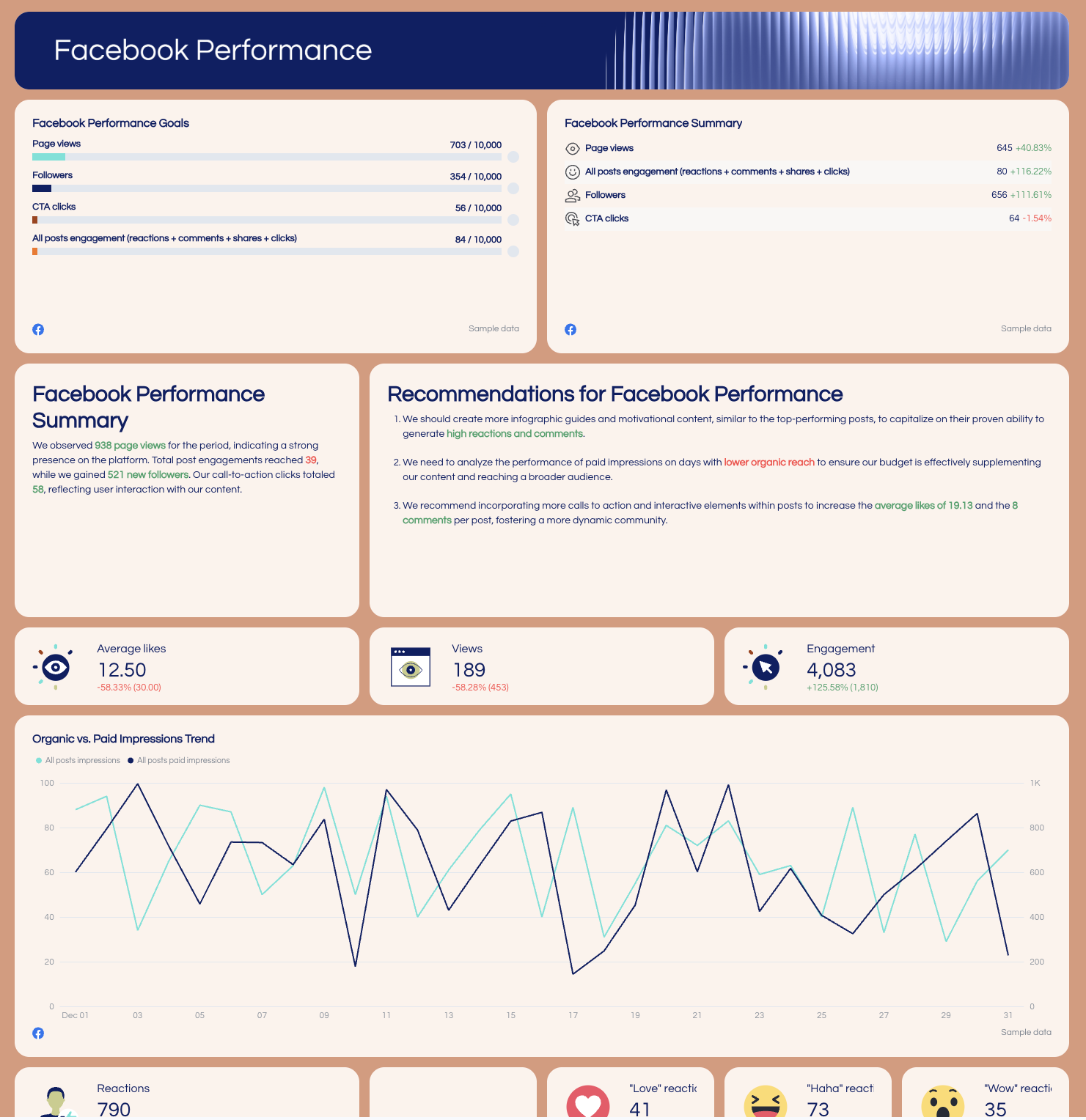
Marketing KPI Report - Facebook performance report showing key metrics, charts and analysis.Purpose: Track non-paid social growth and engagement quality.

Structure

  • Summary + recommendations
  • KPI tiles by platform
  • Growth and engagement trends
  • Platform comparisons

Key metrics

  • Followers
  • Follower growth
  • Impressions
  • Engagements
  • Engagement rate
  • Clicks

Charts & visuals

  • Line charts (follower growth)
  • Bar charts (engagement by platform)
  • Comparison tables (Facebook, Instagram, LinkedIn)

8. Email Marketing
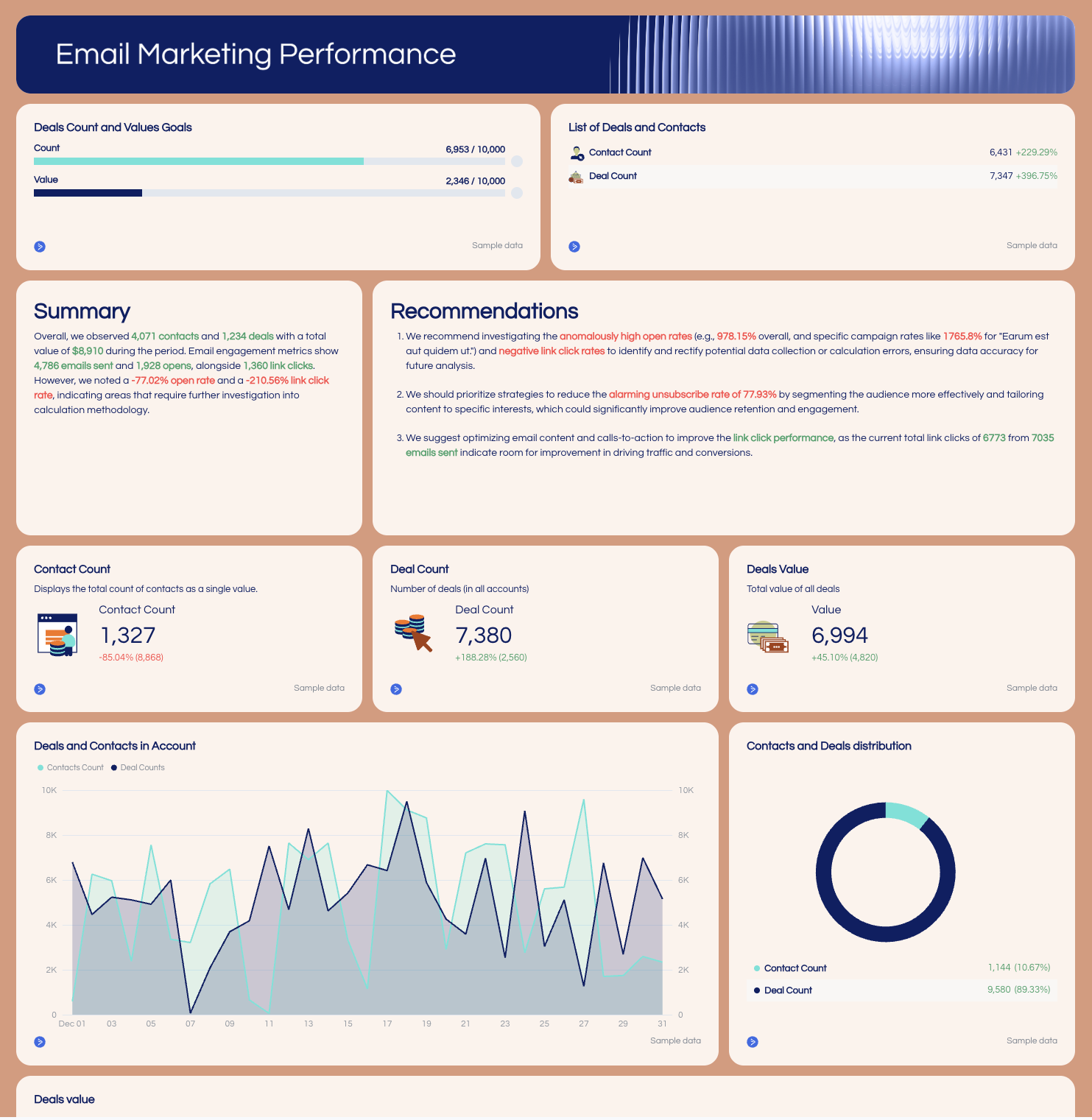
Marketing KPI Report Template - Email Marketing Performance - Dashboard with charts showing email campaign stats.

Purpose: Measure lifecycle and retention impact from email marketing.

Structure

  • Summary + recommendations
  • Email KPI tiles
  • Campaign-level performance
  • Trend analysis

Key metrics

  • Sends
  • Open rate
  • Click-through rate (CTR)
  • Unsubscribe rate
  • Conversions
  • Revenue (for ecommerce)

Charts & visuals

  • Line charts (open and click trends)
  • Bar charts (campaign comparisons)

Tables for Mailchimp or ESP campaign performance

Connect All Your Marketing Data in One Place

Bring all your marketing data into one place with no-code, stable connectors that you don't need to babysit. 

Why Marketers Love Reporting on Whatagraph

Great feature! Nice work. This looks really easy.

Lars Maat

Lars Maat

Company Owner @ Maatwerk Online

StarStarStarStarStar

Whatagraph has become an essential partner for scaling our reporting, and my teams love it because it saves so much time. We’d recommend it to any team looking to automate data reporting and use AI for insights.

Danielle Roberts

Danielle Roberts

Director of Implementation & Support @ Rentable

StarStarStarStarStar

Whatagraph took us to the next level with our clients and within our team. Our relationships with clients have been amazing, and we’ve even been able to retain them longer.

Kim Strickland

Kim Strickland

Digital Marketing Specialist @ Peak Seven

StarStarStarStarStar

Whatagraph is easy to use, visually attractive, and much smoother compared to tools like Looker Studio. It helped us not only get clients on board but also keep them within the agency.

Stef Oosterik

Stef Oosterik

Quality Manager @ Dtch. Digitals

StarStarStarStarStar

Frequently Asked Questions

Have more questions? We answered them below.

What is a KPI reporting template?

A KPI reporting template is a standardized framework for tracking and presenting key performance indicators across your marketing activities. Instead of rebuilding reports every month in Excel or a spreadsheet, it gives your marketing team a repeatable structure to track KPIs, compare performance over time, and report results consistently to stakeholders or clients.

What is a marketing dashboard?

A marketing dashboard is a visual, real-time view of your most important marketing metrics. Unlike static reports, a KPI dashboard updates automatically and shows how marketing campaigns, ad campaigns, and content marketing are performing at a glance—often by channel, funnel stage, or goal. It’s designed for fast decision-making, not deep analysis.

What are the key components of a marketing KPI report template?

A strong marketing KPI report template typically includes:


- An executive summary with core KPIs


- A funnel-based view of marketing performance


- Channel-level sections for website, ads, social media, and email


- Clear charts and tables that turn data into actionable insights


- Space for commentary and next steps


Together, these components help streamline the reporting process and keep the marketing strategy aligned with business goals.

Which marketing KPIs and metrics should I report on?

The right KPIs depend on your goals and what’s agreed between you and your clients / stakeholders, but most teams report on:


- Traffic and engagement (sessions, engagement rate)


- Lead and conversion metrics (conversion rate, cost per lead)


- Revenue metrics (ROAS, return on investment)


- Channel efficiency across SEO, paid ads, social media, and email


The key is to avoid tracking everything. Focus on metrics that actually help your team members evaluate performance and optimize marketing campaigns.

What is a digital marketing report template?

A digital marketing report template is a prebuilt format that combines data from multiple channels—paid ads, SEO, social media, email, and website analytics—into one report. It can live as a marketing dashboard, a monthly report, or a spreadsheet-based format, depending on how your team prefers to review and share results.

Is there a free digital marketing report template available?

Yes. You can use Whatagraph’s free digital marketing report templates to get started quickly—without building reports from scratch in Excel or Google Sheets.


These templates are designed for real-world reporting and cover the most common digital marketing use cases, including:


PPC report template


Google Ads report template


Facebook Ads report template


Social media report template


Facebook Analytics report template


Instagram Analytics report template


SEO report template


GA4 report template


Google My Business report template


GEO report template


Each template comes with preselected KPIs, charts, and structure, so you can plug in your data and start reporting immediately. 


Unlike basic spreadsheet templates, these dashboard templates are built to automate updates, track KPIs over time, and scale with your marketing campaigns—making them suitable for both in-house teams and agencies running monthly reports or white-label client reporting.

How do I create an effective marketing KPI report template?

Start by defining your business objectives and the KPIs that measure success. Then:


- Group metrics by funnel stage and marketing channel


- Choose a format (dashboard, spreadsheet, or Google Sheets)


- Keep the number of KPIs focused and consistent


- Automate data updates where possible to streamline reporting


- Add context so reports support real decisions, not just data reviews


For agencies, an effective template should also be white-label, easy to duplicate, and simple for different team members to use across clients.